
Rolf-Bernhard Essig
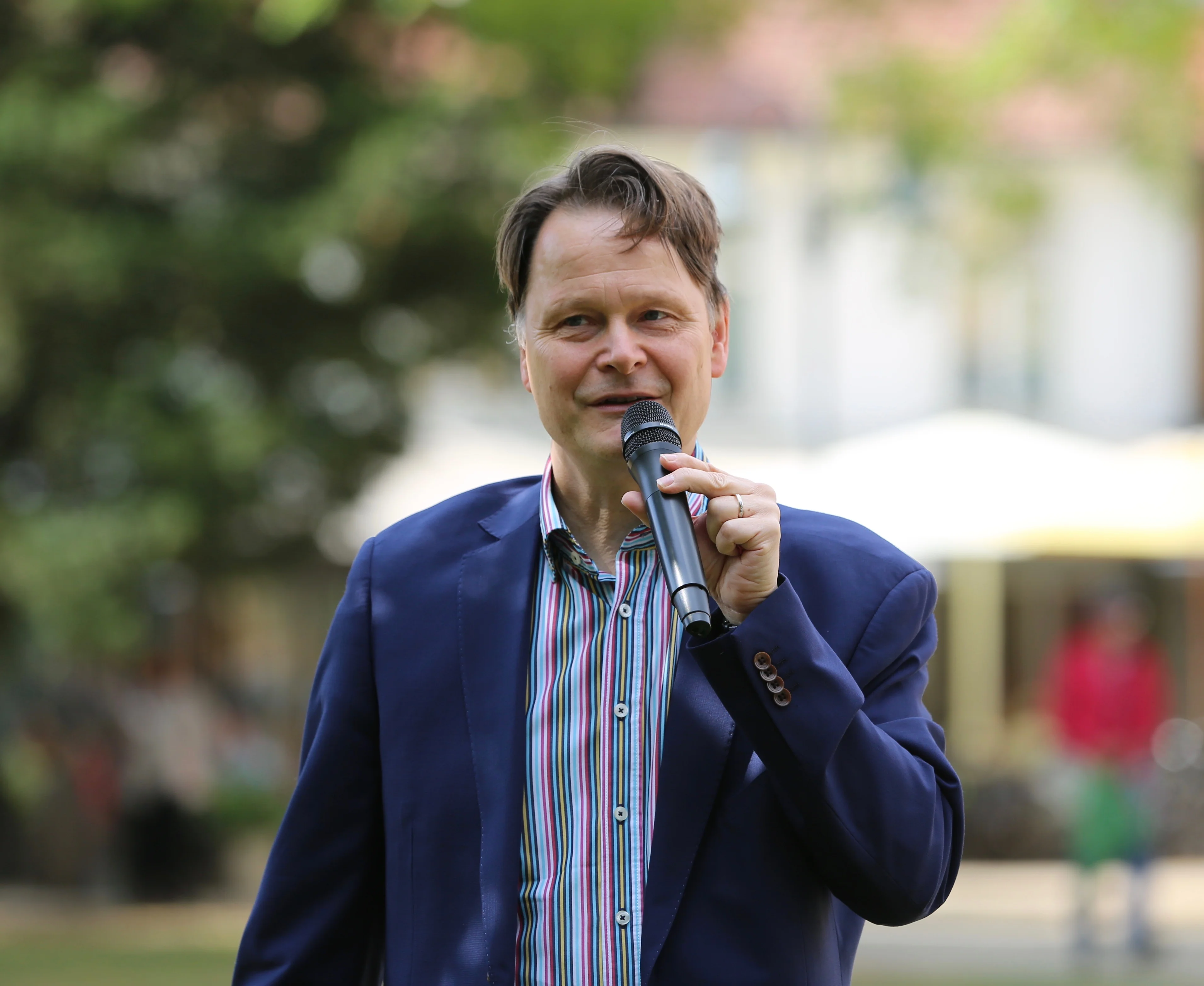
Image from Wikipedia
Image from Wikipedia
Rolf-Bernhard Essig: The Language Artist Bridging Literature, Stage, and Public Cultural Mediation
An Author Who Breathes Life Into Idioms and Sets Language in Motion
Rolf-Bernhard Essig, born in 1963 in Hamburg, is among the most distinguished German voices when it comes to language, literary criticism, and cultural historical mediation. He is known as an author, literary critic, entertainer, exhibition curator, and lecturer, but above all as someone who brings idioms, language stories, and literary forms to the stage with wit, precision, and narrative energy. His work combines scholarly rigor with an entertaining, audience-friendly approach that has made him visible far beyond the classic literary scene. (de.wikipedia.org)
Background, Education, and Intellectual Influence
Essig grew up in Kulmbach and studied German studies and history at Otto-Friedrich-University Bamberg. This dual education is crucial for his later work, as it merges literary scholarly analysis with historical thinking and a special sensitivity to linguistic developments. After working as a research assistant and librarian, he published his dissertation in 2000 on the open letter as a journalistic form from Isocrates to Günter Grass. This early work laid the foundation for a career that consistently intertwines texts, forms, and cultural contexts. (de.wikipedia.org)
His family background also points to literary history: Essig is the grandson of the writer Hermann Essig. This connection is not merely a biographical detail but part of a literary self-understanding that productively thinks tradition, memory, and the present together. As early as 1993/94, he collaborated with Gudrun Schury on an exhibition about Hermann Essig, establishing his profile as a curator and mediator. Throughout his career, he showcases a rare blend of research, journalism, and public cultural work. (de.wikipedia.org)
Path to Public Engagement: Literary Criticism, Radio, and Stage
After earning his doctorate, Essig became a freelance literary critic, author, and curator. He wrote for prestigious media such as FAZ, Die Zeit, Süddeutsche Zeitung, and Frankfurter Rundschau, developing a voice that combines expertise with pointed discourse. He became particularly well-known through columns on idioms, such as "Essigs Essenzen," "Alles in Butter oder alles Essig?" and "Hin und weg." These formats established him as an expert who does not simply refer to linguistic knowledge dryly but presents it narratively. (de.wikipedia.org)
In radio, he shaped the format of language-themed columns for many years. His weekly program "Essigs Essenzen" focused on German idioms, followed by other radio projects, including a format on Deutschlandradio Kultur and the daily SWR1 column "Butter bei die Fische." Here, his particular strength shines: Essig thinks of language not merely as a topic but as a stage where cultural history, daily observations, and humor merge. His performance thus becomes a part of the artistic work itself. (de.wikipedia.org)
Exhibitions, Language History, and Cultural Mediation
A central field of his work is exhibition curation. Essig conceived and curated projects on open letters, picture letters, and idioms, among others, for museums in Nuremberg and Frankfurt. Later, he created more language exhibitions like "Mein Name ist Hase! Redensarten auf der Spur," "Potz! Blitz! Vom Fluch des Pharao bis zur Hate Speech," and "Nicht mit dem Latein am Ende! Bunte Redensarten von tabula rasa bis Rolling Stones." These titles demonstrate how consistently Essig treats language as cultural material that oscillates between everyday humor, educated bourgeois culture, and societal debate. (de.wikipedia.org)
In these projects, his authority becomes evident. He connects research on language and literary history with a form of edutainment that brings together audience, museum, and stage. Since 2008, he has been touring Germany with language-themed programs and performing at festivals and literary events. His impact arises not just from content but from the manner of presentation: vivid, precise, entertaining, and always with a sense of cultural resonance. (de.wikipedia.org)
The Literary Work: Books on Language, Texts, and Cultural Peculiarities
Essig's bibliography shows an author who explores language in all its facets. His published titles include "Der Offene Brief," "Bilderbriefe," "Der Rausch der Meere," "Schreiberlust und Dichterfrust," "Wie die Kuh aufs Eis kam," "Da wird doch der Hund in der Pfanne verrückt," "Essigs Essenzen," and "Butter bei die Fische." Many of these books revolve around idioms, linguistic imagery, and the cultural stories behind spoken words. Others address literary-historical or essayistic themes, underscoring the breadth of Essig's intellectual practice. (de.wikipedia.org)
As an editor and co-author, he is also notable, frequently collaborating with Gudrun Schury. Together, they have produced works such as "Bilderbriefe" and "Alles über Karl May." These collaborations add a dialogical dimension to his profile: language in Essig's work does not appear as a solo project but as a shared field of research, interpretation, and literary curiosity. This gives his work a unique openness that productively combines academic rigor with popular accessibility. (de.wikipedia.org)
Style, Methodology, and Thematic Signature
Stylistically, Essig's work thrives on observational sharpness, precise formulation, and a strong sense of the sound of language. His themes range from idioms and proverbs to letter culture, cursing traditions, literary biographies, and popular language imagery. This mix of historical depth and everyday accessibility makes his style distinctive. He not only explains where words and phrases come from but also shows why they have remained culturally effective. (de.wikipedia.org)
In public perception, Essig is thus more than just an author in the narrow sense. He is a cultural mediator who combines scholarly expertise with performance quality. His appearances as a lecturer and his musical-literary duo "Die Streifenhörnchen" with Franz Tröger broaden the spectrum to a performative level, where language, rhythm, and stage presence intersect. This creates a unique tension in his music career in a broader sense: not as a traditional musical path but as literary-musical stage art. (de.wikipedia.org)
Reception, Awards, and Cultural Impact
Essig has received multiple awards, including special prizes from the Bavarian State Center for New Media, a nomination for the Oldenburg Children's and Young Adult Literature Prize, Book of the Month from the German Academy for Children's and Young Adult Literature, a shortlist mention for the Pied Piper Literature Prize, the Berganza Prize from the Bamberg Art Association, and a special prize from the Walter Serner Prize. These honors underscore his status as an author and mediator, whose work is recognized both by the literary scene, cultural institutions, and the public. (de.wikipedia.org)
His cultural impact lies primarily in the popularization of historical linguistic knowledge. Essig has shaped idioms, proverbs, and language stories into a form that works on radio, in museums, in books, and on stage. He has thus not only occupied a niche but also expanded it: he has created a culture format from language criticism, wordplay, and language history that resonates with audiences. This ability to translate between academic reflection and public impact is what keeps him relevant over time. (de.wikipedia.org)
Current Projects and Public Presence
Even in recent sources, Essig remains present, notably in connection with events, readings, and language programs. In 2025 and 2026, he appears in regional cultural announcements and program brochures, demonstrating his continued activity as a lecturer and stage artist. His work thus does not recede into the past but is current: he remains a sought-after name for formats that convey language in a vivid, accessible, and entertaining way. (freilassing.de)
It is particularly interesting that his public appearances continue to revolve around themes that connect culture, everyday life, and linguistic humor. This is precisely where his strength as a creative personality lies: Essig transforms linguistic details into cultural events and seemingly minor phrases into grand narratives. His career exemplifies how academic authority can be transformed into a compelling stage presence. (de.wikipedia.org)
Conclusion: Why Rolf-Bernhard Essig Remains Fascinating
Rolf-Bernhard Essig is fascinating because he does not just analyze language but stages it. He moves confidently between literary criticism, cultural education, exhibition practice, lecturing, and journalism, creating a profile that is rare in the German-speaking cultural landscape. Experiencing him is more than just gaining knowledge; it is a lively performance about the history, wit, and power of language. His work shows how deeply literature and everyday life are connected. To experience him live means to encounter language as a cultural event. (de.wikipedia.org)
Official Channels of Rolf-Bernhard Essig:
- Instagram: no official profile found
- Facebook: no official profile found
- YouTube: no official profile found
- Spotify: no official profile found
- TikTok: no official profile found
Sources:
- Wikipedia – Rolf-Bernhard Essig
- Herder.de – Rolf-Bernhard Essig
- Wallstein Verlag – Rolf-Bernhard Essig
- Literaturportal Bayern – Rolf-Bernhard Essig
- fernsehserien.de – Dr. Rolf-Bernhard Essig
- Fränkischer Tag – Rolf-Bernhard Essig
- bgland24.de – The Women are the Clever Ones
- Wikipedia: Image and Text Source