
Traunstein
Bahnhofstraße, 83278 Traunstein, Deutschland
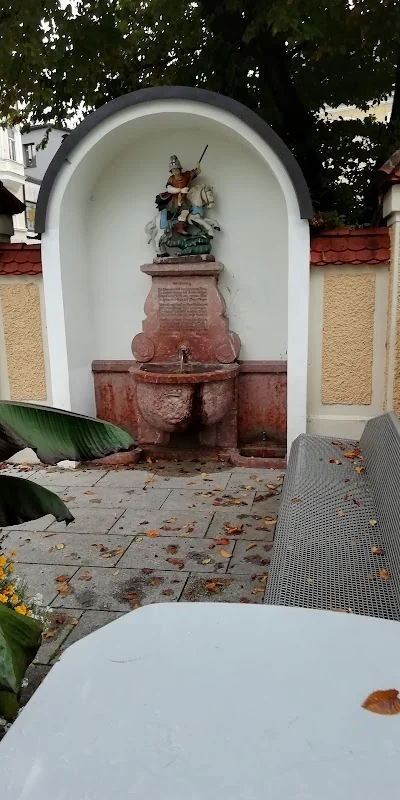
Saint George Fountain | Photos & City Park Traunstein
The Saint George Fountain is one of those search terms where a closer look at the location is particularly worthwhile, as it is not isolated in Traunstein, but embedded in a historically grown urban landscape. Those who come here are usually looking for not just a single motif, but a place with atmosphere, green surroundings, and a clear connection to the city's history. That is exactly what makes it appealing: The surroundings on Bahnhofstraße, the city park, and the adjacent complex of St. George and Catherine together form a quiet yet central urban space that is suitable for a walk as well as for photographic motifs and brief cultural stops. Traunstein describes this area as part of its public green spaces and as a station in the city walk through the town. At the same time, the location is well integrated into a visit due to its position between the train station, city center, and other attractions. So, those looking for photos, sightlines, or a short tour will find here not a loud tourist hotspot, but a place with substance, a culture of remembrance, and everyday urban beauty. ([traunstein.de](https://www.traunstein.de/media/4203/gruenanlagensatzung.pdf))
Photos and Impressions at the Saint George Fountain
The Saint George Fountain is particularly interesting for photos because the surroundings offer a rare mix of greenery, architecture, and historical depth. The city park on Bahnhofstraße does not feel like an isolated monument area, but like an open, urban park where paths, trees, sightlines, and the adjacent facilities interact. This very mix creates images that appear calm yet lively: in the foreground the park vegetation, in the background the urban structure, alongside the historically shaped complex of St. George and Catherine. This is especially valuable for photography because different moods arise depending on the season. In spring and summer, plants and light play a larger role, in autumn the paths and tree crowns often appear more graphic, and in winter the shapes of the park and the historical elements stand out more. The city of Traunstein itself repeatedly uses the city park as a venue, for example during the Rose Days or the Cultural Winter, which shows that this place is not only a monument but also a living space. For visitors, this means: Those looking for pictures of the Saint George Fountain do not get a rigid postcard motif, but a flexible urban motif with a changing backdrop and a very own Traunstein atmosphere. ([traunstein.de](https://www.traunstein.de/media/4203/gruenanlagensatzung.pdf))
Location on Bahnhofstraße and City Park
The location is one of the greatest advantages of this place. The city of Traunstein explicitly lists the city park as a green space on Bahnhofstraße, and the park area at the War Memorial Church of St. George and St. Catherine is situated between Bahnhofstraße and Ludwigstraße. This is not just a dry location description, but also explains why the Saint George Fountain is often combined in search queries with the city center, city park, and train station. The place is where urban accessibility meets a quiet park atmosphere. Those coming from the train station can quickly reach the area on foot, and those already moving in the city center can easily incorporate the fountain into a walk. The official city walk leads from the town square past the Cultural Forum and city park further into other historical areas, so the Saint George Fountain and its surroundings can be read as a connecting element between the old town and green space. From an urban development perspective, this part of Traunstein is also exciting because public green spaces here do not function as fringe zones, but as central gathering areas. The location is thus ideal for people seeking clear orientation: Bahnhofstraße, city park, St. George and Catherine, city center - these axes make the visit simple, comprehensible, and experienceable in short distances. ([traunstein.de](https://www.traunstein.de/media/4203/gruenanlagensatzung.pdf))
St. George and Catherine: History and Remembrance
The historical core of the entire surroundings dates back a long way. The city of Traunstein describes St. George and Catherine as a church mentioned as early as 1405, whose cemetery was expanded in 1638 on a newly acquired property. On March 25, 1639, the new cemetery was consecrated, and the following day the foundation stone of the cemetery church was laid. The construction was commissioned to the Traunstein city mason Wolf König; the consecration took place in 1654, a sacristy was added in 1669, and in 1687 the ossuary or charnel house was built. The current tower was only added in 1824, and between 1810 and 1828 the cemetery received arcade walkways on all four sides, of which only the western ones are still preserved today. This sequence shows that the place had not only religious but also urban planning and social significance. The layer of remembrance becomes even stronger when considering the later changes: After the opening of the new cemetery on Wasserburger Straße in 1908, the old burial site was finally abandoned in 1922 and transformed into a war memorial. The obelisk unveiled in 1837 is one of the oldest in Bavaria and commemorates the Napoleonic campaigns; the Caterpillar Helmet Memorial refers to the fallen of 1870/71. Metal books in the open forehall name the dead of both world wars, and since 1994 a stele has commemorated the victims of Nazi persecution. This makes the facility a place where the history of Traunstein becomes readable in layers - from the piety of the 17th century to the culture of remembrance of the 20th century. ([traunstein.de](https://www.traunstein.de/kultur-brauchtum/stadtgeschichte/qr-code-stadtspaziergang/st-georg-und-katharina/?utm_source=openai))
Access, Train, and Parking in Traunstein
For practical planning, Traunstein is very well accessible. According to official information, the city is located about 110 kilometers southeast of Munich and about 50 kilometers west of Salzburg, in close proximity to Chiemsee and Waginger See. It is well connected by both car and train via the A8 Munich-Salzburg; the city also points to direct train connections from Munich and Salzburg. For visitors with cars, Traunstein offers 3,000 centrally located parking spaces in parking garages, underground garages, and parking lots. This is important for a visit to the city center because one can comfortably integrate the Saint George Fountain or the St. George surroundings into a city tour. Additionally, the city draws attention to specific parking rules: In the Traunstein city center, a maximum parking duration of two hours usually applies, at the train station 30 minutes. Vehicles with electric license plates can park for free on public spaces for up to three hours under certain conditions, even at the Karl-Theodor parking lot within this timeframe. Those arriving without an electric license plate can park for free, among other places, at the festival site on Siegsdorfer Straße and reach the city center in just a few minutes. Particularly pleasant for pedestrians is that the city park, where the Traunstein Rose Days take place, is only about a five-minute walk from the train station and bus station. For a visit to the Saint George Fountain, this means: arrive, park briefly, walk, and experience the place without complicated routes. ([traunstein.de](https://www.traunstein.de/tourismus-freizeit/anreise-informationen/))
City Walk, Cultural Center, and Surroundings
The Saint George Fountain is located in an environment that can be excellently combined with other Traunstein attractions. The official city walk begins at the town square at St. Oswald, the Lindl Fountain, and the Jackl Tower, then leads past the Cultural Forum Monastery Church towards the city park and finally ends in the Au at the saline chapel, the saline houses, and the saline park. This route shows how closely the area around the city park is connected to the historical center. The immediate surroundings also offer cultural anchor points: In a former breadcrumb factory, the cultural center in the city park was opened in 1977; today, it houses the city library, adult education center, and a hall for concerts and exhibitions. This makes the location lively because not only is history explained here, but everyday life is also organized. Those interested in fountains, squares, and urban landscapes can also connect their visit with other Traunstein fountain locations, such as the Lindl Fountain at the town square and the historical draw well, where a late medieval shaft has been made visible. This creates a thematic walk through the city: from the representative town square through the green city park to the memorial sites of St. George and Catherine. For visitors, this is ideal because one experiences very different urban images in a small space - baroque or historical charm, park atmosphere, culture of remembrance, and modern cultural infrastructure. ([traunstein.de](https://www.traunstein.de/tourismus-freizeit/traunsteiner-stadtfuehrungen/stadtrundgaenge-auf-eigene-faust/stadtspaziergang-ein-rundweg-durch-traunstein/))
Why the Saint George Fountain is Ideal for a Short Visit
The great advantage of this place lies in its clarity. One does not have to undertake a long journey or complicated planning to experience a content-rich destination. The location is central, walkable, historically charged, and at the same time open enough to simply stop by. This is important for visitors who want to take photos, are looking for a short walk, or want to experience Traunstein not just as a transit station but as a city with character. Due to its official classification as a green space and its proximity to the War Memorial Church of St. George and St. Catherine, the place is not only a pretty motif but also part of the urban identity. Additionally, Traunstein repeatedly uses its city center and city park for events: Rose Days, city walks, cultural offerings, and seasonal formats such as the Cultural Winter give the surroundings additional liveliness. This creates a place that works both in the morning with calm light and in the afternoon with stronger foot traffic. Those arriving by train can get there quickly; those driving will find centrally located options; those who enjoy culture can easily extend their visit. The Saint George Fountain is therefore less a single object than a strong anchor point in an attractive urban space. It connects orientation, history, greenery, and city center in a way that works well for residents as well as for guests discovering Traunstein for the first time. ([traunstein.de](https://www.traunstein.de/media/4203/gruenanlagensatzung.pdf))
Sources:
Mehr anzeigenWeniger anzeigen
Saint George Fountain | Photos & City Park Traunstein
The Saint George Fountain is one of those search terms where a closer look at the location is particularly worthwhile, as it is not isolated in Traunstein, but embedded in a historically grown urban landscape. Those who come here are usually looking for not just a single motif, but a place with atmosphere, green surroundings, and a clear connection to the city's history. That is exactly what makes it appealing: The surroundings on Bahnhofstraße, the city park, and the adjacent complex of St. George and Catherine together form a quiet yet central urban space that is suitable for a walk as well as for photographic motifs and brief cultural stops. Traunstein describes this area as part of its public green spaces and as a station in the city walk through the town. At the same time, the location is well integrated into a visit due to its position between the train station, city center, and other attractions. So, those looking for photos, sightlines, or a short tour will find here not a loud tourist hotspot, but a place with substance, a culture of remembrance, and everyday urban beauty. ([traunstein.de](https://www.traunstein.de/media/4203/gruenanlagensatzung.pdf))
Photos and Impressions at the Saint George Fountain
The Saint George Fountain is particularly interesting for photos because the surroundings offer a rare mix of greenery, architecture, and historical depth. The city park on Bahnhofstraße does not feel like an isolated monument area, but like an open, urban park where paths, trees, sightlines, and the adjacent facilities interact. This very mix creates images that appear calm yet lively: in the foreground the park vegetation, in the background the urban structure, alongside the historically shaped complex of St. George and Catherine. This is especially valuable for photography because different moods arise depending on the season. In spring and summer, plants and light play a larger role, in autumn the paths and tree crowns often appear more graphic, and in winter the shapes of the park and the historical elements stand out more. The city of Traunstein itself repeatedly uses the city park as a venue, for example during the Rose Days or the Cultural Winter, which shows that this place is not only a monument but also a living space. For visitors, this means: Those looking for pictures of the Saint George Fountain do not get a rigid postcard motif, but a flexible urban motif with a changing backdrop and a very own Traunstein atmosphere. ([traunstein.de](https://www.traunstein.de/media/4203/gruenanlagensatzung.pdf))
Location on Bahnhofstraße and City Park
The location is one of the greatest advantages of this place. The city of Traunstein explicitly lists the city park as a green space on Bahnhofstraße, and the park area at the War Memorial Church of St. George and St. Catherine is situated between Bahnhofstraße and Ludwigstraße. This is not just a dry location description, but also explains why the Saint George Fountain is often combined in search queries with the city center, city park, and train station. The place is where urban accessibility meets a quiet park atmosphere. Those coming from the train station can quickly reach the area on foot, and those already moving in the city center can easily incorporate the fountain into a walk. The official city walk leads from the town square past the Cultural Forum and city park further into other historical areas, so the Saint George Fountain and its surroundings can be read as a connecting element between the old town and green space. From an urban development perspective, this part of Traunstein is also exciting because public green spaces here do not function as fringe zones, but as central gathering areas. The location is thus ideal for people seeking clear orientation: Bahnhofstraße, city park, St. George and Catherine, city center - these axes make the visit simple, comprehensible, and experienceable in short distances. ([traunstein.de](https://www.traunstein.de/media/4203/gruenanlagensatzung.pdf))
St. George and Catherine: History and Remembrance
The historical core of the entire surroundings dates back a long way. The city of Traunstein describes St. George and Catherine as a church mentioned as early as 1405, whose cemetery was expanded in 1638 on a newly acquired property. On March 25, 1639, the new cemetery was consecrated, and the following day the foundation stone of the cemetery church was laid. The construction was commissioned to the Traunstein city mason Wolf König; the consecration took place in 1654, a sacristy was added in 1669, and in 1687 the ossuary or charnel house was built. The current tower was only added in 1824, and between 1810 and 1828 the cemetery received arcade walkways on all four sides, of which only the western ones are still preserved today. This sequence shows that the place had not only religious but also urban planning and social significance. The layer of remembrance becomes even stronger when considering the later changes: After the opening of the new cemetery on Wasserburger Straße in 1908, the old burial site was finally abandoned in 1922 and transformed into a war memorial. The obelisk unveiled in 1837 is one of the oldest in Bavaria and commemorates the Napoleonic campaigns; the Caterpillar Helmet Memorial refers to the fallen of 1870/71. Metal books in the open forehall name the dead of both world wars, and since 1994 a stele has commemorated the victims of Nazi persecution. This makes the facility a place where the history of Traunstein becomes readable in layers - from the piety of the 17th century to the culture of remembrance of the 20th century. ([traunstein.de](https://www.traunstein.de/kultur-brauchtum/stadtgeschichte/qr-code-stadtspaziergang/st-georg-und-katharina/?utm_source=openai))
Access, Train, and Parking in Traunstein
For practical planning, Traunstein is very well accessible. According to official information, the city is located about 110 kilometers southeast of Munich and about 50 kilometers west of Salzburg, in close proximity to Chiemsee and Waginger See. It is well connected by both car and train via the A8 Munich-Salzburg; the city also points to direct train connections from Munich and Salzburg. For visitors with cars, Traunstein offers 3,000 centrally located parking spaces in parking garages, underground garages, and parking lots. This is important for a visit to the city center because one can comfortably integrate the Saint George Fountain or the St. George surroundings into a city tour. Additionally, the city draws attention to specific parking rules: In the Traunstein city center, a maximum parking duration of two hours usually applies, at the train station 30 minutes. Vehicles with electric license plates can park for free on public spaces for up to three hours under certain conditions, even at the Karl-Theodor parking lot within this timeframe. Those arriving without an electric license plate can park for free, among other places, at the festival site on Siegsdorfer Straße and reach the city center in just a few minutes. Particularly pleasant for pedestrians is that the city park, where the Traunstein Rose Days take place, is only about a five-minute walk from the train station and bus station. For a visit to the Saint George Fountain, this means: arrive, park briefly, walk, and experience the place without complicated routes. ([traunstein.de](https://www.traunstein.de/tourismus-freizeit/anreise-informationen/))
City Walk, Cultural Center, and Surroundings
The Saint George Fountain is located in an environment that can be excellently combined with other Traunstein attractions. The official city walk begins at the town square at St. Oswald, the Lindl Fountain, and the Jackl Tower, then leads past the Cultural Forum Monastery Church towards the city park and finally ends in the Au at the saline chapel, the saline houses, and the saline park. This route shows how closely the area around the city park is connected to the historical center. The immediate surroundings also offer cultural anchor points: In a former breadcrumb factory, the cultural center in the city park was opened in 1977; today, it houses the city library, adult education center, and a hall for concerts and exhibitions. This makes the location lively because not only is history explained here, but everyday life is also organized. Those interested in fountains, squares, and urban landscapes can also connect their visit with other Traunstein fountain locations, such as the Lindl Fountain at the town square and the historical draw well, where a late medieval shaft has been made visible. This creates a thematic walk through the city: from the representative town square through the green city park to the memorial sites of St. George and Catherine. For visitors, this is ideal because one experiences very different urban images in a small space - baroque or historical charm, park atmosphere, culture of remembrance, and modern cultural infrastructure. ([traunstein.de](https://www.traunstein.de/tourismus-freizeit/traunsteiner-stadtfuehrungen/stadtrundgaenge-auf-eigene-faust/stadtspaziergang-ein-rundweg-durch-traunstein/))
Why the Saint George Fountain is Ideal for a Short Visit
The great advantage of this place lies in its clarity. One does not have to undertake a long journey or complicated planning to experience a content-rich destination. The location is central, walkable, historically charged, and at the same time open enough to simply stop by. This is important for visitors who want to take photos, are looking for a short walk, or want to experience Traunstein not just as a transit station but as a city with character. Due to its official classification as a green space and its proximity to the War Memorial Church of St. George and St. Catherine, the place is not only a pretty motif but also part of the urban identity. Additionally, Traunstein repeatedly uses its city center and city park for events: Rose Days, city walks, cultural offerings, and seasonal formats such as the Cultural Winter give the surroundings additional liveliness. This creates a place that works both in the morning with calm light and in the afternoon with stronger foot traffic. Those arriving by train can get there quickly; those driving will find centrally located options; those who enjoy culture can easily extend their visit. The Saint George Fountain is therefore less a single object than a strong anchor point in an attractive urban space. It connects orientation, history, greenery, and city center in a way that works well for residents as well as for guests discovering Traunstein for the first time. ([traunstein.de](https://www.traunstein.de/media/4203/gruenanlagensatzung.pdf))
Sources:
Saint George Fountain | Photos & City Park Traunstein
The Saint George Fountain is one of those search terms where a closer look at the location is particularly worthwhile, as it is not isolated in Traunstein, but embedded in a historically grown urban landscape. Those who come here are usually looking for not just a single motif, but a place with atmosphere, green surroundings, and a clear connection to the city's history. That is exactly what makes it appealing: The surroundings on Bahnhofstraße, the city park, and the adjacent complex of St. George and Catherine together form a quiet yet central urban space that is suitable for a walk as well as for photographic motifs and brief cultural stops. Traunstein describes this area as part of its public green spaces and as a station in the city walk through the town. At the same time, the location is well integrated into a visit due to its position between the train station, city center, and other attractions. So, those looking for photos, sightlines, or a short tour will find here not a loud tourist hotspot, but a place with substance, a culture of remembrance, and everyday urban beauty. ([traunstein.de](https://www.traunstein.de/media/4203/gruenanlagensatzung.pdf))
Photos and Impressions at the Saint George Fountain
The Saint George Fountain is particularly interesting for photos because the surroundings offer a rare mix of greenery, architecture, and historical depth. The city park on Bahnhofstraße does not feel like an isolated monument area, but like an open, urban park where paths, trees, sightlines, and the adjacent facilities interact. This very mix creates images that appear calm yet lively: in the foreground the park vegetation, in the background the urban structure, alongside the historically shaped complex of St. George and Catherine. This is especially valuable for photography because different moods arise depending on the season. In spring and summer, plants and light play a larger role, in autumn the paths and tree crowns often appear more graphic, and in winter the shapes of the park and the historical elements stand out more. The city of Traunstein itself repeatedly uses the city park as a venue, for example during the Rose Days or the Cultural Winter, which shows that this place is not only a monument but also a living space. For visitors, this means: Those looking for pictures of the Saint George Fountain do not get a rigid postcard motif, but a flexible urban motif with a changing backdrop and a very own Traunstein atmosphere. ([traunstein.de](https://www.traunstein.de/media/4203/gruenanlagensatzung.pdf))
Location on Bahnhofstraße and City Park
The location is one of the greatest advantages of this place. The city of Traunstein explicitly lists the city park as a green space on Bahnhofstraße, and the park area at the War Memorial Church of St. George and St. Catherine is situated between Bahnhofstraße and Ludwigstraße. This is not just a dry location description, but also explains why the Saint George Fountain is often combined in search queries with the city center, city park, and train station. The place is where urban accessibility meets a quiet park atmosphere. Those coming from the train station can quickly reach the area on foot, and those already moving in the city center can easily incorporate the fountain into a walk. The official city walk leads from the town square past the Cultural Forum and city park further into other historical areas, so the Saint George Fountain and its surroundings can be read as a connecting element between the old town and green space. From an urban development perspective, this part of Traunstein is also exciting because public green spaces here do not function as fringe zones, but as central gathering areas. The location is thus ideal for people seeking clear orientation: Bahnhofstraße, city park, St. George and Catherine, city center - these axes make the visit simple, comprehensible, and experienceable in short distances. ([traunstein.de](https://www.traunstein.de/media/4203/gruenanlagensatzung.pdf))
St. George and Catherine: History and Remembrance
The historical core of the entire surroundings dates back a long way. The city of Traunstein describes St. George and Catherine as a church mentioned as early as 1405, whose cemetery was expanded in 1638 on a newly acquired property. On March 25, 1639, the new cemetery was consecrated, and the following day the foundation stone of the cemetery church was laid. The construction was commissioned to the Traunstein city mason Wolf König; the consecration took place in 1654, a sacristy was added in 1669, and in 1687 the ossuary or charnel house was built. The current tower was only added in 1824, and between 1810 and 1828 the cemetery received arcade walkways on all four sides, of which only the western ones are still preserved today. This sequence shows that the place had not only religious but also urban planning and social significance. The layer of remembrance becomes even stronger when considering the later changes: After the opening of the new cemetery on Wasserburger Straße in 1908, the old burial site was finally abandoned in 1922 and transformed into a war memorial. The obelisk unveiled in 1837 is one of the oldest in Bavaria and commemorates the Napoleonic campaigns; the Caterpillar Helmet Memorial refers to the fallen of 1870/71. Metal books in the open forehall name the dead of both world wars, and since 1994 a stele has commemorated the victims of Nazi persecution. This makes the facility a place where the history of Traunstein becomes readable in layers - from the piety of the 17th century to the culture of remembrance of the 20th century. ([traunstein.de](https://www.traunstein.de/kultur-brauchtum/stadtgeschichte/qr-code-stadtspaziergang/st-georg-und-katharina/?utm_source=openai))
Access, Train, and Parking in Traunstein
For practical planning, Traunstein is very well accessible. According to official information, the city is located about 110 kilometers southeast of Munich and about 50 kilometers west of Salzburg, in close proximity to Chiemsee and Waginger See. It is well connected by both car and train via the A8 Munich-Salzburg; the city also points to direct train connections from Munich and Salzburg. For visitors with cars, Traunstein offers 3,000 centrally located parking spaces in parking garages, underground garages, and parking lots. This is important for a visit to the city center because one can comfortably integrate the Saint George Fountain or the St. George surroundings into a city tour. Additionally, the city draws attention to specific parking rules: In the Traunstein city center, a maximum parking duration of two hours usually applies, at the train station 30 minutes. Vehicles with electric license plates can park for free on public spaces for up to three hours under certain conditions, even at the Karl-Theodor parking lot within this timeframe. Those arriving without an electric license plate can park for free, among other places, at the festival site on Siegsdorfer Straße and reach the city center in just a few minutes. Particularly pleasant for pedestrians is that the city park, where the Traunstein Rose Days take place, is only about a five-minute walk from the train station and bus station. For a visit to the Saint George Fountain, this means: arrive, park briefly, walk, and experience the place without complicated routes. ([traunstein.de](https://www.traunstein.de/tourismus-freizeit/anreise-informationen/))
City Walk, Cultural Center, and Surroundings
The Saint George Fountain is located in an environment that can be excellently combined with other Traunstein attractions. The official city walk begins at the town square at St. Oswald, the Lindl Fountain, and the Jackl Tower, then leads past the Cultural Forum Monastery Church towards the city park and finally ends in the Au at the saline chapel, the saline houses, and the saline park. This route shows how closely the area around the city park is connected to the historical center. The immediate surroundings also offer cultural anchor points: In a former breadcrumb factory, the cultural center in the city park was opened in 1977; today, it houses the city library, adult education center, and a hall for concerts and exhibitions. This makes the location lively because not only is history explained here, but everyday life is also organized. Those interested in fountains, squares, and urban landscapes can also connect their visit with other Traunstein fountain locations, such as the Lindl Fountain at the town square and the historical draw well, where a late medieval shaft has been made visible. This creates a thematic walk through the city: from the representative town square through the green city park to the memorial sites of St. George and Catherine. For visitors, this is ideal because one experiences very different urban images in a small space - baroque or historical charm, park atmosphere, culture of remembrance, and modern cultural infrastructure. ([traunstein.de](https://www.traunstein.de/tourismus-freizeit/traunsteiner-stadtfuehrungen/stadtrundgaenge-auf-eigene-faust/stadtspaziergang-ein-rundweg-durch-traunstein/))
Why the Saint George Fountain is Ideal for a Short Visit
The great advantage of this place lies in its clarity. One does not have to undertake a long journey or complicated planning to experience a content-rich destination. The location is central, walkable, historically charged, and at the same time open enough to simply stop by. This is important for visitors who want to take photos, are looking for a short walk, or want to experience Traunstein not just as a transit station but as a city with character. Due to its official classification as a green space and its proximity to the War Memorial Church of St. George and St. Catherine, the place is not only a pretty motif but also part of the urban identity. Additionally, Traunstein repeatedly uses its city center and city park for events: Rose Days, city walks, cultural offerings, and seasonal formats such as the Cultural Winter give the surroundings additional liveliness. This creates a place that works both in the morning with calm light and in the afternoon with stronger foot traffic. Those arriving by train can get there quickly; those driving will find centrally located options; those who enjoy culture can easily extend their visit. The Saint George Fountain is therefore less a single object than a strong anchor point in an attractive urban space. It connects orientation, history, greenery, and city center in a way that works well for residents as well as for guests discovering Traunstein for the first time. ([traunstein.de](https://www.traunstein.de/media/4203/gruenanlagensatzung.pdf))
Sources:
Upcoming Events
No events found
Frequently Asked Questions
Reviews
No reviews found