
Marquartstein
Loitshauser Str. 7, 83250 Marquartstein, Deutschland
Parish Church of the Precious Blood | Marquartstein & Faith
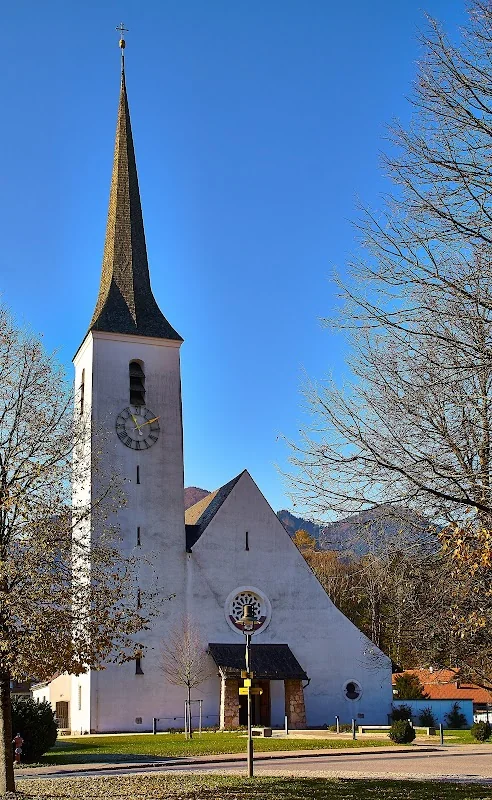
The Parish Church of the Precious Blood is one of the most prominent ecclesiastical sites in Marquartstein and is much more than just a building in the town center. Those who visit the church on Loitshauser Straße experience a place where village history, Catholic identity, and regional art come together in a small space. The church was consecrated in 1936 and is now part of the parish association of Grassau, which includes Marquartstein, Grassau, Rottau, and Staudach-Egerndach. This connection shows how closely the parish church is tied to the religious and social life of the Achental valley. The official community pages describe the church as a central part of local church life, and the Sunday service at 10 a.m. makes it clear that it is not only a place of remembrance but still an active space for worship. ([marquartstein.de](https://www.marquartstein.de/buerger-dorfleben/kirchen/))
The name “Precious Blood” stands out in Bavaria because it is rare in this form. This rarity gives the Marquartstein parish church a special aura. The parish website explains that the name can be understood as a conscious counterpoint to the ideology of the Nazi era. This makes the church historically significant, as it tells not only of liturgy but also of attitude and contemporary history. Therefore, those who visit the church encounter a building that opens the view beyond the purely external: to the development of the place, to the independence of the community, to religious continuity, and to the question of how spaces of faith can make a statement in politically difficult times. Marquartstein itself was long shaped by the castle and the older castle church; the current parish church adds to this long line a building from the 20th century that immediately provides orientation in the townscape. ([pfarrverband-grassau.de](https://www.pfarrverband-grassau.de/marquartstein/))
History of the Parish Church of the Precious Blood in Marquartstein
The history of the parish church is closely linked to the older local history. Marquartstein has been an important place in the Achental since the High Middle Ages, and the official community history indicates that the actual local history begins with the founding of the castle in 1075. A church site, the castle church of St. Bartholomew and St. Vitus, was already part of the castle early on and served as a spiritual reference point for centuries. Even into the 20th century, the religious life of the residents was therefore shaped by older structures. Only in 1936 was the new Parish Church of the Precious Blood built in the town center. Both the community and the parish association emphasize that this created an independent ecclesiastical center for Marquartstein. The temporal proximity to the political independence of the place is noteworthy: Marquartstein only became an independent political municipality in 1938. Thus, the parish church represents a transition from the historically grown settlement to modern community life. ([pfarrverband-grassau.de](https://www.pfarrverband-grassau.de/marquartstein/))
The classification of the church as an expression of a contradiction against the ideology of the time makes its historical value even clearer. The unusual name was not a coincidence but a conscious confession. According to the parish association, the church was elevated to an independent parish after the war, following the establishment of a mission station. This not only gave the building a liturgical function but also institutional significance for church life in the area. Today, the parish is said to have around 1,600 Catholics, which illustrates that the church is not isolated but embedded in a vibrant community. Understanding the history of the church also helps to better understand Marquartstein: not merely as a holiday destination in the Chiemgau but as a place with a long ecclesiastical and communal development, where the castle, village, and parish community have remained intertwined for centuries. ([pfarrverband-grassau.de](https://www.pfarrverband-grassau.de/marquartstein/))
Services, Parish Association, and Pastoral Care in Marquartstein
For visitors, the parish church is not only an architectural or historical site but primarily a lived space of faith. The official pages mention the Sunday service at 10 a.m. as a fixed orientation. This is practical for all who want to combine a visit with a joint celebration, but also for people from the area who are looking for reliable times for community life. The parish association of Grassau incorporated the parish of Marquartstein in 2010 and now sees itself as a pastoral and administrative unit for several places in the Achental. This is typical for many rural regions in Bavaria, where church community is organized across municipal boundaries. Marquartstein is not a peripheral address in this association but a solid parish with its own identity and a clear role in the regional structure. ([marquartstein.de](https://www.marquartstein.de/buerger-dorfleben/kirchen/))
The parish office information also shows that pastoral care remains easily accessible. For Marquartstein, the parish office is located at Unterer Mühlfeldweg 3; according to the parish association, it is open on Mondays, Tuesdays, and Thursdays from 9 a.m. to 12 p.m., while it is closed on Wednesdays and Fridays. These times are helpful for registration, inquiries, or organizational concerns and give an impression of how much the church is integrated into everyday life. Especially in smaller communities, the parish office is often the first point of contact for baptisms, first communions, weddings, funerals, or general church inquiries. Together with the Sunday service, it forms the organizational backbone of the parish. Therefore, those who discover the church as a search result or as a destination on an excursion route find here not a museum backdrop but an active religious center that shapes the place in a lasting way. ([pfarrverband-grassau.de](https://www.pfarrverband-grassau.de/marquartstein/))
Interior, Paintings, and Werner Schön
A special reason to take a closer look at the Parish Church of the Precious Blood lies in the interior. The community explicitly states that the church has been adorned with paintings by the local artist Werner Schön, who hails from Piesenhausen. Additionally, there is a depiction of the 12 articles of faith that shapes the interior and gives it a distinct theological profile. Such decorations are not merely decoration but part of a narrative spatial design: the church space itself becomes a place of faith education, remembrance, and contemplation. For visitors, this means that they see not only benches, altar, and liturgical furnishings but a space that speaks through images. The church thus gains a unique atmosphere that goes beyond the purely functional. ([marquartstein.de](https://www.marquartstein.de/buerger-dorfleben/kirchen/))
Local reports about Werner Schön show that his work on the Marquartstein church was recognized far beyond the locality. An article in the regional press describes the cycle of images “Credo” as a journey through the church and notes that the Archdiocesan Ordinariate commissioned him to paint the church. Although the official pages mainly mention the 12 articles of faith, it is evident in regional memory that the artistic ambition was high and the painting remains a special feature to this day. For SEO and for real user inquiries, this is important: those searching for the interior, for special features, or for the name Werner Schön expect not only dry data but a comprehensible context. This context is clear here: the art inside is part of the church's identity, connecting faith content with a locally rooted artistic expression and making the Marquartstein parish church a place that leaves an impression. ([traunsteiner-tagblatt.de](https://www.traunsteiner-tagblatt.de/region/landkreis-traunstein/marquartstein_artikel%2C-kunstmaler-schoen-und-sein-bilderzyklus-credo-musikalisch-umrahmter-streifzug-durch-die-pfarrkirche-_arid%2C723119.html?utm_source=openai))
Address, Location, and Directions to the Church in Marquartstein
The Parish Church of the Precious Blood is located at Loitshauser Str. 7 in 83250 Marquartstein. The address alone shows that it is not on the outskirts but in the middle of the town structure. The community describes it as a church in the town center, and this is also felt in practical orientation: those visiting Marquartstein can use the church as a fixed reference point in the town. For many people, this central location is an advantage because a visit to the church can easily be combined with a walk through the town or a stroll in the Achental. Especially in a place like Marquartstein, which stands between local history, regional landscape, and tourist use, such a center is valuable. It gives the place a calm yet visible focus. ([marquartstein.de](https://www.marquartstein.de/buerger-dorfleben/kirchen/))
The practical information is also clear. The parish office Marquartstein is located at Unterer Mühlfeldweg 3, according to the parish association. The community cemetery is located immediately north of the church cemetery of the Catholic parish church, further anchoring the ecclesiastical facility in the local area. For visitors, this means: the church is part of a cohesive ecclesiastical environment where the cemetery, parish office, and church lie close together. Those looking for a specific destination can orient themselves by the street address, those with organizational questions will find the right place in the parish office, and those wanting to understand the surroundings quickly realize that the church does not appear isolated but as the center of a grown ecclesiastical area. This tangible proximity to the location makes the Marquartstein parish church particularly relevant for inquiries about address, orientation, and parish office. ([pfarrverband-grassau.de](https://www.pfarrverband-grassau.de/marquartstein/))
Castle Church of St. Vitus and the Older Roots of the Place
To understand the Parish Church of the Precious Blood, one should also keep the older history of Marquartstein in mind. The official local history reminds us that Marquartstein has been a place of political and ecclesiastical significance since the High Middle Ages and that the castle church of St. Bartholomew and St. Vitus served as an early spiritual site. This older church was important for both the lords of the castle and the residents of the place and thus forms the historical foundation for later parish life. The community describes it as the foundation of church life in Marquartstein. The fact that the modern parish church was only built in 1936 does not mean the beginning but rather the visible continuation of a much older tradition. Therefore, today, when walking through Marquartstein, one encounters two levels of history: the castle church as an early witness and the parish church as an expression of the 20th century. ([pfarrverband-grassau.de](https://www.pfarrverband-grassau.de/marquartstein/))
It is particularly interesting that the castle church of St. Vitus did not disappear after the construction of the new parish church. It remained as a filial church in the parish and continues to be part of church life. The community also mentions the service from May to September every Wednesday at 7 p.m., which keeps the place lively seasonally. For visitors, this means an additional incentive, as Marquartstein offers both the new parish church and the older castle church, two distinctly different but interconnected sacred places. One represents the place in the 20th century, while the other represents deeper historical roots. This creates a strong narrative profile that works well in search engines as well as for real guests: it is not just about a single church but about a developed ecclesiastical landscape in the Achental, whose traces reach back to early local history. ([marquartstein.de](https://www.marquartstein.de/buerger-dorfleben/kirchen/))
Visit, Orientation, and Practical Tips for Marquartstein
For a visit to the Parish Church of the Precious Blood, it is especially important that it presents itself not as a closed art site but as a living community church. This is felt in the fixed service time, the clear parish office information, and the integration into the parish association of Grassau. Those coming to Marquartstein will therefore find not only a quiet church space but a place where religious life, regional history, and everyday pastoral care connect. This is valuable for travelers in the Achental, as the church can be easily combined with the town center, historical references, and a short stay in Marquartstein. The community and the parish association make it clear that the church has been a reliable center for decades, where the Catholic community of the place finds its orientation. ([marquartstein.de](https://www.marquartstein.de/buerger-dorfleben/kirchen/))
Additionally, the special aura of the interior adds to the experience. The paintings by Werner Schön and the depiction of the 12 articles of faith give the building a deep content level that many other village churches do not possess. Thus, entering the church means encountering not only a place for quiet reflection but also a pictorial condensation of faith. Therefore, the visit is worthwhile for both culture-historically interested guests and those seeking a spiritual place. In Marquartstein, the parish church combines exactly what makes good local churches: it is clearly identifiable, it is anchored in local life, it is historically grounded, and it has a clear aesthetic signature. This creates an authentic image that goes far beyond mere location data and makes the Parish Church of the Precious Blood a significant address in the Chiemgau. ([marquartstein.de](https://www.marquartstein.de/buerger-dorfleben/kirchen/))
Sources:
- Community Marquartstein - Churches, Chapels, and Parishes ([marquartstein.de](https://www.marquartstein.de/buerger-dorfleben/kirchen/))
- Parish Association Grassau - Marquartstein ([pfarrverband-grassau.de](https://www.pfarrverband-grassau.de/marquartstein/))
- Community Marquartstein - History ([marquartstein.de](https://www.marquartstein.de/ueber-marquartstein/historie/))
- Traunsteiner Tagblatt - Painter Schön and his image cycle »Credo« ([traunsteiner-tagblatt.de](https://www.traunsteiner-tagblatt.de/region/landkreis-traunstein/marquartstein_artikel%2C-kunstmaler-schoen-und-sein-bilderzyklus-credo-musikalisch-umrahmter-streifzug-durch-die-pfarrkirche-_arid%2C723119.html?utm_source=openai))
Mehr anzeigenWeniger anzeigen
Parish Church of the Precious Blood | Marquartstein & Faith
The Parish Church of the Precious Blood is one of the most prominent ecclesiastical sites in Marquartstein and is much more than just a building in the town center. Those who visit the church on Loitshauser Straße experience a place where village history, Catholic identity, and regional art come together in a small space. The church was consecrated in 1936 and is now part of the parish association of Grassau, which includes Marquartstein, Grassau, Rottau, and Staudach-Egerndach. This connection shows how closely the parish church is tied to the religious and social life of the Achental valley. The official community pages describe the church as a central part of local church life, and the Sunday service at 10 a.m. makes it clear that it is not only a place of remembrance but still an active space for worship. ([marquartstein.de](https://www.marquartstein.de/buerger-dorfleben/kirchen/))
The name “Precious Blood” stands out in Bavaria because it is rare in this form. This rarity gives the Marquartstein parish church a special aura. The parish website explains that the name can be understood as a conscious counterpoint to the ideology of the Nazi era. This makes the church historically significant, as it tells not only of liturgy but also of attitude and contemporary history. Therefore, those who visit the church encounter a building that opens the view beyond the purely external: to the development of the place, to the independence of the community, to religious continuity, and to the question of how spaces of faith can make a statement in politically difficult times. Marquartstein itself was long shaped by the castle and the older castle church; the current parish church adds to this long line a building from the 20th century that immediately provides orientation in the townscape. ([pfarrverband-grassau.de](https://www.pfarrverband-grassau.de/marquartstein/))
History of the Parish Church of the Precious Blood in Marquartstein
The history of the parish church is closely linked to the older local history. Marquartstein has been an important place in the Achental since the High Middle Ages, and the official community history indicates that the actual local history begins with the founding of the castle in 1075. A church site, the castle church of St. Bartholomew and St. Vitus, was already part of the castle early on and served as a spiritual reference point for centuries. Even into the 20th century, the religious life of the residents was therefore shaped by older structures. Only in 1936 was the new Parish Church of the Precious Blood built in the town center. Both the community and the parish association emphasize that this created an independent ecclesiastical center for Marquartstein. The temporal proximity to the political independence of the place is noteworthy: Marquartstein only became an independent political municipality in 1938. Thus, the parish church represents a transition from the historically grown settlement to modern community life. ([pfarrverband-grassau.de](https://www.pfarrverband-grassau.de/marquartstein/))
The classification of the church as an expression of a contradiction against the ideology of the time makes its historical value even clearer. The unusual name was not a coincidence but a conscious confession. According to the parish association, the church was elevated to an independent parish after the war, following the establishment of a mission station. This not only gave the building a liturgical function but also institutional significance for church life in the area. Today, the parish is said to have around 1,600 Catholics, which illustrates that the church is not isolated but embedded in a vibrant community. Understanding the history of the church also helps to better understand Marquartstein: not merely as a holiday destination in the Chiemgau but as a place with a long ecclesiastical and communal development, where the castle, village, and parish community have remained intertwined for centuries. ([pfarrverband-grassau.de](https://www.pfarrverband-grassau.de/marquartstein/))
Services, Parish Association, and Pastoral Care in Marquartstein
For visitors, the parish church is not only an architectural or historical site but primarily a lived space of faith. The official pages mention the Sunday service at 10 a.m. as a fixed orientation. This is practical for all who want to combine a visit with a joint celebration, but also for people from the area who are looking for reliable times for community life. The parish association of Grassau incorporated the parish of Marquartstein in 2010 and now sees itself as a pastoral and administrative unit for several places in the Achental. This is typical for many rural regions in Bavaria, where church community is organized across municipal boundaries. Marquartstein is not a peripheral address in this association but a solid parish with its own identity and a clear role in the regional structure. ([marquartstein.de](https://www.marquartstein.de/buerger-dorfleben/kirchen/))
The parish office information also shows that pastoral care remains easily accessible. For Marquartstein, the parish office is located at Unterer Mühlfeldweg 3; according to the parish association, it is open on Mondays, Tuesdays, and Thursdays from 9 a.m. to 12 p.m., while it is closed on Wednesdays and Fridays. These times are helpful for registration, inquiries, or organizational concerns and give an impression of how much the church is integrated into everyday life. Especially in smaller communities, the parish office is often the first point of contact for baptisms, first communions, weddings, funerals, or general church inquiries. Together with the Sunday service, it forms the organizational backbone of the parish. Therefore, those who discover the church as a search result or as a destination on an excursion route find here not a museum backdrop but an active religious center that shapes the place in a lasting way. ([pfarrverband-grassau.de](https://www.pfarrverband-grassau.de/marquartstein/))
Interior, Paintings, and Werner Schön
A special reason to take a closer look at the Parish Church of the Precious Blood lies in the interior. The community explicitly states that the church has been adorned with paintings by the local artist Werner Schön, who hails from Piesenhausen. Additionally, there is a depiction of the 12 articles of faith that shapes the interior and gives it a distinct theological profile. Such decorations are not merely decoration but part of a narrative spatial design: the church space itself becomes a place of faith education, remembrance, and contemplation. For visitors, this means that they see not only benches, altar, and liturgical furnishings but a space that speaks through images. The church thus gains a unique atmosphere that goes beyond the purely functional. ([marquartstein.de](https://www.marquartstein.de/buerger-dorfleben/kirchen/))
Local reports about Werner Schön show that his work on the Marquartstein church was recognized far beyond the locality. An article in the regional press describes the cycle of images “Credo” as a journey through the church and notes that the Archdiocesan Ordinariate commissioned him to paint the church. Although the official pages mainly mention the 12 articles of faith, it is evident in regional memory that the artistic ambition was high and the painting remains a special feature to this day. For SEO and for real user inquiries, this is important: those searching for the interior, for special features, or for the name Werner Schön expect not only dry data but a comprehensible context. This context is clear here: the art inside is part of the church's identity, connecting faith content with a locally rooted artistic expression and making the Marquartstein parish church a place that leaves an impression. ([traunsteiner-tagblatt.de](https://www.traunsteiner-tagblatt.de/region/landkreis-traunstein/marquartstein_artikel%2C-kunstmaler-schoen-und-sein-bilderzyklus-credo-musikalisch-umrahmter-streifzug-durch-die-pfarrkirche-_arid%2C723119.html?utm_source=openai))
Address, Location, and Directions to the Church in Marquartstein
The Parish Church of the Precious Blood is located at Loitshauser Str. 7 in 83250 Marquartstein. The address alone shows that it is not on the outskirts but in the middle of the town structure. The community describes it as a church in the town center, and this is also felt in practical orientation: those visiting Marquartstein can use the church as a fixed reference point in the town. For many people, this central location is an advantage because a visit to the church can easily be combined with a walk through the town or a stroll in the Achental. Especially in a place like Marquartstein, which stands between local history, regional landscape, and tourist use, such a center is valuable. It gives the place a calm yet visible focus. ([marquartstein.de](https://www.marquartstein.de/buerger-dorfleben/kirchen/))
The practical information is also clear. The parish office Marquartstein is located at Unterer Mühlfeldweg 3, according to the parish association. The community cemetery is located immediately north of the church cemetery of the Catholic parish church, further anchoring the ecclesiastical facility in the local area. For visitors, this means: the church is part of a cohesive ecclesiastical environment where the cemetery, parish office, and church lie close together. Those looking for a specific destination can orient themselves by the street address, those with organizational questions will find the right place in the parish office, and those wanting to understand the surroundings quickly realize that the church does not appear isolated but as the center of a grown ecclesiastical area. This tangible proximity to the location makes the Marquartstein parish church particularly relevant for inquiries about address, orientation, and parish office. ([pfarrverband-grassau.de](https://www.pfarrverband-grassau.de/marquartstein/))
Castle Church of St. Vitus and the Older Roots of the Place
To understand the Parish Church of the Precious Blood, one should also keep the older history of Marquartstein in mind. The official local history reminds us that Marquartstein has been a place of political and ecclesiastical significance since the High Middle Ages and that the castle church of St. Bartholomew and St. Vitus served as an early spiritual site. This older church was important for both the lords of the castle and the residents of the place and thus forms the historical foundation for later parish life. The community describes it as the foundation of church life in Marquartstein. The fact that the modern parish church was only built in 1936 does not mean the beginning but rather the visible continuation of a much older tradition. Therefore, today, when walking through Marquartstein, one encounters two levels of history: the castle church as an early witness and the parish church as an expression of the 20th century. ([pfarrverband-grassau.de](https://www.pfarrverband-grassau.de/marquartstein/))
It is particularly interesting that the castle church of St. Vitus did not disappear after the construction of the new parish church. It remained as a filial church in the parish and continues to be part of church life. The community also mentions the service from May to September every Wednesday at 7 p.m., which keeps the place lively seasonally. For visitors, this means an additional incentive, as Marquartstein offers both the new parish church and the older castle church, two distinctly different but interconnected sacred places. One represents the place in the 20th century, while the other represents deeper historical roots. This creates a strong narrative profile that works well in search engines as well as for real guests: it is not just about a single church but about a developed ecclesiastical landscape in the Achental, whose traces reach back to early local history. ([marquartstein.de](https://www.marquartstein.de/buerger-dorfleben/kirchen/))
Visit, Orientation, and Practical Tips for Marquartstein
For a visit to the Parish Church of the Precious Blood, it is especially important that it presents itself not as a closed art site but as a living community church. This is felt in the fixed service time, the clear parish office information, and the integration into the parish association of Grassau. Those coming to Marquartstein will therefore find not only a quiet church space but a place where religious life, regional history, and everyday pastoral care connect. This is valuable for travelers in the Achental, as the church can be easily combined with the town center, historical references, and a short stay in Marquartstein. The community and the parish association make it clear that the church has been a reliable center for decades, where the Catholic community of the place finds its orientation. ([marquartstein.de](https://www.marquartstein.de/buerger-dorfleben/kirchen/))
Additionally, the special aura of the interior adds to the experience. The paintings by Werner Schön and the depiction of the 12 articles of faith give the building a deep content level that many other village churches do not possess. Thus, entering the church means encountering not only a place for quiet reflection but also a pictorial condensation of faith. Therefore, the visit is worthwhile for both culture-historically interested guests and those seeking a spiritual place. In Marquartstein, the parish church combines exactly what makes good local churches: it is clearly identifiable, it is anchored in local life, it is historically grounded, and it has a clear aesthetic signature. This creates an authentic image that goes far beyond mere location data and makes the Parish Church of the Precious Blood a significant address in the Chiemgau. ([marquartstein.de](https://www.marquartstein.de/buerger-dorfleben/kirchen/))
Sources:
- Community Marquartstein - Churches, Chapels, and Parishes ([marquartstein.de](https://www.marquartstein.de/buerger-dorfleben/kirchen/))
- Parish Association Grassau - Marquartstein ([pfarrverband-grassau.de](https://www.pfarrverband-grassau.de/marquartstein/))
- Community Marquartstein - History ([marquartstein.de](https://www.marquartstein.de/ueber-marquartstein/historie/))
- Traunsteiner Tagblatt - Painter Schön and his image cycle »Credo« ([traunsteiner-tagblatt.de](https://www.traunsteiner-tagblatt.de/region/landkreis-traunstein/marquartstein_artikel%2C-kunstmaler-schoen-und-sein-bilderzyklus-credo-musikalisch-umrahmter-streifzug-durch-die-pfarrkirche-_arid%2C723119.html?utm_source=openai))
Parish Church of the Precious Blood | Marquartstein & Faith
The Parish Church of the Precious Blood is one of the most prominent ecclesiastical sites in Marquartstein and is much more than just a building in the town center. Those who visit the church on Loitshauser Straße experience a place where village history, Catholic identity, and regional art come together in a small space. The church was consecrated in 1936 and is now part of the parish association of Grassau, which includes Marquartstein, Grassau, Rottau, and Staudach-Egerndach. This connection shows how closely the parish church is tied to the religious and social life of the Achental valley. The official community pages describe the church as a central part of local church life, and the Sunday service at 10 a.m. makes it clear that it is not only a place of remembrance but still an active space for worship. ([marquartstein.de](https://www.marquartstein.de/buerger-dorfleben/kirchen/))
The name “Precious Blood” stands out in Bavaria because it is rare in this form. This rarity gives the Marquartstein parish church a special aura. The parish website explains that the name can be understood as a conscious counterpoint to the ideology of the Nazi era. This makes the church historically significant, as it tells not only of liturgy but also of attitude and contemporary history. Therefore, those who visit the church encounter a building that opens the view beyond the purely external: to the development of the place, to the independence of the community, to religious continuity, and to the question of how spaces of faith can make a statement in politically difficult times. Marquartstein itself was long shaped by the castle and the older castle church; the current parish church adds to this long line a building from the 20th century that immediately provides orientation in the townscape. ([pfarrverband-grassau.de](https://www.pfarrverband-grassau.de/marquartstein/))
History of the Parish Church of the Precious Blood in Marquartstein
The history of the parish church is closely linked to the older local history. Marquartstein has been an important place in the Achental since the High Middle Ages, and the official community history indicates that the actual local history begins with the founding of the castle in 1075. A church site, the castle church of St. Bartholomew and St. Vitus, was already part of the castle early on and served as a spiritual reference point for centuries. Even into the 20th century, the religious life of the residents was therefore shaped by older structures. Only in 1936 was the new Parish Church of the Precious Blood built in the town center. Both the community and the parish association emphasize that this created an independent ecclesiastical center for Marquartstein. The temporal proximity to the political independence of the place is noteworthy: Marquartstein only became an independent political municipality in 1938. Thus, the parish church represents a transition from the historically grown settlement to modern community life. ([pfarrverband-grassau.de](https://www.pfarrverband-grassau.de/marquartstein/))
The classification of the church as an expression of a contradiction against the ideology of the time makes its historical value even clearer. The unusual name was not a coincidence but a conscious confession. According to the parish association, the church was elevated to an independent parish after the war, following the establishment of a mission station. This not only gave the building a liturgical function but also institutional significance for church life in the area. Today, the parish is said to have around 1,600 Catholics, which illustrates that the church is not isolated but embedded in a vibrant community. Understanding the history of the church also helps to better understand Marquartstein: not merely as a holiday destination in the Chiemgau but as a place with a long ecclesiastical and communal development, where the castle, village, and parish community have remained intertwined for centuries. ([pfarrverband-grassau.de](https://www.pfarrverband-grassau.de/marquartstein/))
Services, Parish Association, and Pastoral Care in Marquartstein
For visitors, the parish church is not only an architectural or historical site but primarily a lived space of faith. The official pages mention the Sunday service at 10 a.m. as a fixed orientation. This is practical for all who want to combine a visit with a joint celebration, but also for people from the area who are looking for reliable times for community life. The parish association of Grassau incorporated the parish of Marquartstein in 2010 and now sees itself as a pastoral and administrative unit for several places in the Achental. This is typical for many rural regions in Bavaria, where church community is organized across municipal boundaries. Marquartstein is not a peripheral address in this association but a solid parish with its own identity and a clear role in the regional structure. ([marquartstein.de](https://www.marquartstein.de/buerger-dorfleben/kirchen/))
The parish office information also shows that pastoral care remains easily accessible. For Marquartstein, the parish office is located at Unterer Mühlfeldweg 3; according to the parish association, it is open on Mondays, Tuesdays, and Thursdays from 9 a.m. to 12 p.m., while it is closed on Wednesdays and Fridays. These times are helpful for registration, inquiries, or organizational concerns and give an impression of how much the church is integrated into everyday life. Especially in smaller communities, the parish office is often the first point of contact for baptisms, first communions, weddings, funerals, or general church inquiries. Together with the Sunday service, it forms the organizational backbone of the parish. Therefore, those who discover the church as a search result or as a destination on an excursion route find here not a museum backdrop but an active religious center that shapes the place in a lasting way. ([pfarrverband-grassau.de](https://www.pfarrverband-grassau.de/marquartstein/))
Interior, Paintings, and Werner Schön
A special reason to take a closer look at the Parish Church of the Precious Blood lies in the interior. The community explicitly states that the church has been adorned with paintings by the local artist Werner Schön, who hails from Piesenhausen. Additionally, there is a depiction of the 12 articles of faith that shapes the interior and gives it a distinct theological profile. Such decorations are not merely decoration but part of a narrative spatial design: the church space itself becomes a place of faith education, remembrance, and contemplation. For visitors, this means that they see not only benches, altar, and liturgical furnishings but a space that speaks through images. The church thus gains a unique atmosphere that goes beyond the purely functional. ([marquartstein.de](https://www.marquartstein.de/buerger-dorfleben/kirchen/))
Local reports about Werner Schön show that his work on the Marquartstein church was recognized far beyond the locality. An article in the regional press describes the cycle of images “Credo” as a journey through the church and notes that the Archdiocesan Ordinariate commissioned him to paint the church. Although the official pages mainly mention the 12 articles of faith, it is evident in regional memory that the artistic ambition was high and the painting remains a special feature to this day. For SEO and for real user inquiries, this is important: those searching for the interior, for special features, or for the name Werner Schön expect not only dry data but a comprehensible context. This context is clear here: the art inside is part of the church's identity, connecting faith content with a locally rooted artistic expression and making the Marquartstein parish church a place that leaves an impression. ([traunsteiner-tagblatt.de](https://www.traunsteiner-tagblatt.de/region/landkreis-traunstein/marquartstein_artikel%2C-kunstmaler-schoen-und-sein-bilderzyklus-credo-musikalisch-umrahmter-streifzug-durch-die-pfarrkirche-_arid%2C723119.html?utm_source=openai))
Address, Location, and Directions to the Church in Marquartstein
The Parish Church of the Precious Blood is located at Loitshauser Str. 7 in 83250 Marquartstein. The address alone shows that it is not on the outskirts but in the middle of the town structure. The community describes it as a church in the town center, and this is also felt in practical orientation: those visiting Marquartstein can use the church as a fixed reference point in the town. For many people, this central location is an advantage because a visit to the church can easily be combined with a walk through the town or a stroll in the Achental. Especially in a place like Marquartstein, which stands between local history, regional landscape, and tourist use, such a center is valuable. It gives the place a calm yet visible focus. ([marquartstein.de](https://www.marquartstein.de/buerger-dorfleben/kirchen/))
The practical information is also clear. The parish office Marquartstein is located at Unterer Mühlfeldweg 3, according to the parish association. The community cemetery is located immediately north of the church cemetery of the Catholic parish church, further anchoring the ecclesiastical facility in the local area. For visitors, this means: the church is part of a cohesive ecclesiastical environment where the cemetery, parish office, and church lie close together. Those looking for a specific destination can orient themselves by the street address, those with organizational questions will find the right place in the parish office, and those wanting to understand the surroundings quickly realize that the church does not appear isolated but as the center of a grown ecclesiastical area. This tangible proximity to the location makes the Marquartstein parish church particularly relevant for inquiries about address, orientation, and parish office. ([pfarrverband-grassau.de](https://www.pfarrverband-grassau.de/marquartstein/))
Castle Church of St. Vitus and the Older Roots of the Place
To understand the Parish Church of the Precious Blood, one should also keep the older history of Marquartstein in mind. The official local history reminds us that Marquartstein has been a place of political and ecclesiastical significance since the High Middle Ages and that the castle church of St. Bartholomew and St. Vitus served as an early spiritual site. This older church was important for both the lords of the castle and the residents of the place and thus forms the historical foundation for later parish life. The community describes it as the foundation of church life in Marquartstein. The fact that the modern parish church was only built in 1936 does not mean the beginning but rather the visible continuation of a much older tradition. Therefore, today, when walking through Marquartstein, one encounters two levels of history: the castle church as an early witness and the parish church as an expression of the 20th century. ([pfarrverband-grassau.de](https://www.pfarrverband-grassau.de/marquartstein/))
It is particularly interesting that the castle church of St. Vitus did not disappear after the construction of the new parish church. It remained as a filial church in the parish and continues to be part of church life. The community also mentions the service from May to September every Wednesday at 7 p.m., which keeps the place lively seasonally. For visitors, this means an additional incentive, as Marquartstein offers both the new parish church and the older castle church, two distinctly different but interconnected sacred places. One represents the place in the 20th century, while the other represents deeper historical roots. This creates a strong narrative profile that works well in search engines as well as for real guests: it is not just about a single church but about a developed ecclesiastical landscape in the Achental, whose traces reach back to early local history. ([marquartstein.de](https://www.marquartstein.de/buerger-dorfleben/kirchen/))
Visit, Orientation, and Practical Tips for Marquartstein
For a visit to the Parish Church of the Precious Blood, it is especially important that it presents itself not as a closed art site but as a living community church. This is felt in the fixed service time, the clear parish office information, and the integration into the parish association of Grassau. Those coming to Marquartstein will therefore find not only a quiet church space but a place where religious life, regional history, and everyday pastoral care connect. This is valuable for travelers in the Achental, as the church can be easily combined with the town center, historical references, and a short stay in Marquartstein. The community and the parish association make it clear that the church has been a reliable center for decades, where the Catholic community of the place finds its orientation. ([marquartstein.de](https://www.marquartstein.de/buerger-dorfleben/kirchen/))
Additionally, the special aura of the interior adds to the experience. The paintings by Werner Schön and the depiction of the 12 articles of faith give the building a deep content level that many other village churches do not possess. Thus, entering the church means encountering not only a place for quiet reflection but also a pictorial condensation of faith. Therefore, the visit is worthwhile for both culture-historically interested guests and those seeking a spiritual place. In Marquartstein, the parish church combines exactly what makes good local churches: it is clearly identifiable, it is anchored in local life, it is historically grounded, and it has a clear aesthetic signature. This creates an authentic image that goes far beyond mere location data and makes the Parish Church of the Precious Blood a significant address in the Chiemgau. ([marquartstein.de](https://www.marquartstein.de/buerger-dorfleben/kirchen/))
Sources:
- Community Marquartstein - Churches, Chapels, and Parishes ([marquartstein.de](https://www.marquartstein.de/buerger-dorfleben/kirchen/))
- Parish Association Grassau - Marquartstein ([pfarrverband-grassau.de](https://www.pfarrverband-grassau.de/marquartstein/))
- Community Marquartstein - History ([marquartstein.de](https://www.marquartstein.de/ueber-marquartstein/historie/))
- Traunsteiner Tagblatt - Painter Schön and his image cycle »Credo« ([traunsteiner-tagblatt.de](https://www.traunsteiner-tagblatt.de/region/landkreis-traunstein/marquartstein_artikel%2C-kunstmaler-schoen-und-sein-bilderzyklus-credo-musikalisch-umrahmter-streifzug-durch-die-pfarrkirche-_arid%2C723119.html?utm_source=openai))
Upcoming Events
No events found
Frequently Asked Questions
Reviews
No reviews found