
Traunstein
Am Schwimmbad 13, 83278 Traunstein, Deutschland
Climbing Center Traunstein | Opening Hours & Parking
Many inquiries about the climbing center of the DAV section Traunstein revolve around photos, images, and reviews, but on-site, one thing matters most: a striking outdoor climbing facility right next to the Traunstein swimming pool at Siegsdorfer Straße 33. The official section describes a large climbing area, many routes, and a wide range of climbing grades; the city of Traunstein emphasizes that the climbing tower offers color-coded difficulty levels and appears particularly vibrant as a summer destination. This combination of sport, open space, and clear structure makes the facility interesting for beginners, families, clubs, and experienced climbers. Those who inform themselves before visiting usually want to know how access works, where to park, what tickets cost, and how the facility feels compared to a traditional hall. The climbing center is an exciting special case because it combines modern access and booking methods with a true outdoor character while remaining well-organized. ([alpenverein-traunstein.de](https://www.alpenverein-traunstein.de/stuetzpunkte/kletterturm))
Opening Hours, Day Passes, and Season Passes
For practical planning, access is particularly important. The DAV website lists opening hours for the facility from 7:00 AM to 10:00 PM; after 10:00 PM, changing rooms and toilets are automatically locked. At the same time, the city of Traunstein describes the climbing tower as a facility that is only open in summer. From an SEO perspective, this meets the search intent of many users: they are not only looking for a name but for a realistic assessment of when a visit makes sense and how entry is organized. The section also clearly states that access is only possible with a season pass or day pass. The day pass is purchased online and used via PIN, while season passes work with an activated RFID card. On-site supervision does not accept cash payments. This is important for visitors because one should not plan the trip like a spontaneous visit to a hall without preparation. Therefore, anyone wanting to climb on the same day should book online in advance and have the access data ready. ([alpenverein-traunstein.de](https://www.alpenverein-traunstein.de/stuetzpunkte/kletterturm))
The pricing structure is also transparent. The website lists day fees according to membership status: For children up to 14 years, the section charges 4 euros for members of the Traunstein section, 5 euros for members of other DAV sections, and 7 euros for non-members. For youths up to 18 years, the table shows 5.50 euros, 7 euros, and 9 euros; for juniors and adults, 7 euros, 9 euros, and 11 euros. For season passes, the listed amounts start at 40 euros for youths, 75 euros for juniors up to 25 years, and 110 euros for adults; family passes are also listed. There are separate day fees for groups that must be registered at the office. This makes the climbing center attractive not only for individual visitors but also for clubs, school groups, and organized training sessions. Those planning a longer visit will find a clear cost structure and can easily assess whether a day pass, season pass, or group rate is the most worthwhile. ([alpenverein-traunstein.de](https://www.alpenverein-traunstein.de/stuetzpunkte/kletterturm))
For user-friendliness, it is also crucial that booking can be well-prepared digitally. The section's pages refer to online bookable day passes and season pass applications, while the office is the organizational contact point for groups. This fits with a facility that is heavily used on many days and therefore needs a clean access system. Those who train regularly should keep an eye on the season pass; those who only climb occasionally can remain flexible with a day pass. For search engines, these terms are relevant because users often search for opening hours, prices, day pass, or season pass in connection with the location name. Content-wise, it shows: The climbing center Traunstein is not an improvised meeting point but a clearly regulated, modern outdoor facility with online-controlled access and comprehensible pricing logic. ([shop.alpenverein-traunstein.de](https://shop.alpenverein-traunstein.de/collections/kletterzentrum))
Directions and Parking at the Traunstein Swimming Pool
The directions are easy to understand because the official location description is very specific. The climbing facility of the DAV Traunstein is located next to the Traunstein swimming pool, and the parking option mentioned is the swimming pool's parking lots. The address is Siegsdorfer Straße 33 in 83278 Traunstein. This is ideal for visitors because the climbing center is embedded in an existing recreational environment and is not located in an isolated industrial area. Especially when arriving with children, equipment, or multiple people, this direct association is helpful. Therefore, those searching for the facility for the first time do not have to drive around the city for long but can orient themselves at the swimming pool and the parking spaces there. This is strong for keyword relevance because many inquiries specifically target parking, directions, and location. The official wording also makes it clear that the climbing center is directly part of the recreational area and is not far away. ([alpenverein-traunstein.de](https://www.alpenverein-traunstein.de/stuetzpunkte/kletterturm))
The city of Traunstein also provides useful orientation for regional travel. According to city information, Traunstein is located about 110 kilometers southeast of Munich and around 50 kilometers west of Salzburg in the Chiemgau region. The city refers to the nearby A8 Munich-Salzburg highway and direct train connections from Munich and Salzburg. For drivers, the city mentions exits such as Traunstein/Siegsdorf-East, Bergen, and Siegsdorf-West; there are also around 3,000 centrally located parking spaces in parking garages, underground garages, and parking lots. However, for the climbing center itself, the swimming pool is the most convenient solution, as you park right next to the facility and keep the distance short. Therefore, if you are not only planning a single climbing session but want to combine the visit with a city stroll, a café stop, or a family outing, you will find a well-connected environment with many options in Traunstein. This is a real advantage compared to many remote climbing facilities that are only accessible with additional effort. ([traunstein.de](https://www.traunstein.de/tourismus-freizeit/anreise-informationen/))
In practice, this means: When visiting, it is worth considering the leisure chain. First, the journey through the well-connected city, then parking at the swimming pool, followed by the short walk to the facility. This saves time and makes the start more relaxed. Those traveling with an electric vehicle should pay attention to the city's general parking rules; however, these mainly concern the inner-city parking areas and not the direct recommendation of the section for the climbing facility. For the climbing center's side, the core message is clear: use swimming pool parking, plan short distances, and consider the facility as part of the Traunstein recreational area. This clarity helps with inquiries about parking and directions because visitors immediately know where to go and what environment to expect. ([alpenverein-traunstein.de](https://www.alpenverein-traunstein.de/stuetzpunkte/kletterturm))
Climbing Area, Routes, and Difficulty Levels
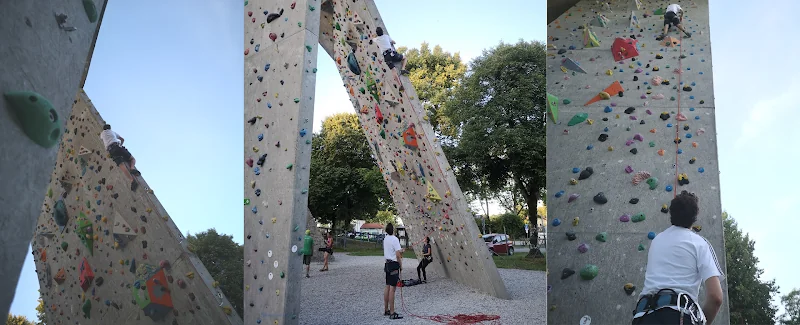
The numbers of the climbing center are a core argument for the facility. According to DAV Traunstein, the climbing facility encompasses a total climbing area of 1320 square meters, 75 climbing lines with redirects, and about 8 square meters of children's bouldering area. In total, around 180 climbing routes are mentioned, equipped with artificial holds and footholds in difficulty levels from 2+ to 10-. This makes the facility broadly accessible: beginners find easy lines, advanced climbers have a wide selection, and very strong climbers are also offered challenging routes. For inquiries about climbing facilities, climbing centers, or best places, this range is particularly relevant because it shows that the facility is not just a small practice wall but a large, versatile training field. The color-coded holds and clearly named lines also facilitate orientation. So, for those wondering if a visit is worthwhile for a sporty training evening, there is a clear answer: Yes, the facility offers an unusually large selection of paths and inclinations. ([alpenverein-traunstein.de](https://www.alpenverein-traunstein.de/stuetzpunkte/kletterturm))
The construction history of the route areas explains why the facility appears so varied. The origin dates back to 1989 and includes concrete construction and natural stone; at that time, vertical walls, an inclined beginner wall, and a wall made of conglomerate stone were created. In 2009, the facility was fundamentally expanded, including additional beginner and overhang areas, vertical walls with structure, and lines at edges. A further expansion followed in 2024 with a wooden structure up to a maximum height of 15.5 meters, 25 lines in different inclinations, and significantly more overhanging areas, which are mainly intended for more difficult routes in the 7th to 9th grade. These development stages make the facility particularly exciting because one can read the various epochs of climbing construction in one place. For users, this means: The climbing center is not static but has grown and been continuously modernized. Especially the combination of older concrete and natural stone segments with newer wooden elements creates a diversity that is immediately recognizable in pictures and directly felt on-site. ([alpenverein-traunstein.de](https://www.alpenverein-traunstein.de/stuetzpunkte/kletterturm))
Additionally, the terrain not only offers vertical or slightly inclined surfaces but also overhangs, a roof, edge routes, and an inclined beginner wall. The city of Traunstein also describes the climbing tower in such a way that overhangs and even upside-down climbing are possible there. The section simultaneously points out that the facility is only partially equipped with fixed quickdraws. This is important for planning because it underscores the character of an outdoor sports facility: Those who want to climb here should know that not every line is prepared like in a fully equipped indoor wall. This mixture of structure, height, and outdoor feeling is precisely what makes it appealing. The facility is thus interesting for people who consciously seek a sporty environment with a real outdoor experience and want to try different wall types at one location. ([traunstein.de](https://www.traunstein.de/tourismus-freizeit/sport-freizeit/spielplaetze-sportstaetten/kletterturm/))
Facilities, Safety, and On-Site Use
On-site use includes not only the walls but also the accompanying facilities. The DAV website mentions a slackline next to the toilet facility, two changing rooms, a material room, and lockers with deposit locks that can be closed with 1- or 2-euro coins. The lighting of the entire facility is equipped with twilight switches or motion detectors, and entrances are illuminated when darkness falls. This is particularly important for an outdoor facility because use is not limited to bright daylight. At the same time, clear rules are pointed out: The changing rooms and toilets are locked between 10:00 PM and 7:00 AM but can be opened from the inside, and during the winter break, the water installation is not frost-proof, which is why toilets and pipes are secured accordingly. These details may seem unremarkable at first glance but are extremely relevant for inquiries about facilities, safety, and practical use. They show that the facility is not only sporty but also well-organized. ([alpenverein-traunstein.de](https://www.alpenverein-traunstein.de/stuetzpunkte/kletterturm))
Also important is the question of equipment and comfort. The section explicitly states that there is no material rental at the facility. Therefore, those needing shoes, harnesses, or belay devices should plan this in advance or go through courses and organized offers. At the same time, the website makes it clear that certain course offerings provide equipment, which is very convenient for beginners. Additionally, the newer access solutions with RFID and day PIN show how modern the organization has become. In the current announcement regarding the climbing facility, it is also mentioned that with the construction of a third climbing tower, access will be redesigned and that the old key has been replaced by a magnetic card. This is a good example of how the section connects tradition and modernization: the facility has grown but remains technically up to date with what users expect today. For visitors, this means a mix of outdoor charm and contemporary management. ([alpenverein-traunstein.de](https://www.alpenverein-traunstein.de/aktuelles/moderner-zugang-zur-kletteranlage))
Another practical point is the current expansion and renovation situation. The official page points out that due to past renovation work on the concrete towers, not all routes have been restored, while the newest tower is fully equipped with routes. This is an important note for anyone expecting specific lines or who has not visited the facility for a while. For the visitor experience, this means: The climbing center is lively and in transition, but not every wall is fully identical to the final expansion state at all times. This transparency is helpful because it sets expectations correctly. Those coming should understand the facility as an ongoing optimized sports area where old elements, new constructions, and ongoing maintenance work together. This creates authenticity and also explains why the facility is so attractive for inquiries about facilities and special features. ([alpenverein-traunstein.de](https://www.alpenverein-traunstein.de/stuetzpunkte/kletterturm?utm_source=openai))
History, Expansion, and Modern Access
The history of the facility is closely linked to the development of the Traunstein section. On the section's page, the establishment of the climbing facility in 1989 is referred to as a milestone, which was fundamentally expanded in 2009 and is said to have significantly contributed to the steady increase in membership. It is also mentioned that the climbing facility is also available for school sports. Thus, the center is not only a recreational place but also a local building block for education, youth, and club life. The historical perspective explains why the facility today is more than just a training wall: it is part of a longer club narrative in which mountain sports, education, and community come together. From an SEO perspective, this is valuable because inquiries about history, special features, or background can be answered content-wise in a clean manner. Therefore, when visiting the facility, one experiences not only routes and holds but also a piece of club history that has grown over decades. ([alpenverein-traunstein.de](https://www.alpenverein-traunstein.de/verein/geschichte?utm_source=openai))
At the same time, the recent development shows that the section is consciously modernizing the location. In a current announcement, it is stated that with the construction of a third climbing tower, access to the facility will also be redesigned, and in the future, an activated magnetic card with RFID technology will be used. This is not just a technical detail but a sign of today's usage culture: more comfort, better traceability, and less dependence on traditional key solutions. The facility is to become more modern and contemporary. When considering this development along with the construction years 1989, 2009, and 2024, a clear red thread emerges: The climbing center Traunstein is not simply operated but actively developed further. For visitors, this is a good sign because it indicates care, investment, and long-term interest. ([alpenverein-traunstein.de](https://www.alpenverein-traunstein.de/aktuelles/moderner-zugang-zur-kletteranlage))
The historical picture also includes the integration into the regional mountain sports culture. The Traunstein section describes itself as part of a city known as a city before the mountains and refers to a vibrant club structure with groups, membership, and education. On the homepage and in the club areas, it becomes clear that the climbing center is only part of a larger offering that includes hut tours, education, group activities, and events. This clarifies why the facility is not viewed in isolation in many inquiries: those searching for climbing centers or climbing facilities often indirectly also seek the club life behind it. This is precisely where the added value of the Traunstein facility lies: it is a training place, a community place, and a symbol for the development of the section at the same time. ([alpenverein-traunstein.de](https://www.alpenverein-traunstein.de/))
Courses, Groups, and Practical Tips for Visiting
For those who want to use the facility systematically rather than just once, the Traunstein section offers a wide range of courses and group offerings. In the section's shop, climbing courses for beginners or top rope, indoor climbing certificate part I, via ferrata courses, and other training modules are offered, among others. The content ranges from safe climbing in the hall or at the climbing tower to lead climbing and outdoor transitions to climbing-specific topics for beginners and advanced climbers. The club page also clearly shows that there are children’s and youth groups, youth teams, family groups, adult groups, and senior groups. This fits excellently with a facility that is as broadly positioned as the climbing center Traunstein. For inquiries about climbing courses, groups, or training opportunities, this is particularly relevant because the facility is not just a sports area but an organized learning and meeting place. ([shop.alpenverein-traunstein.de](https://shop.alpenverein-traunstein.de/products/26-a-39?utm_source=openai))
Practically important is that course offerings often include equipment, making entry easier. The section points out that equipment is provided as part of the course, and the rental usually occurs through the event management. For beginners, this is a significant advantage because they do not have to buy their complete equipment immediately. At the same time, it applies to normal individual visits that there is no rental at the facility itself. Therefore, those coming without a course should have their equipment organized in advance. The group structure of the section, the WhatsApp community, and the clear contacts make it easy to orient oneself in the club environment. This is particularly useful for families, youths, and regular training partners because a one-time use can quickly turn into a permanent sports routine. The facility thus fulfills several functions: it is a recreational place, an educational place, and a meeting point. ([alpenverein-traunstein.de](https://www.alpenverein-traunstein.de/service/verleih?utm_source=openai))
For the use itself, a simple rule of thumb is worthwhile: book online, plan the journey via the swimming pool, check equipment, and keep an eye on the opening hours. Those arriving early or late should pay attention to the rule regarding the automatically locked changing rooms and toilets. Anyone wanting to purchase a day pass should do so preferably before the visit, as the PIN is sent via email and access does not work without it. Those with a season pass can use the RFID technology and benefit from uncomplicated repeated access. In summary, the climbing center Traunstein shows a rare combination of transparent organization, real outdoor character, and much depth of content. That is why the facility is not only interesting for active climbers but also for anyone looking for a well-maintained local sports venue with history and future. ([shop.alpenverein-traunstein.de](https://shop.alpenverein-traunstein.de/collections/kletterzentrum))
Sources:
Mehr anzeigenWeniger anzeigen
Climbing Center Traunstein | Opening Hours & Parking
Many inquiries about the climbing center of the DAV section Traunstein revolve around photos, images, and reviews, but on-site, one thing matters most: a striking outdoor climbing facility right next to the Traunstein swimming pool at Siegsdorfer Straße 33. The official section describes a large climbing area, many routes, and a wide range of climbing grades; the city of Traunstein emphasizes that the climbing tower offers color-coded difficulty levels and appears particularly vibrant as a summer destination. This combination of sport, open space, and clear structure makes the facility interesting for beginners, families, clubs, and experienced climbers. Those who inform themselves before visiting usually want to know how access works, where to park, what tickets cost, and how the facility feels compared to a traditional hall. The climbing center is an exciting special case because it combines modern access and booking methods with a true outdoor character while remaining well-organized. ([alpenverein-traunstein.de](https://www.alpenverein-traunstein.de/stuetzpunkte/kletterturm))
Opening Hours, Day Passes, and Season Passes
For practical planning, access is particularly important. The DAV website lists opening hours for the facility from 7:00 AM to 10:00 PM; after 10:00 PM, changing rooms and toilets are automatically locked. At the same time, the city of Traunstein describes the climbing tower as a facility that is only open in summer. From an SEO perspective, this meets the search intent of many users: they are not only looking for a name but for a realistic assessment of when a visit makes sense and how entry is organized. The section also clearly states that access is only possible with a season pass or day pass. The day pass is purchased online and used via PIN, while season passes work with an activated RFID card. On-site supervision does not accept cash payments. This is important for visitors because one should not plan the trip like a spontaneous visit to a hall without preparation. Therefore, anyone wanting to climb on the same day should book online in advance and have the access data ready. ([alpenverein-traunstein.de](https://www.alpenverein-traunstein.de/stuetzpunkte/kletterturm))
The pricing structure is also transparent. The website lists day fees according to membership status: For children up to 14 years, the section charges 4 euros for members of the Traunstein section, 5 euros for members of other DAV sections, and 7 euros for non-members. For youths up to 18 years, the table shows 5.50 euros, 7 euros, and 9 euros; for juniors and adults, 7 euros, 9 euros, and 11 euros. For season passes, the listed amounts start at 40 euros for youths, 75 euros for juniors up to 25 years, and 110 euros for adults; family passes are also listed. There are separate day fees for groups that must be registered at the office. This makes the climbing center attractive not only for individual visitors but also for clubs, school groups, and organized training sessions. Those planning a longer visit will find a clear cost structure and can easily assess whether a day pass, season pass, or group rate is the most worthwhile. ([alpenverein-traunstein.de](https://www.alpenverein-traunstein.de/stuetzpunkte/kletterturm))
For user-friendliness, it is also crucial that booking can be well-prepared digitally. The section's pages refer to online bookable day passes and season pass applications, while the office is the organizational contact point for groups. This fits with a facility that is heavily used on many days and therefore needs a clean access system. Those who train regularly should keep an eye on the season pass; those who only climb occasionally can remain flexible with a day pass. For search engines, these terms are relevant because users often search for opening hours, prices, day pass, or season pass in connection with the location name. Content-wise, it shows: The climbing center Traunstein is not an improvised meeting point but a clearly regulated, modern outdoor facility with online-controlled access and comprehensible pricing logic. ([shop.alpenverein-traunstein.de](https://shop.alpenverein-traunstein.de/collections/kletterzentrum))
Directions and Parking at the Traunstein Swimming Pool
The directions are easy to understand because the official location description is very specific. The climbing facility of the DAV Traunstein is located next to the Traunstein swimming pool, and the parking option mentioned is the swimming pool's parking lots. The address is Siegsdorfer Straße 33 in 83278 Traunstein. This is ideal for visitors because the climbing center is embedded in an existing recreational environment and is not located in an isolated industrial area. Especially when arriving with children, equipment, or multiple people, this direct association is helpful. Therefore, those searching for the facility for the first time do not have to drive around the city for long but can orient themselves at the swimming pool and the parking spaces there. This is strong for keyword relevance because many inquiries specifically target parking, directions, and location. The official wording also makes it clear that the climbing center is directly part of the recreational area and is not far away. ([alpenverein-traunstein.de](https://www.alpenverein-traunstein.de/stuetzpunkte/kletterturm))
The city of Traunstein also provides useful orientation for regional travel. According to city information, Traunstein is located about 110 kilometers southeast of Munich and around 50 kilometers west of Salzburg in the Chiemgau region. The city refers to the nearby A8 Munich-Salzburg highway and direct train connections from Munich and Salzburg. For drivers, the city mentions exits such as Traunstein/Siegsdorf-East, Bergen, and Siegsdorf-West; there are also around 3,000 centrally located parking spaces in parking garages, underground garages, and parking lots. However, for the climbing center itself, the swimming pool is the most convenient solution, as you park right next to the facility and keep the distance short. Therefore, if you are not only planning a single climbing session but want to combine the visit with a city stroll, a café stop, or a family outing, you will find a well-connected environment with many options in Traunstein. This is a real advantage compared to many remote climbing facilities that are only accessible with additional effort. ([traunstein.de](https://www.traunstein.de/tourismus-freizeit/anreise-informationen/))
In practice, this means: When visiting, it is worth considering the leisure chain. First, the journey through the well-connected city, then parking at the swimming pool, followed by the short walk to the facility. This saves time and makes the start more relaxed. Those traveling with an electric vehicle should pay attention to the city's general parking rules; however, these mainly concern the inner-city parking areas and not the direct recommendation of the section for the climbing facility. For the climbing center's side, the core message is clear: use swimming pool parking, plan short distances, and consider the facility as part of the Traunstein recreational area. This clarity helps with inquiries about parking and directions because visitors immediately know where to go and what environment to expect. ([alpenverein-traunstein.de](https://www.alpenverein-traunstein.de/stuetzpunkte/kletterturm))
Climbing Area, Routes, and Difficulty Levels
The numbers of the climbing center are a core argument for the facility. According to DAV Traunstein, the climbing facility encompasses a total climbing area of 1320 square meters, 75 climbing lines with redirects, and about 8 square meters of children's bouldering area. In total, around 180 climbing routes are mentioned, equipped with artificial holds and footholds in difficulty levels from 2+ to 10-. This makes the facility broadly accessible: beginners find easy lines, advanced climbers have a wide selection, and very strong climbers are also offered challenging routes. For inquiries about climbing facilities, climbing centers, or best places, this range is particularly relevant because it shows that the facility is not just a small practice wall but a large, versatile training field. The color-coded holds and clearly named lines also facilitate orientation. So, for those wondering if a visit is worthwhile for a sporty training evening, there is a clear answer: Yes, the facility offers an unusually large selection of paths and inclinations. ([alpenverein-traunstein.de](https://www.alpenverein-traunstein.de/stuetzpunkte/kletterturm))
The construction history of the route areas explains why the facility appears so varied. The origin dates back to 1989 and includes concrete construction and natural stone; at that time, vertical walls, an inclined beginner wall, and a wall made of conglomerate stone were created. In 2009, the facility was fundamentally expanded, including additional beginner and overhang areas, vertical walls with structure, and lines at edges. A further expansion followed in 2024 with a wooden structure up to a maximum height of 15.5 meters, 25 lines in different inclinations, and significantly more overhanging areas, which are mainly intended for more difficult routes in the 7th to 9th grade. These development stages make the facility particularly exciting because one can read the various epochs of climbing construction in one place. For users, this means: The climbing center is not static but has grown and been continuously modernized. Especially the combination of older concrete and natural stone segments with newer wooden elements creates a diversity that is immediately recognizable in pictures and directly felt on-site. ([alpenverein-traunstein.de](https://www.alpenverein-traunstein.de/stuetzpunkte/kletterturm))
Additionally, the terrain not only offers vertical or slightly inclined surfaces but also overhangs, a roof, edge routes, and an inclined beginner wall. The city of Traunstein also describes the climbing tower in such a way that overhangs and even upside-down climbing are possible there. The section simultaneously points out that the facility is only partially equipped with fixed quickdraws. This is important for planning because it underscores the character of an outdoor sports facility: Those who want to climb here should know that not every line is prepared like in a fully equipped indoor wall. This mixture of structure, height, and outdoor feeling is precisely what makes it appealing. The facility is thus interesting for people who consciously seek a sporty environment with a real outdoor experience and want to try different wall types at one location. ([traunstein.de](https://www.traunstein.de/tourismus-freizeit/sport-freizeit/spielplaetze-sportstaetten/kletterturm/))
Facilities, Safety, and On-Site Use
On-site use includes not only the walls but also the accompanying facilities. The DAV website mentions a slackline next to the toilet facility, two changing rooms, a material room, and lockers with deposit locks that can be closed with 1- or 2-euro coins. The lighting of the entire facility is equipped with twilight switches or motion detectors, and entrances are illuminated when darkness falls. This is particularly important for an outdoor facility because use is not limited to bright daylight. At the same time, clear rules are pointed out: The changing rooms and toilets are locked between 10:00 PM and 7:00 AM but can be opened from the inside, and during the winter break, the water installation is not frost-proof, which is why toilets and pipes are secured accordingly. These details may seem unremarkable at first glance but are extremely relevant for inquiries about facilities, safety, and practical use. They show that the facility is not only sporty but also well-organized. ([alpenverein-traunstein.de](https://www.alpenverein-traunstein.de/stuetzpunkte/kletterturm))
Also important is the question of equipment and comfort. The section explicitly states that there is no material rental at the facility. Therefore, those needing shoes, harnesses, or belay devices should plan this in advance or go through courses and organized offers. At the same time, the website makes it clear that certain course offerings provide equipment, which is very convenient for beginners. Additionally, the newer access solutions with RFID and day PIN show how modern the organization has become. In the current announcement regarding the climbing facility, it is also mentioned that with the construction of a third climbing tower, access will be redesigned and that the old key has been replaced by a magnetic card. This is a good example of how the section connects tradition and modernization: the facility has grown but remains technically up to date with what users expect today. For visitors, this means a mix of outdoor charm and contemporary management. ([alpenverein-traunstein.de](https://www.alpenverein-traunstein.de/aktuelles/moderner-zugang-zur-kletteranlage))
Another practical point is the current expansion and renovation situation. The official page points out that due to past renovation work on the concrete towers, not all routes have been restored, while the newest tower is fully equipped with routes. This is an important note for anyone expecting specific lines or who has not visited the facility for a while. For the visitor experience, this means: The climbing center is lively and in transition, but not every wall is fully identical to the final expansion state at all times. This transparency is helpful because it sets expectations correctly. Those coming should understand the facility as an ongoing optimized sports area where old elements, new constructions, and ongoing maintenance work together. This creates authenticity and also explains why the facility is so attractive for inquiries about facilities and special features. ([alpenverein-traunstein.de](https://www.alpenverein-traunstein.de/stuetzpunkte/kletterturm?utm_source=openai))
History, Expansion, and Modern Access
The history of the facility is closely linked to the development of the Traunstein section. On the section's page, the establishment of the climbing facility in 1989 is referred to as a milestone, which was fundamentally expanded in 2009 and is said to have significantly contributed to the steady increase in membership. It is also mentioned that the climbing facility is also available for school sports. Thus, the center is not only a recreational place but also a local building block for education, youth, and club life. The historical perspective explains why the facility today is more than just a training wall: it is part of a longer club narrative in which mountain sports, education, and community come together. From an SEO perspective, this is valuable because inquiries about history, special features, or background can be answered content-wise in a clean manner. Therefore, when visiting the facility, one experiences not only routes and holds but also a piece of club history that has grown over decades. ([alpenverein-traunstein.de](https://www.alpenverein-traunstein.de/verein/geschichte?utm_source=openai))
At the same time, the recent development shows that the section is consciously modernizing the location. In a current announcement, it is stated that with the construction of a third climbing tower, access to the facility will also be redesigned, and in the future, an activated magnetic card with RFID technology will be used. This is not just a technical detail but a sign of today's usage culture: more comfort, better traceability, and less dependence on traditional key solutions. The facility is to become more modern and contemporary. When considering this development along with the construction years 1989, 2009, and 2024, a clear red thread emerges: The climbing center Traunstein is not simply operated but actively developed further. For visitors, this is a good sign because it indicates care, investment, and long-term interest. ([alpenverein-traunstein.de](https://www.alpenverein-traunstein.de/aktuelles/moderner-zugang-zur-kletteranlage))
The historical picture also includes the integration into the regional mountain sports culture. The Traunstein section describes itself as part of a city known as a city before the mountains and refers to a vibrant club structure with groups, membership, and education. On the homepage and in the club areas, it becomes clear that the climbing center is only part of a larger offering that includes hut tours, education, group activities, and events. This clarifies why the facility is not viewed in isolation in many inquiries: those searching for climbing centers or climbing facilities often indirectly also seek the club life behind it. This is precisely where the added value of the Traunstein facility lies: it is a training place, a community place, and a symbol for the development of the section at the same time. ([alpenverein-traunstein.de](https://www.alpenverein-traunstein.de/))
Courses, Groups, and Practical Tips for Visiting
For those who want to use the facility systematically rather than just once, the Traunstein section offers a wide range of courses and group offerings. In the section's shop, climbing courses for beginners or top rope, indoor climbing certificate part I, via ferrata courses, and other training modules are offered, among others. The content ranges from safe climbing in the hall or at the climbing tower to lead climbing and outdoor transitions to climbing-specific topics for beginners and advanced climbers. The club page also clearly shows that there are children’s and youth groups, youth teams, family groups, adult groups, and senior groups. This fits excellently with a facility that is as broadly positioned as the climbing center Traunstein. For inquiries about climbing courses, groups, or training opportunities, this is particularly relevant because the facility is not just a sports area but an organized learning and meeting place. ([shop.alpenverein-traunstein.de](https://shop.alpenverein-traunstein.de/products/26-a-39?utm_source=openai))
Practically important is that course offerings often include equipment, making entry easier. The section points out that equipment is provided as part of the course, and the rental usually occurs through the event management. For beginners, this is a significant advantage because they do not have to buy their complete equipment immediately. At the same time, it applies to normal individual visits that there is no rental at the facility itself. Therefore, those coming without a course should have their equipment organized in advance. The group structure of the section, the WhatsApp community, and the clear contacts make it easy to orient oneself in the club environment. This is particularly useful for families, youths, and regular training partners because a one-time use can quickly turn into a permanent sports routine. The facility thus fulfills several functions: it is a recreational place, an educational place, and a meeting point. ([alpenverein-traunstein.de](https://www.alpenverein-traunstein.de/service/verleih?utm_source=openai))
For the use itself, a simple rule of thumb is worthwhile: book online, plan the journey via the swimming pool, check equipment, and keep an eye on the opening hours. Those arriving early or late should pay attention to the rule regarding the automatically locked changing rooms and toilets. Anyone wanting to purchase a day pass should do so preferably before the visit, as the PIN is sent via email and access does not work without it. Those with a season pass can use the RFID technology and benefit from uncomplicated repeated access. In summary, the climbing center Traunstein shows a rare combination of transparent organization, real outdoor character, and much depth of content. That is why the facility is not only interesting for active climbers but also for anyone looking for a well-maintained local sports venue with history and future. ([shop.alpenverein-traunstein.de](https://shop.alpenverein-traunstein.de/collections/kletterzentrum))
Sources:
Climbing Center Traunstein | Opening Hours & Parking
Many inquiries about the climbing center of the DAV section Traunstein revolve around photos, images, and reviews, but on-site, one thing matters most: a striking outdoor climbing facility right next to the Traunstein swimming pool at Siegsdorfer Straße 33. The official section describes a large climbing area, many routes, and a wide range of climbing grades; the city of Traunstein emphasizes that the climbing tower offers color-coded difficulty levels and appears particularly vibrant as a summer destination. This combination of sport, open space, and clear structure makes the facility interesting for beginners, families, clubs, and experienced climbers. Those who inform themselves before visiting usually want to know how access works, where to park, what tickets cost, and how the facility feels compared to a traditional hall. The climbing center is an exciting special case because it combines modern access and booking methods with a true outdoor character while remaining well-organized. ([alpenverein-traunstein.de](https://www.alpenverein-traunstein.de/stuetzpunkte/kletterturm))
Opening Hours, Day Passes, and Season Passes
For practical planning, access is particularly important. The DAV website lists opening hours for the facility from 7:00 AM to 10:00 PM; after 10:00 PM, changing rooms and toilets are automatically locked. At the same time, the city of Traunstein describes the climbing tower as a facility that is only open in summer. From an SEO perspective, this meets the search intent of many users: they are not only looking for a name but for a realistic assessment of when a visit makes sense and how entry is organized. The section also clearly states that access is only possible with a season pass or day pass. The day pass is purchased online and used via PIN, while season passes work with an activated RFID card. On-site supervision does not accept cash payments. This is important for visitors because one should not plan the trip like a spontaneous visit to a hall without preparation. Therefore, anyone wanting to climb on the same day should book online in advance and have the access data ready. ([alpenverein-traunstein.de](https://www.alpenverein-traunstein.de/stuetzpunkte/kletterturm))
The pricing structure is also transparent. The website lists day fees according to membership status: For children up to 14 years, the section charges 4 euros for members of the Traunstein section, 5 euros for members of other DAV sections, and 7 euros for non-members. For youths up to 18 years, the table shows 5.50 euros, 7 euros, and 9 euros; for juniors and adults, 7 euros, 9 euros, and 11 euros. For season passes, the listed amounts start at 40 euros for youths, 75 euros for juniors up to 25 years, and 110 euros for adults; family passes are also listed. There are separate day fees for groups that must be registered at the office. This makes the climbing center attractive not only for individual visitors but also for clubs, school groups, and organized training sessions. Those planning a longer visit will find a clear cost structure and can easily assess whether a day pass, season pass, or group rate is the most worthwhile. ([alpenverein-traunstein.de](https://www.alpenverein-traunstein.de/stuetzpunkte/kletterturm))
For user-friendliness, it is also crucial that booking can be well-prepared digitally. The section's pages refer to online bookable day passes and season pass applications, while the office is the organizational contact point for groups. This fits with a facility that is heavily used on many days and therefore needs a clean access system. Those who train regularly should keep an eye on the season pass; those who only climb occasionally can remain flexible with a day pass. For search engines, these terms are relevant because users often search for opening hours, prices, day pass, or season pass in connection with the location name. Content-wise, it shows: The climbing center Traunstein is not an improvised meeting point but a clearly regulated, modern outdoor facility with online-controlled access and comprehensible pricing logic. ([shop.alpenverein-traunstein.de](https://shop.alpenverein-traunstein.de/collections/kletterzentrum))
Directions and Parking at the Traunstein Swimming Pool
The directions are easy to understand because the official location description is very specific. The climbing facility of the DAV Traunstein is located next to the Traunstein swimming pool, and the parking option mentioned is the swimming pool's parking lots. The address is Siegsdorfer Straße 33 in 83278 Traunstein. This is ideal for visitors because the climbing center is embedded in an existing recreational environment and is not located in an isolated industrial area. Especially when arriving with children, equipment, or multiple people, this direct association is helpful. Therefore, those searching for the facility for the first time do not have to drive around the city for long but can orient themselves at the swimming pool and the parking spaces there. This is strong for keyword relevance because many inquiries specifically target parking, directions, and location. The official wording also makes it clear that the climbing center is directly part of the recreational area and is not far away. ([alpenverein-traunstein.de](https://www.alpenverein-traunstein.de/stuetzpunkte/kletterturm))
The city of Traunstein also provides useful orientation for regional travel. According to city information, Traunstein is located about 110 kilometers southeast of Munich and around 50 kilometers west of Salzburg in the Chiemgau region. The city refers to the nearby A8 Munich-Salzburg highway and direct train connections from Munich and Salzburg. For drivers, the city mentions exits such as Traunstein/Siegsdorf-East, Bergen, and Siegsdorf-West; there are also around 3,000 centrally located parking spaces in parking garages, underground garages, and parking lots. However, for the climbing center itself, the swimming pool is the most convenient solution, as you park right next to the facility and keep the distance short. Therefore, if you are not only planning a single climbing session but want to combine the visit with a city stroll, a café stop, or a family outing, you will find a well-connected environment with many options in Traunstein. This is a real advantage compared to many remote climbing facilities that are only accessible with additional effort. ([traunstein.de](https://www.traunstein.de/tourismus-freizeit/anreise-informationen/))
In practice, this means: When visiting, it is worth considering the leisure chain. First, the journey through the well-connected city, then parking at the swimming pool, followed by the short walk to the facility. This saves time and makes the start more relaxed. Those traveling with an electric vehicle should pay attention to the city's general parking rules; however, these mainly concern the inner-city parking areas and not the direct recommendation of the section for the climbing facility. For the climbing center's side, the core message is clear: use swimming pool parking, plan short distances, and consider the facility as part of the Traunstein recreational area. This clarity helps with inquiries about parking and directions because visitors immediately know where to go and what environment to expect. ([alpenverein-traunstein.de](https://www.alpenverein-traunstein.de/stuetzpunkte/kletterturm))
Climbing Area, Routes, and Difficulty Levels
The numbers of the climbing center are a core argument for the facility. According to DAV Traunstein, the climbing facility encompasses a total climbing area of 1320 square meters, 75 climbing lines with redirects, and about 8 square meters of children's bouldering area. In total, around 180 climbing routes are mentioned, equipped with artificial holds and footholds in difficulty levels from 2+ to 10-. This makes the facility broadly accessible: beginners find easy lines, advanced climbers have a wide selection, and very strong climbers are also offered challenging routes. For inquiries about climbing facilities, climbing centers, or best places, this range is particularly relevant because it shows that the facility is not just a small practice wall but a large, versatile training field. The color-coded holds and clearly named lines also facilitate orientation. So, for those wondering if a visit is worthwhile for a sporty training evening, there is a clear answer: Yes, the facility offers an unusually large selection of paths and inclinations. ([alpenverein-traunstein.de](https://www.alpenverein-traunstein.de/stuetzpunkte/kletterturm))
The construction history of the route areas explains why the facility appears so varied. The origin dates back to 1989 and includes concrete construction and natural stone; at that time, vertical walls, an inclined beginner wall, and a wall made of conglomerate stone were created. In 2009, the facility was fundamentally expanded, including additional beginner and overhang areas, vertical walls with structure, and lines at edges. A further expansion followed in 2024 with a wooden structure up to a maximum height of 15.5 meters, 25 lines in different inclinations, and significantly more overhanging areas, which are mainly intended for more difficult routes in the 7th to 9th grade. These development stages make the facility particularly exciting because one can read the various epochs of climbing construction in one place. For users, this means: The climbing center is not static but has grown and been continuously modernized. Especially the combination of older concrete and natural stone segments with newer wooden elements creates a diversity that is immediately recognizable in pictures and directly felt on-site. ([alpenverein-traunstein.de](https://www.alpenverein-traunstein.de/stuetzpunkte/kletterturm))
Additionally, the terrain not only offers vertical or slightly inclined surfaces but also overhangs, a roof, edge routes, and an inclined beginner wall. The city of Traunstein also describes the climbing tower in such a way that overhangs and even upside-down climbing are possible there. The section simultaneously points out that the facility is only partially equipped with fixed quickdraws. This is important for planning because it underscores the character of an outdoor sports facility: Those who want to climb here should know that not every line is prepared like in a fully equipped indoor wall. This mixture of structure, height, and outdoor feeling is precisely what makes it appealing. The facility is thus interesting for people who consciously seek a sporty environment with a real outdoor experience and want to try different wall types at one location. ([traunstein.de](https://www.traunstein.de/tourismus-freizeit/sport-freizeit/spielplaetze-sportstaetten/kletterturm/))
Facilities, Safety, and On-Site Use
On-site use includes not only the walls but also the accompanying facilities. The DAV website mentions a slackline next to the toilet facility, two changing rooms, a material room, and lockers with deposit locks that can be closed with 1- or 2-euro coins. The lighting of the entire facility is equipped with twilight switches or motion detectors, and entrances are illuminated when darkness falls. This is particularly important for an outdoor facility because use is not limited to bright daylight. At the same time, clear rules are pointed out: The changing rooms and toilets are locked between 10:00 PM and 7:00 AM but can be opened from the inside, and during the winter break, the water installation is not frost-proof, which is why toilets and pipes are secured accordingly. These details may seem unremarkable at first glance but are extremely relevant for inquiries about facilities, safety, and practical use. They show that the facility is not only sporty but also well-organized. ([alpenverein-traunstein.de](https://www.alpenverein-traunstein.de/stuetzpunkte/kletterturm))
Also important is the question of equipment and comfort. The section explicitly states that there is no material rental at the facility. Therefore, those needing shoes, harnesses, or belay devices should plan this in advance or go through courses and organized offers. At the same time, the website makes it clear that certain course offerings provide equipment, which is very convenient for beginners. Additionally, the newer access solutions with RFID and day PIN show how modern the organization has become. In the current announcement regarding the climbing facility, it is also mentioned that with the construction of a third climbing tower, access will be redesigned and that the old key has been replaced by a magnetic card. This is a good example of how the section connects tradition and modernization: the facility has grown but remains technically up to date with what users expect today. For visitors, this means a mix of outdoor charm and contemporary management. ([alpenverein-traunstein.de](https://www.alpenverein-traunstein.de/aktuelles/moderner-zugang-zur-kletteranlage))
Another practical point is the current expansion and renovation situation. The official page points out that due to past renovation work on the concrete towers, not all routes have been restored, while the newest tower is fully equipped with routes. This is an important note for anyone expecting specific lines or who has not visited the facility for a while. For the visitor experience, this means: The climbing center is lively and in transition, but not every wall is fully identical to the final expansion state at all times. This transparency is helpful because it sets expectations correctly. Those coming should understand the facility as an ongoing optimized sports area where old elements, new constructions, and ongoing maintenance work together. This creates authenticity and also explains why the facility is so attractive for inquiries about facilities and special features. ([alpenverein-traunstein.de](https://www.alpenverein-traunstein.de/stuetzpunkte/kletterturm?utm_source=openai))
History, Expansion, and Modern Access
The history of the facility is closely linked to the development of the Traunstein section. On the section's page, the establishment of the climbing facility in 1989 is referred to as a milestone, which was fundamentally expanded in 2009 and is said to have significantly contributed to the steady increase in membership. It is also mentioned that the climbing facility is also available for school sports. Thus, the center is not only a recreational place but also a local building block for education, youth, and club life. The historical perspective explains why the facility today is more than just a training wall: it is part of a longer club narrative in which mountain sports, education, and community come together. From an SEO perspective, this is valuable because inquiries about history, special features, or background can be answered content-wise in a clean manner. Therefore, when visiting the facility, one experiences not only routes and holds but also a piece of club history that has grown over decades. ([alpenverein-traunstein.de](https://www.alpenverein-traunstein.de/verein/geschichte?utm_source=openai))
At the same time, the recent development shows that the section is consciously modernizing the location. In a current announcement, it is stated that with the construction of a third climbing tower, access to the facility will also be redesigned, and in the future, an activated magnetic card with RFID technology will be used. This is not just a technical detail but a sign of today's usage culture: more comfort, better traceability, and less dependence on traditional key solutions. The facility is to become more modern and contemporary. When considering this development along with the construction years 1989, 2009, and 2024, a clear red thread emerges: The climbing center Traunstein is not simply operated but actively developed further. For visitors, this is a good sign because it indicates care, investment, and long-term interest. ([alpenverein-traunstein.de](https://www.alpenverein-traunstein.de/aktuelles/moderner-zugang-zur-kletteranlage))
The historical picture also includes the integration into the regional mountain sports culture. The Traunstein section describes itself as part of a city known as a city before the mountains and refers to a vibrant club structure with groups, membership, and education. On the homepage and in the club areas, it becomes clear that the climbing center is only part of a larger offering that includes hut tours, education, group activities, and events. This clarifies why the facility is not viewed in isolation in many inquiries: those searching for climbing centers or climbing facilities often indirectly also seek the club life behind it. This is precisely where the added value of the Traunstein facility lies: it is a training place, a community place, and a symbol for the development of the section at the same time. ([alpenverein-traunstein.de](https://www.alpenverein-traunstein.de/))
Courses, Groups, and Practical Tips for Visiting
For those who want to use the facility systematically rather than just once, the Traunstein section offers a wide range of courses and group offerings. In the section's shop, climbing courses for beginners or top rope, indoor climbing certificate part I, via ferrata courses, and other training modules are offered, among others. The content ranges from safe climbing in the hall or at the climbing tower to lead climbing and outdoor transitions to climbing-specific topics for beginners and advanced climbers. The club page also clearly shows that there are children’s and youth groups, youth teams, family groups, adult groups, and senior groups. This fits excellently with a facility that is as broadly positioned as the climbing center Traunstein. For inquiries about climbing courses, groups, or training opportunities, this is particularly relevant because the facility is not just a sports area but an organized learning and meeting place. ([shop.alpenverein-traunstein.de](https://shop.alpenverein-traunstein.de/products/26-a-39?utm_source=openai))
Practically important is that course offerings often include equipment, making entry easier. The section points out that equipment is provided as part of the course, and the rental usually occurs through the event management. For beginners, this is a significant advantage because they do not have to buy their complete equipment immediately. At the same time, it applies to normal individual visits that there is no rental at the facility itself. Therefore, those coming without a course should have their equipment organized in advance. The group structure of the section, the WhatsApp community, and the clear contacts make it easy to orient oneself in the club environment. This is particularly useful for families, youths, and regular training partners because a one-time use can quickly turn into a permanent sports routine. The facility thus fulfills several functions: it is a recreational place, an educational place, and a meeting point. ([alpenverein-traunstein.de](https://www.alpenverein-traunstein.de/service/verleih?utm_source=openai))
For the use itself, a simple rule of thumb is worthwhile: book online, plan the journey via the swimming pool, check equipment, and keep an eye on the opening hours. Those arriving early or late should pay attention to the rule regarding the automatically locked changing rooms and toilets. Anyone wanting to purchase a day pass should do so preferably before the visit, as the PIN is sent via email and access does not work without it. Those with a season pass can use the RFID technology and benefit from uncomplicated repeated access. In summary, the climbing center Traunstein shows a rare combination of transparent organization, real outdoor character, and much depth of content. That is why the facility is not only interesting for active climbers but also for anyone looking for a well-maintained local sports venue with history and future. ([shop.alpenverein-traunstein.de](https://shop.alpenverein-traunstein.de/collections/kletterzentrum))
Sources:
Frequently Asked Questions
Reviews
No reviews found