
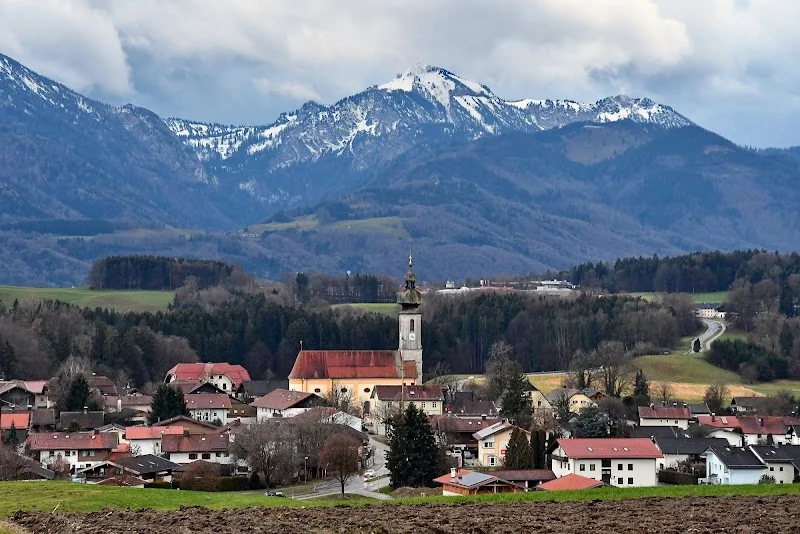
Vachendorf
Hauptstraße 13, 83377 Vachendorf, Deutschland
Catholic Parish Office of the Assumption of Mary | Address & Opening Hours
The Catholic Parish Office of the Assumption of Mary in Vachendorf is much more than just an administrative address. At Hauptstraße 13, a piece of vibrant local history, church organization, and a parish church that has been present in the region for centuries comes together. Those looking for contact, services, history, or photos will find a place here that closely connects religious tradition and everyday life. The parish now belongs to the parish association of Saint Francis of Assisi along with Bergen, Erlstätt, and Grabenstätt. This integration makes the location interesting for visitors, community members, and seekers, as it combines an independent church profile with a larger pastoral network. Vachendorf is thus a classic hit for people who expect a parish office, a church with history, and practical information in one place. ([vachendorf.de](https://www.vachendorf.de/pfarrgemeinde-vachendorf))
Opening Hours, Contact, and Parish Office in Vachendorf
For most inquiries regarding the Assumption of Mary Vachendorf, very practical questions come first: Where is the parish office, when is it open, and how can one reach the community the fastest? The official parish community page lists the parish church foundation of the Assumption of Mary Vachendorf at Hauptstr. 13, 83377 Vachendorf. Additionally, the phone number 0861 / 4974, fax, and the email address mariae-himmelfahrt.vachendorf@ebmuc.de are provided. The opening hours are also clearly stated: Mondays from 8 to 11 a.m., Tuesdays from 1 to 4 p.m., and Thursdays from 8 to 11 a.m. This is helpful for anyone planning a baptism registration, a query about a pastoral topic, or just a quick question on-site. ([vachendorf.de](https://www.vachendorf.de/pfarrgemeinde-vachendorf))
It is also noteworthy to mention the structure behind it. The parishes of Bergen, Erlstätt, Grabenstätt, and Vachendorf have joined together to form a parish association to better organize accessibility and ensure that at least one parish office is staffed at all times. This speaks to a well-coordinated church infrastructure that does not work in isolation but thinks in a network. The official page also lists the full-time and volunteer contacts, including parish association leadership, staff team, community referent, sacristan, parish office, and church administration. For visitors, this is an important indication: Behind the name Assumption of Mary stands a real, reachable parish community with clear responsibilities and fixed points of contact. ([vachendorf.de](https://www.vachendorf.de/pfarrgemeinde-vachendorf))
Those preparing for a visit should also know the pastoral emergency number, which is also published on the parish community page. Such information shows that the parish office is not only responsible for organizational matters but also serves as a reliable contact point in the everyday life of the community. Especially regarding search terms related to contact, opening hours, and parish office, this is important because visitors often want not just an address but an immediately usable orientation. Vachendorf meets this need exactly: compact, clear, and officially documented. ([vachendorf.de](https://www.vachendorf.de/pfarrgemeinde-vachendorf))
History of the Parish of the Assumption of Mary in Vachendorf
The historical depth of the parish is one of the strongest reasons why the Assumption of Mary Vachendorf is more than just a pure administrative site. The village of Vachendorf was already mentioned in 790 in the Breves Notitiae, and the first documentary evidence of the parish dates back to between 1188 and 1191. In the Middle Ages, Vachendorf was a large and significant parish that encompassed vast parts of the southeastern Chiemgau, including Vachendorf itself, Siegsdorf, Bergen, Inzell, and Ruhpolding. Thus, the place belonged to the ecclesiastical centers of the region and was significantly larger in its jurisdiction than it is today. This early significance explains why the name Assumption of Mary is still immediately recognizable in the region today. ([de.wikipedia.org](https://de.wikipedia.org/wiki/Mari%C3%A4_Himmelfahrt_%28Vachendorf%29))
Particularly exciting is the predecessor building of the current church. According to the preserved floor plan by the master builder Lorenzo Sciasca, the medieval church was a seven-bay, three-nave Romanesque pillar basilica with apses. For a village church, this was already a remarkably large structure. The western late Gothic tower was not demolished during the reconstruction in the 17th century but was deliberately preserved and continues to shape the overall image to this day. This interplay of the older tower and the Baroque nave makes the church architecturally appealing and explains why it is regularly sought after for photo inquiries and church research. ([de.wikipedia.org](https://de.wikipedia.org/wiki/Mari%C3%A4_Himmelfahrt_%28Vachendorf%29))
The current early Baroque church was essentially built between 1680 and 1682 under Lorenzo Sciasca from Graubünden. Originally, the court master builder Kaspar Zuccalli was commissioned, but after his early death, Sciasca took over the execution. After a church fire in 1891, the vaults and tower had to be extensively renovated: The outer walls were raised, the upper tower floors were removed, and the tower was subsequently rebuilt and richly decorated. In 1892, the stucco work on the ceiling vault was created, and in 1894/95, Max Fürst repainted the ceiling paintings after the first images were lost in the fire. This construction history makes it clear that while the church is Baroque in character, it carries several layers of time within it. ([de.wikipedia.org](https://de.wikipedia.org/wiki/Mari%C3%A4_Himmelfahrt_%28Vachendorf%29))
Architecture, Sanctuary, and Furnishings of the Church
Architecturally, the Assumption of Mary Vachendorf is a very beautiful example of an early Baroque country church in Upper Bavaria. The house of worship has a nave with three bays, which is concluded by a semicircular apse. The barrel vault rests on strong wall pillars with pilasters, while a surrounding crown beam horizontally divides the space. Above the large windows are transverse oval ox eyes, which are typical for the architect Lorenzo Sciasca. Even these details show that this is not just a functional church space but a consciously composed building with a clear spatial effect. Particularly interesting for visitors is the interplay of light, vault, and bright wall surfaces, which gives the interior openness despite its historical depth. ([de.wikipedia.org](https://de.wikipedia.org/wiki/Mari%C3%A4_Himmelfahrt_%28Vachendorf%29))
The furnishings also tell a lot about the history of the place. The three altars and the pulpit date from the time of construction and are early Baroque. They were created by masters from Traunstein and have been restored in black and gold since 1954, thus returning to a color scheme that connects to the original effect. The main altar is designed in a three-part triumphal arch scheme and is oriented towards the high altar of the collegiate church of Herrenchiemsee. The altar painting depicts the Assumption of Mary; during Lent, it is replaced by the Deposition from the Cross. The side figures, including Rupert, Maximilian, Joachim, and Joseph with the child, are also part of this rich Baroque overall concept. For those looking for photos or special furnishing details, these elements are real highlights. ([de.wikipedia.org](https://de.wikipedia.org/wiki/Mari%C3%A4_Himmelfahrt_%28Vachendorf%29))
Further special features include the two side altars with their saint figures, the chancel arch cross from around 1700, the Baroque statue of Saint Joseph in front of the right side altar, the neo-Gothic baptismal font from 1891, and the Schleifladen organ from 1973/75. In the church space, there are also tombstones of parish priests, a votive picture of the old grace image of Mary Vachendorf under the pulpit, and a memorial plaque for Eugen Pacelli, the later Pope Pius XII., at the south entrance. These are details that make the place authentic and distinctive. Those who observe the space attentively will quickly recognize that here not only liturgical function but also regional art and memory culture become visible. ([de.wikipedia.org](https://de.wikipedia.org/wiki/Mari%C3%A4_Himmelfahrt_%28Vachendorf%29))
Services, Taizé Prayer, and Community Life
A significant part of the inquiries regarding the Assumption of Mary Vachendorf revolves around services, programs, and vibrant parish life. The official parish community page explicitly publishes a service schedule, which shows that the community regularly works with current dates. Furthermore, the diocesan page points out that Taizé prayers regularly take place in Vachendorf within the parish association of Saint Francis of Assisi. Taizé stands for meditative songs, silence, and prayer, thus representing a form of celebration that particularly appeals to young people and adults seeking a calm, focused atmosphere. For seekers looking for a spiritual place rather than mere architecture, this is an important plus. ([vachendorf.de](https://www.vachendorf.de/pfarrgemeinde-vachendorf))
The altar server work also shows that the community is not only historically interesting but also active today. The diocesan page names specific responsible individuals for the parish of the Assumption of Mary Vachendorf and describes that new altar servers have been introduced into service. The text also reports on a joint excursion to Bayernpark, which is explicitly understood as a contribution to community. This is a good indication of how strongly the parish relies on volunteer work, cohesion, and youth. For families, this is relevant because it shows that children and young people have a visible place in the parish. ([erzbistum-muenchen.de](https://www.erzbistum-muenchen.de/pfarrei/hl-franz-von-assisi/gemeindeleben/kinder-jugend-familie/Ministranten))
Community life also includes practical pastoral care regarding the cemetery and burials. The parish association has its own guidelines for cemetery and fee regulations for Vachendorf, and it is explicitly stated that urn graves can be used in Vachendorf. This broadens the view of the parish to an important everyday aspect that often plays a role in church inquiries. Additionally, the parish is organized in a network, thus remaining embedded beyond local boundaries. Therefore, anyone searching for service schedules, cemeteries, Taizé, or altar servers will find an astonishingly broad church spectrum in Vachendorf in a tight space. ([erzbistum-muenchen.de](https://www.erzbistum-muenchen.de/pfarrei/hl-franz-von-assisi/friedhoefe))
Photos, Reviews, and Practical Tips for Visiting
The search for photos and reviews is quite understandable for the Assumption of Mary Vachendorf, as the church has a clear visual identity. Particularly characteristic is the view of the western late Gothic tower along with the early Baroque nave. Wikimedia Commons describes the parish church as choir and nave by Lorenzo Sciasca from 1680 to 1682 with a late Gothic tower. This connection between the older tower and the Baroque overall structure creates a strong first impression and makes the church interesting for both image searches and local research. Therefore, those looking for photos will find not just any church building but a structure with clear recognizability. ([commons.wikimedia.org](https://commons.wikimedia.org/wiki/Category%3AMari%C3%A4_Himmelfahrt_%28Vachendorf%29?utm_source=openai))
Practically, the location is also easy to place: The address at Hauptstraße 13 points to a location in the center of Vachendorf, making the parish office easily findable in everyday life. The official pages focus on the parish office, services, pastoral care, and community life; separate parking information is not highlighted there. Therefore, anyone with specific questions about access or parking options is best advised to make a quick inquiry at the parish office. This type of information situation is typical for smaller, active parish locations: The most important data is available, and detailed questions are clarified directly on-site. This makes the search for address, access, and parking both sensible and uncomplicated. ([vachendorf.de](https://www.vachendorf.de/pfarrgemeinde-vachendorf))
For visitors, it is also worthwhile to take a look at the surroundings of the interior. The architectural structure with three bays, the semicircular apse, the strong wall pillars, and the richly designed sanctuary offers several good photo motifs without drifting into the sensational. Additionally, the altars, the pulpit, the chancel arch cross, and the memorial plaques give depth to the space. Therefore, those writing reviews or wanting to gather impressions in advance should not only pay attention to the exterior but also to the interplay of architectural history, furnishings, and current community life. This is precisely where the special strength of the Assumption of Mary Vachendorf lies: The church is not a loud event place but a historically grown, vibrant parish location with a calm aura and clear identity. ([de.wikipedia.org](https://de.wikipedia.org/wiki/Mari%C3%A4_Himmelfahrt_%28Vachendorf%29))
Sources:
- Parish Community Vachendorf - Official Website
- Assumption of Mary Vachendorf - Archdiocese of Munich and Freising
- Taizé Prayer - Parish Association of Saint Francis of Assisi
- Altar Servers - Parish Association of Saint Francis of Assisi
- Assumption of Mary (Vachendorf) - Wikipedia
- Assumption of Mary (Vachendorf) - Wikimedia Commons
Mehr anzeigenWeniger anzeigen
Catholic Parish Office of the Assumption of Mary | Address & Opening Hours
The Catholic Parish Office of the Assumption of Mary in Vachendorf is much more than just an administrative address. At Hauptstraße 13, a piece of vibrant local history, church organization, and a parish church that has been present in the region for centuries comes together. Those looking for contact, services, history, or photos will find a place here that closely connects religious tradition and everyday life. The parish now belongs to the parish association of Saint Francis of Assisi along with Bergen, Erlstätt, and Grabenstätt. This integration makes the location interesting for visitors, community members, and seekers, as it combines an independent church profile with a larger pastoral network. Vachendorf is thus a classic hit for people who expect a parish office, a church with history, and practical information in one place. ([vachendorf.de](https://www.vachendorf.de/pfarrgemeinde-vachendorf))
Opening Hours, Contact, and Parish Office in Vachendorf
For most inquiries regarding the Assumption of Mary Vachendorf, very practical questions come first: Where is the parish office, when is it open, and how can one reach the community the fastest? The official parish community page lists the parish church foundation of the Assumption of Mary Vachendorf at Hauptstr. 13, 83377 Vachendorf. Additionally, the phone number 0861 / 4974, fax, and the email address mariae-himmelfahrt.vachendorf@ebmuc.de are provided. The opening hours are also clearly stated: Mondays from 8 to 11 a.m., Tuesdays from 1 to 4 p.m., and Thursdays from 8 to 11 a.m. This is helpful for anyone planning a baptism registration, a query about a pastoral topic, or just a quick question on-site. ([vachendorf.de](https://www.vachendorf.de/pfarrgemeinde-vachendorf))
It is also noteworthy to mention the structure behind it. The parishes of Bergen, Erlstätt, Grabenstätt, and Vachendorf have joined together to form a parish association to better organize accessibility and ensure that at least one parish office is staffed at all times. This speaks to a well-coordinated church infrastructure that does not work in isolation but thinks in a network. The official page also lists the full-time and volunteer contacts, including parish association leadership, staff team, community referent, sacristan, parish office, and church administration. For visitors, this is an important indication: Behind the name Assumption of Mary stands a real, reachable parish community with clear responsibilities and fixed points of contact. ([vachendorf.de](https://www.vachendorf.de/pfarrgemeinde-vachendorf))
Those preparing for a visit should also know the pastoral emergency number, which is also published on the parish community page. Such information shows that the parish office is not only responsible for organizational matters but also serves as a reliable contact point in the everyday life of the community. Especially regarding search terms related to contact, opening hours, and parish office, this is important because visitors often want not just an address but an immediately usable orientation. Vachendorf meets this need exactly: compact, clear, and officially documented. ([vachendorf.de](https://www.vachendorf.de/pfarrgemeinde-vachendorf))
History of the Parish of the Assumption of Mary in Vachendorf
The historical depth of the parish is one of the strongest reasons why the Assumption of Mary Vachendorf is more than just a pure administrative site. The village of Vachendorf was already mentioned in 790 in the Breves Notitiae, and the first documentary evidence of the parish dates back to between 1188 and 1191. In the Middle Ages, Vachendorf was a large and significant parish that encompassed vast parts of the southeastern Chiemgau, including Vachendorf itself, Siegsdorf, Bergen, Inzell, and Ruhpolding. Thus, the place belonged to the ecclesiastical centers of the region and was significantly larger in its jurisdiction than it is today. This early significance explains why the name Assumption of Mary is still immediately recognizable in the region today. ([de.wikipedia.org](https://de.wikipedia.org/wiki/Mari%C3%A4_Himmelfahrt_%28Vachendorf%29))
Particularly exciting is the predecessor building of the current church. According to the preserved floor plan by the master builder Lorenzo Sciasca, the medieval church was a seven-bay, three-nave Romanesque pillar basilica with apses. For a village church, this was already a remarkably large structure. The western late Gothic tower was not demolished during the reconstruction in the 17th century but was deliberately preserved and continues to shape the overall image to this day. This interplay of the older tower and the Baroque nave makes the church architecturally appealing and explains why it is regularly sought after for photo inquiries and church research. ([de.wikipedia.org](https://de.wikipedia.org/wiki/Mari%C3%A4_Himmelfahrt_%28Vachendorf%29))
The current early Baroque church was essentially built between 1680 and 1682 under Lorenzo Sciasca from Graubünden. Originally, the court master builder Kaspar Zuccalli was commissioned, but after his early death, Sciasca took over the execution. After a church fire in 1891, the vaults and tower had to be extensively renovated: The outer walls were raised, the upper tower floors were removed, and the tower was subsequently rebuilt and richly decorated. In 1892, the stucco work on the ceiling vault was created, and in 1894/95, Max Fürst repainted the ceiling paintings after the first images were lost in the fire. This construction history makes it clear that while the church is Baroque in character, it carries several layers of time within it. ([de.wikipedia.org](https://de.wikipedia.org/wiki/Mari%C3%A4_Himmelfahrt_%28Vachendorf%29))
Architecture, Sanctuary, and Furnishings of the Church
Architecturally, the Assumption of Mary Vachendorf is a very beautiful example of an early Baroque country church in Upper Bavaria. The house of worship has a nave with three bays, which is concluded by a semicircular apse. The barrel vault rests on strong wall pillars with pilasters, while a surrounding crown beam horizontally divides the space. Above the large windows are transverse oval ox eyes, which are typical for the architect Lorenzo Sciasca. Even these details show that this is not just a functional church space but a consciously composed building with a clear spatial effect. Particularly interesting for visitors is the interplay of light, vault, and bright wall surfaces, which gives the interior openness despite its historical depth. ([de.wikipedia.org](https://de.wikipedia.org/wiki/Mari%C3%A4_Himmelfahrt_%28Vachendorf%29))
The furnishings also tell a lot about the history of the place. The three altars and the pulpit date from the time of construction and are early Baroque. They were created by masters from Traunstein and have been restored in black and gold since 1954, thus returning to a color scheme that connects to the original effect. The main altar is designed in a three-part triumphal arch scheme and is oriented towards the high altar of the collegiate church of Herrenchiemsee. The altar painting depicts the Assumption of Mary; during Lent, it is replaced by the Deposition from the Cross. The side figures, including Rupert, Maximilian, Joachim, and Joseph with the child, are also part of this rich Baroque overall concept. For those looking for photos or special furnishing details, these elements are real highlights. ([de.wikipedia.org](https://de.wikipedia.org/wiki/Mari%C3%A4_Himmelfahrt_%28Vachendorf%29))
Further special features include the two side altars with their saint figures, the chancel arch cross from around 1700, the Baroque statue of Saint Joseph in front of the right side altar, the neo-Gothic baptismal font from 1891, and the Schleifladen organ from 1973/75. In the church space, there are also tombstones of parish priests, a votive picture of the old grace image of Mary Vachendorf under the pulpit, and a memorial plaque for Eugen Pacelli, the later Pope Pius XII., at the south entrance. These are details that make the place authentic and distinctive. Those who observe the space attentively will quickly recognize that here not only liturgical function but also regional art and memory culture become visible. ([de.wikipedia.org](https://de.wikipedia.org/wiki/Mari%C3%A4_Himmelfahrt_%28Vachendorf%29))
Services, Taizé Prayer, and Community Life
A significant part of the inquiries regarding the Assumption of Mary Vachendorf revolves around services, programs, and vibrant parish life. The official parish community page explicitly publishes a service schedule, which shows that the community regularly works with current dates. Furthermore, the diocesan page points out that Taizé prayers regularly take place in Vachendorf within the parish association of Saint Francis of Assisi. Taizé stands for meditative songs, silence, and prayer, thus representing a form of celebration that particularly appeals to young people and adults seeking a calm, focused atmosphere. For seekers looking for a spiritual place rather than mere architecture, this is an important plus. ([vachendorf.de](https://www.vachendorf.de/pfarrgemeinde-vachendorf))
The altar server work also shows that the community is not only historically interesting but also active today. The diocesan page names specific responsible individuals for the parish of the Assumption of Mary Vachendorf and describes that new altar servers have been introduced into service. The text also reports on a joint excursion to Bayernpark, which is explicitly understood as a contribution to community. This is a good indication of how strongly the parish relies on volunteer work, cohesion, and youth. For families, this is relevant because it shows that children and young people have a visible place in the parish. ([erzbistum-muenchen.de](https://www.erzbistum-muenchen.de/pfarrei/hl-franz-von-assisi/gemeindeleben/kinder-jugend-familie/Ministranten))
Community life also includes practical pastoral care regarding the cemetery and burials. The parish association has its own guidelines for cemetery and fee regulations for Vachendorf, and it is explicitly stated that urn graves can be used in Vachendorf. This broadens the view of the parish to an important everyday aspect that often plays a role in church inquiries. Additionally, the parish is organized in a network, thus remaining embedded beyond local boundaries. Therefore, anyone searching for service schedules, cemeteries, Taizé, or altar servers will find an astonishingly broad church spectrum in Vachendorf in a tight space. ([erzbistum-muenchen.de](https://www.erzbistum-muenchen.de/pfarrei/hl-franz-von-assisi/friedhoefe))
Photos, Reviews, and Practical Tips for Visiting
The search for photos and reviews is quite understandable for the Assumption of Mary Vachendorf, as the church has a clear visual identity. Particularly characteristic is the view of the western late Gothic tower along with the early Baroque nave. Wikimedia Commons describes the parish church as choir and nave by Lorenzo Sciasca from 1680 to 1682 with a late Gothic tower. This connection between the older tower and the Baroque overall structure creates a strong first impression and makes the church interesting for both image searches and local research. Therefore, those looking for photos will find not just any church building but a structure with clear recognizability. ([commons.wikimedia.org](https://commons.wikimedia.org/wiki/Category%3AMari%C3%A4_Himmelfahrt_%28Vachendorf%29?utm_source=openai))
Practically, the location is also easy to place: The address at Hauptstraße 13 points to a location in the center of Vachendorf, making the parish office easily findable in everyday life. The official pages focus on the parish office, services, pastoral care, and community life; separate parking information is not highlighted there. Therefore, anyone with specific questions about access or parking options is best advised to make a quick inquiry at the parish office. This type of information situation is typical for smaller, active parish locations: The most important data is available, and detailed questions are clarified directly on-site. This makes the search for address, access, and parking both sensible and uncomplicated. ([vachendorf.de](https://www.vachendorf.de/pfarrgemeinde-vachendorf))
For visitors, it is also worthwhile to take a look at the surroundings of the interior. The architectural structure with three bays, the semicircular apse, the strong wall pillars, and the richly designed sanctuary offers several good photo motifs without drifting into the sensational. Additionally, the altars, the pulpit, the chancel arch cross, and the memorial plaques give depth to the space. Therefore, those writing reviews or wanting to gather impressions in advance should not only pay attention to the exterior but also to the interplay of architectural history, furnishings, and current community life. This is precisely where the special strength of the Assumption of Mary Vachendorf lies: The church is not a loud event place but a historically grown, vibrant parish location with a calm aura and clear identity. ([de.wikipedia.org](https://de.wikipedia.org/wiki/Mari%C3%A4_Himmelfahrt_%28Vachendorf%29))
Sources:
- Parish Community Vachendorf - Official Website
- Assumption of Mary Vachendorf - Archdiocese of Munich and Freising
- Taizé Prayer - Parish Association of Saint Francis of Assisi
- Altar Servers - Parish Association of Saint Francis of Assisi
- Assumption of Mary (Vachendorf) - Wikipedia
- Assumption of Mary (Vachendorf) - Wikimedia Commons
Catholic Parish Office of the Assumption of Mary | Address & Opening Hours
The Catholic Parish Office of the Assumption of Mary in Vachendorf is much more than just an administrative address. At Hauptstraße 13, a piece of vibrant local history, church organization, and a parish church that has been present in the region for centuries comes together. Those looking for contact, services, history, or photos will find a place here that closely connects religious tradition and everyday life. The parish now belongs to the parish association of Saint Francis of Assisi along with Bergen, Erlstätt, and Grabenstätt. This integration makes the location interesting for visitors, community members, and seekers, as it combines an independent church profile with a larger pastoral network. Vachendorf is thus a classic hit for people who expect a parish office, a church with history, and practical information in one place. ([vachendorf.de](https://www.vachendorf.de/pfarrgemeinde-vachendorf))
Opening Hours, Contact, and Parish Office in Vachendorf
For most inquiries regarding the Assumption of Mary Vachendorf, very practical questions come first: Where is the parish office, when is it open, and how can one reach the community the fastest? The official parish community page lists the parish church foundation of the Assumption of Mary Vachendorf at Hauptstr. 13, 83377 Vachendorf. Additionally, the phone number 0861 / 4974, fax, and the email address mariae-himmelfahrt.vachendorf@ebmuc.de are provided. The opening hours are also clearly stated: Mondays from 8 to 11 a.m., Tuesdays from 1 to 4 p.m., and Thursdays from 8 to 11 a.m. This is helpful for anyone planning a baptism registration, a query about a pastoral topic, or just a quick question on-site. ([vachendorf.de](https://www.vachendorf.de/pfarrgemeinde-vachendorf))
It is also noteworthy to mention the structure behind it. The parishes of Bergen, Erlstätt, Grabenstätt, and Vachendorf have joined together to form a parish association to better organize accessibility and ensure that at least one parish office is staffed at all times. This speaks to a well-coordinated church infrastructure that does not work in isolation but thinks in a network. The official page also lists the full-time and volunteer contacts, including parish association leadership, staff team, community referent, sacristan, parish office, and church administration. For visitors, this is an important indication: Behind the name Assumption of Mary stands a real, reachable parish community with clear responsibilities and fixed points of contact. ([vachendorf.de](https://www.vachendorf.de/pfarrgemeinde-vachendorf))
Those preparing for a visit should also know the pastoral emergency number, which is also published on the parish community page. Such information shows that the parish office is not only responsible for organizational matters but also serves as a reliable contact point in the everyday life of the community. Especially regarding search terms related to contact, opening hours, and parish office, this is important because visitors often want not just an address but an immediately usable orientation. Vachendorf meets this need exactly: compact, clear, and officially documented. ([vachendorf.de](https://www.vachendorf.de/pfarrgemeinde-vachendorf))
History of the Parish of the Assumption of Mary in Vachendorf
The historical depth of the parish is one of the strongest reasons why the Assumption of Mary Vachendorf is more than just a pure administrative site. The village of Vachendorf was already mentioned in 790 in the Breves Notitiae, and the first documentary evidence of the parish dates back to between 1188 and 1191. In the Middle Ages, Vachendorf was a large and significant parish that encompassed vast parts of the southeastern Chiemgau, including Vachendorf itself, Siegsdorf, Bergen, Inzell, and Ruhpolding. Thus, the place belonged to the ecclesiastical centers of the region and was significantly larger in its jurisdiction than it is today. This early significance explains why the name Assumption of Mary is still immediately recognizable in the region today. ([de.wikipedia.org](https://de.wikipedia.org/wiki/Mari%C3%A4_Himmelfahrt_%28Vachendorf%29))
Particularly exciting is the predecessor building of the current church. According to the preserved floor plan by the master builder Lorenzo Sciasca, the medieval church was a seven-bay, three-nave Romanesque pillar basilica with apses. For a village church, this was already a remarkably large structure. The western late Gothic tower was not demolished during the reconstruction in the 17th century but was deliberately preserved and continues to shape the overall image to this day. This interplay of the older tower and the Baroque nave makes the church architecturally appealing and explains why it is regularly sought after for photo inquiries and church research. ([de.wikipedia.org](https://de.wikipedia.org/wiki/Mari%C3%A4_Himmelfahrt_%28Vachendorf%29))
The current early Baroque church was essentially built between 1680 and 1682 under Lorenzo Sciasca from Graubünden. Originally, the court master builder Kaspar Zuccalli was commissioned, but after his early death, Sciasca took over the execution. After a church fire in 1891, the vaults and tower had to be extensively renovated: The outer walls were raised, the upper tower floors were removed, and the tower was subsequently rebuilt and richly decorated. In 1892, the stucco work on the ceiling vault was created, and in 1894/95, Max Fürst repainted the ceiling paintings after the first images were lost in the fire. This construction history makes it clear that while the church is Baroque in character, it carries several layers of time within it. ([de.wikipedia.org](https://de.wikipedia.org/wiki/Mari%C3%A4_Himmelfahrt_%28Vachendorf%29))
Architecture, Sanctuary, and Furnishings of the Church
Architecturally, the Assumption of Mary Vachendorf is a very beautiful example of an early Baroque country church in Upper Bavaria. The house of worship has a nave with three bays, which is concluded by a semicircular apse. The barrel vault rests on strong wall pillars with pilasters, while a surrounding crown beam horizontally divides the space. Above the large windows are transverse oval ox eyes, which are typical for the architect Lorenzo Sciasca. Even these details show that this is not just a functional church space but a consciously composed building with a clear spatial effect. Particularly interesting for visitors is the interplay of light, vault, and bright wall surfaces, which gives the interior openness despite its historical depth. ([de.wikipedia.org](https://de.wikipedia.org/wiki/Mari%C3%A4_Himmelfahrt_%28Vachendorf%29))
The furnishings also tell a lot about the history of the place. The three altars and the pulpit date from the time of construction and are early Baroque. They were created by masters from Traunstein and have been restored in black and gold since 1954, thus returning to a color scheme that connects to the original effect. The main altar is designed in a three-part triumphal arch scheme and is oriented towards the high altar of the collegiate church of Herrenchiemsee. The altar painting depicts the Assumption of Mary; during Lent, it is replaced by the Deposition from the Cross. The side figures, including Rupert, Maximilian, Joachim, and Joseph with the child, are also part of this rich Baroque overall concept. For those looking for photos or special furnishing details, these elements are real highlights. ([de.wikipedia.org](https://de.wikipedia.org/wiki/Mari%C3%A4_Himmelfahrt_%28Vachendorf%29))
Further special features include the two side altars with their saint figures, the chancel arch cross from around 1700, the Baroque statue of Saint Joseph in front of the right side altar, the neo-Gothic baptismal font from 1891, and the Schleifladen organ from 1973/75. In the church space, there are also tombstones of parish priests, a votive picture of the old grace image of Mary Vachendorf under the pulpit, and a memorial plaque for Eugen Pacelli, the later Pope Pius XII., at the south entrance. These are details that make the place authentic and distinctive. Those who observe the space attentively will quickly recognize that here not only liturgical function but also regional art and memory culture become visible. ([de.wikipedia.org](https://de.wikipedia.org/wiki/Mari%C3%A4_Himmelfahrt_%28Vachendorf%29))
Services, Taizé Prayer, and Community Life
A significant part of the inquiries regarding the Assumption of Mary Vachendorf revolves around services, programs, and vibrant parish life. The official parish community page explicitly publishes a service schedule, which shows that the community regularly works with current dates. Furthermore, the diocesan page points out that Taizé prayers regularly take place in Vachendorf within the parish association of Saint Francis of Assisi. Taizé stands for meditative songs, silence, and prayer, thus representing a form of celebration that particularly appeals to young people and adults seeking a calm, focused atmosphere. For seekers looking for a spiritual place rather than mere architecture, this is an important plus. ([vachendorf.de](https://www.vachendorf.de/pfarrgemeinde-vachendorf))
The altar server work also shows that the community is not only historically interesting but also active today. The diocesan page names specific responsible individuals for the parish of the Assumption of Mary Vachendorf and describes that new altar servers have been introduced into service. The text also reports on a joint excursion to Bayernpark, which is explicitly understood as a contribution to community. This is a good indication of how strongly the parish relies on volunteer work, cohesion, and youth. For families, this is relevant because it shows that children and young people have a visible place in the parish. ([erzbistum-muenchen.de](https://www.erzbistum-muenchen.de/pfarrei/hl-franz-von-assisi/gemeindeleben/kinder-jugend-familie/Ministranten))
Community life also includes practical pastoral care regarding the cemetery and burials. The parish association has its own guidelines for cemetery and fee regulations for Vachendorf, and it is explicitly stated that urn graves can be used in Vachendorf. This broadens the view of the parish to an important everyday aspect that often plays a role in church inquiries. Additionally, the parish is organized in a network, thus remaining embedded beyond local boundaries. Therefore, anyone searching for service schedules, cemeteries, Taizé, or altar servers will find an astonishingly broad church spectrum in Vachendorf in a tight space. ([erzbistum-muenchen.de](https://www.erzbistum-muenchen.de/pfarrei/hl-franz-von-assisi/friedhoefe))
Photos, Reviews, and Practical Tips for Visiting
The search for photos and reviews is quite understandable for the Assumption of Mary Vachendorf, as the church has a clear visual identity. Particularly characteristic is the view of the western late Gothic tower along with the early Baroque nave. Wikimedia Commons describes the parish church as choir and nave by Lorenzo Sciasca from 1680 to 1682 with a late Gothic tower. This connection between the older tower and the Baroque overall structure creates a strong first impression and makes the church interesting for both image searches and local research. Therefore, those looking for photos will find not just any church building but a structure with clear recognizability. ([commons.wikimedia.org](https://commons.wikimedia.org/wiki/Category%3AMari%C3%A4_Himmelfahrt_%28Vachendorf%29?utm_source=openai))
Practically, the location is also easy to place: The address at Hauptstraße 13 points to a location in the center of Vachendorf, making the parish office easily findable in everyday life. The official pages focus on the parish office, services, pastoral care, and community life; separate parking information is not highlighted there. Therefore, anyone with specific questions about access or parking options is best advised to make a quick inquiry at the parish office. This type of information situation is typical for smaller, active parish locations: The most important data is available, and detailed questions are clarified directly on-site. This makes the search for address, access, and parking both sensible and uncomplicated. ([vachendorf.de](https://www.vachendorf.de/pfarrgemeinde-vachendorf))
For visitors, it is also worthwhile to take a look at the surroundings of the interior. The architectural structure with three bays, the semicircular apse, the strong wall pillars, and the richly designed sanctuary offers several good photo motifs without drifting into the sensational. Additionally, the altars, the pulpit, the chancel arch cross, and the memorial plaques give depth to the space. Therefore, those writing reviews or wanting to gather impressions in advance should not only pay attention to the exterior but also to the interplay of architectural history, furnishings, and current community life. This is precisely where the special strength of the Assumption of Mary Vachendorf lies: The church is not a loud event place but a historically grown, vibrant parish location with a calm aura and clear identity. ([de.wikipedia.org](https://de.wikipedia.org/wiki/Mari%C3%A4_Himmelfahrt_%28Vachendorf%29))
Sources:
- Parish Community Vachendorf - Official Website
- Assumption of Mary Vachendorf - Archdiocese of Munich and Freising
- Taizé Prayer - Parish Association of Saint Francis of Assisi
- Altar Servers - Parish Association of Saint Francis of Assisi
- Assumption of Mary (Vachendorf) - Wikipedia
- Assumption of Mary (Vachendorf) - Wikimedia Commons
Upcoming Events
No events found
Frequently Asked Questions
Reviews
No reviews found