
Kaltenbacher Weg 17, Grabenstätt-Erlstätt
Kaltenbacher Weg 17, 83355 Grabenstätt, Germany
Volunteer Fire Department Erlstätt | Fire Station & Vehicles
The Volunteer Fire Department Erlstätt e.V. is an integral part of the district of Erlstätt in the municipality of Grabenstätt and combines everyday readiness for action with a strong club life. Those looking for the Erlstätt fire department will find not only a classic aid organization but a vibrant local institution with modern equipment, clear structure, and a long local rooting. The fire station is located at Kaltenbacher Weg 17, the municipality of Grabenstätt lists the department there with contact details and route guidance, and on its own website, current operations, dates, vehicles, annual reports, and social media channels are bundled together. This creates an image of a fire department that is present both in emergencies and in village life and communicates its work transparently to the outside. ([erlstaett.feuerwehren.bayern](https://erlstaett.feuerwehren.bayern/))
Erlstätt itself is historically much older than the current club page suggests. In the representation of the district, the department refers to early historical evidence, the old parish patronage, and traces of a Roman settlement in the area. This connection between tradition and present also shapes the fire department: on the one hand, it stands for modern technology, training, and alerting, on the other hand, for community, volunteer work, and a strong connection to the place. The fact that the fire department's page links not only to operation reports but also to a webcam area, information on HND Bavaria and DWD warning weather, as well as social media, additionally shows how digitally and well accessible the department is today. ([erlstaett.feuerwehren.bayern](https://erlstaett.feuerwehren.bayern/uber-uns/ortsteil-erlstatt/))
Current News, Operation Reports, and Training Plans 2026
Anyone interested in the Volunteer Fire Department Erlstätt will quickly find a well-maintained online presence. There, the current operations for 2026 are as visible as the deployments and training plans for 2026, as well as annual reports from 1998 to 2025. This is remarkable for a local fire department because it not only documents ongoing operations but also keeps the development of the department traceable over many years. For seekers, this is particularly helpful, as terms like operations, program, dates, or training plan lead directly to concrete content instead of just a contact page. The youth group also receives its own role, highlighting the importance of youth work. The combination of operation documentation, annual reports, and dates creates transparency and conveys trust because the work of the volunteers does not remain hidden but is presented in a structured manner. ([erlstaett.feuerwehren.bayern](https://erlstaett.feuerwehren.bayern/))
Particularly current is the extension of the fire station, about which the department informed on March 8, 2026. It is described that important preliminary work has already been done together with many helpers on several Saturdays before the executing construction company could start. Such news is more than just construction site information, as it clearly shows how strongly self-performance and community spirit belong together in Erlstätt. The fire department is not only active in emergencies but also shapes its own infrastructure. Especially for a volunteer fire department, this is a strong signal: the building is being further developed, operational readiness remains secured, and the members contribute with manual work, organization, and time. Therefore, anyone looking for current information about the Erlstätt fire department will find not only operation reports but also real insights into the ongoing development of the location. ([erlstaett.feuerwehren.bayern](https://erlstaett.feuerwehren.bayern/aktuelles/anbau-feuerwehrhaus/))
Fire Station Erlstätt: Construction, Equipment, and Practical Rooms
The fire station of the Volunteer Fire Department Erlstätt was inaugurated in 2001, marking the transition to a modern phase of the department. The chronicle already mentions the groundbreaking in 1999 and the move to the new fire station at Kaltenbacher Weg 17 in 2001. The fire station page describes that the vehicle hall offers three parking spaces for large vehicles, including exhaust extraction. In addition, there are a total of 66 clothing lockers, providing enough space for the personal equipment of the emergency personnel. These numbers alone show that the location is not improvised but functionally planned. For a fire department, this is central because quick response times, clear pathways, and well-organized changing facilities mean valuable time potential in an emergency. The hall is thus not only a storage place but also a logistical control center for everyday operations. ([erlstaett.feuerwehren.bayern](https://erlstaett.feuerwehren.bayern/uber-uns/geratehaus/))
Another important feature is hose maintenance. Here, the department mentions a hose lift from the company Barth, which can accommodate up to 48 hoses on six lanes. At first glance, this may sound like technical detail, but it is enormously important for operational capability because hoses must be cleaned, dried, and stored properly after use. Additionally, there is a training room designed for flexible table arrangements, adequate seating, flip charts, and projectors. Theory evenings and further training for leaders take place there. For inquiries regarding seating plans, equipment, or rooms, this is particularly relevant as it shows: the fire station is not only functional but also a learning and meeting point. The combination of vehicle hall, hose maintenance, and training room makes it clear how versatile the building is used and how well the department is organized. ([erlstaett.feuerwehren.bayern](https://erlstaett.feuerwehren.bayern/uber-uns/geratehaus/))
Vehicles, Alerting, and Technical Equipment
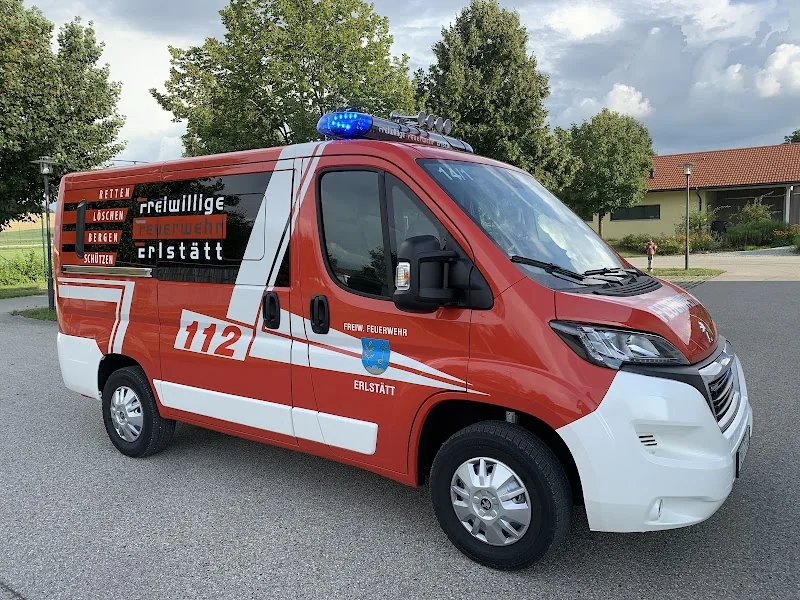
The current vehicle fleet of the Volunteer Fire Department Erlstätt is clearly tailored to the demands of a mixed operational area. The official vehicle page lists an HLF 20, an LF20 KatS, an MZF, and an MTW. The HLF 20 has the radio call sign Florian Erlstätt 40/1, with a crew of 1+8. The LF20 KatS carries the radio call sign Florian Erlstätt 41/1 and also operates with 1+8. The multi-purpose vehicle MZF bears the radio call sign Florian Erlstätt 11/1 and is designed for 1+5, while the personnel transport vehicle MTW can be staffed as Florian Erlstätt 14/1 with 1+8. This listing already shows that the department is well prepared for both fire fighting and technical assistance and personnel transport. ([erlstaett.feuerwehren.bayern](https://erlstaett.feuerwehren.bayern/fahrzeug/))
This technical breadth is important for external perception because it directly answers the search intent behind many terms like vehicles, equipment, or operational readiness. The LF20 KatS with MAN 15.290 chassis and the HLF 20 stand for powerful extinguishing and assistance technology, while the MZF and MTW primarily enable flexibility, transport, and logistical support. The chronicle also shows that vehicle development has continuously progressed: in 2016, the LF20 KatS was handed over, and in 2020, the new personnel transport was added. This demonstrates Erlstätt's typical strength of many well-organized volunteer fire departments in Bavaria: they do not work with a single large device but with a coordinated vehicle mix that is oriented to the demands of the operational area and modernized over the years. This combination of tradition preservation and technical renewal is a central component of the department's profile. ([erlstaett.feuerwehren.bayern](https://erlstaett.feuerwehren.bayern/verein/chronik/))
Operational Area around Erlstätt and the Districts
The operational area of the Volunteer Fire Department Erlstätt encompasses the entire area of the formerly independent municipality of Erlstätt. This includes not only the main town of Erlstätt but also the hamlets of Aberg, Bergen near Erlstätt, Brodeich, Innerlohen, Kaltenbach, Kraimoos, Langenspach, Niederndorf, Tettenmoos, Staudach, and Vocking. This area is complemented by several traffic axes that play an important role in the protection area: the federal highway ST 2095 as well as the district roads TS 3, TS 54, and TS 2 and various municipal connecting roads. For the fire department, this means a very diverse requirement profile, as an operational area with dense residential areas, commercial spaces, and simultaneously difficult topography requires different routines than a purely rural area. This mixture makes Erlstätt both challenging and relevant. ([erlstaett.feuerwehren.bayern](https://erlstaett.feuerwehren.bayern/uber-uns/einsatzgebiet-copy/))
The website explicitly states that there is a large industrial area, dense construction, difficult terrain, and sometimes winding road layouts in the protection area. This leads to operations that require good equipment and solid training. At the same time, the fire department also supports neighboring departments when requested. In the municipality of Grabenstätt, in addition to Erlstätt, there are also the Grabenstätt fire department and the Holzhausen fire department. Additionally, surrounding departments from Chieming, Nußdorf, Wolkersdorf, Traunstein, Haslach, and Vachendorf are involved. For users searching with terms like access, location, operational area, or neighboring departments, this is particularly interesting because the Erlstätt fire department does not operate in isolation but is integrated into a network of municipal assistance. This makes it an important building block of the regional safety structure around Grabenstätt and the Chiemgau. ([erlstaett.feuerwehren.bayern](https://erlstaett.feuerwehren.bayern/uber-uns/einsatzgebiet-copy/))
Chronicle, Tradition, and Club Life since 1871
The chronicle of the Volunteer Fire Department Erlstätt begins on November 16, 1871, with the founding by 34 members. Thus, the department is one of the traditional institutions of the place. As early as 1889, a fire station was built on what is now Hochgernstraße, and in 1900 the flag was consecrated, which is still in service today. In 1935, the first motor pump was added, and in 1938 a portable pump trailer according to the standards of the time. The time after World War II is also documented: in 1949, the re-establishment took place. These dates show how closely the history of the fire department is linked to the technical and social changes of the place. From a hand-organized firefighting community, a modern volunteer fire department with systematic training, growing equipment, and clear structure has developed over the decades. ([erlstaett.feuerwehren.bayern](https://erlstaett.feuerwehren.bayern/verein/chronik/))
The chronicle becomes particularly vivid when considering the sequence of architectural and organizational milestones. In 1978, a new vehicle hall was inaugurated, in 1985 the youth group was founded, and in 1990 the first Erlstätt Wine Festival took place, which has been held annually since then and enjoys great popularity. In 1994, the club flag was restored again, and in 1995 another operational vehicle was put into service. This was followed in 2001 by the move to the new fire station, in 2005 a new LF 16/12, in 2007 the MZF, in 2012 a youth day of the inspection area in Erlstätt, in 2015 a 24-hour professional fire department day, in 2016 the LF20 KatS, and in 2020 the new MTW. This creates a continuous line of tradition, training, and constant renewal. The fire department is thus not only an operational organization but also a bearer of local identity and active club life. ([erlstaett.feuerwehren.bayern](https://erlstaett.feuerwehren.bayern/verein/chronik/))
The historical embedding of the district itself is also remarkable. The fire department's page explains the coat of arms of Erlstätt with early cult sites, a Roman settlement record, and the reference to the very old parish patronage. At the same time, it is pointed out that the name Erlstätt already appears around 788 in an early Salzburg directory, which mentions a church with associated land. For a fire department page, this is unusually profound and shows that not only operations are discussed here but also the history of the place. This historical density is part of why Erlstätt is more than just a mere location name: it is a developed living space where the fire department, village, church, and regional history have shaped each other over centuries. ([erlstaett.feuerwehren.bayern](https://erlstaett.feuerwehren.bayern/uber-uns/ortsteil-erlstatt/))
Youth, Participation, and Contact with the Fire Department Erlstätt
The Volunteer Fire Department Erlstätt clearly shows on its homepage that it is a lively team. Currently, the active department has 59 active members, and the youth group has 7 youths. For a local volunteer fire department, this is a strong sign as it indicates a viable personnel base and simultaneously points to youth work. The website links not only to the team but also to the leaders, the youth, and the club, so visitors can quickly recognize how the organization is structured. Additionally, there is the guiding principle of being available for duty voluntarily around the clock, every day of the year. This claim is not just a marketing slogan but precisely describes the self-understanding of a fire department that is rooted in the village and must function reliably in emergencies. ([erlstaett.feuerwehren.bayern](https://erlstaett.feuerwehren.bayern/))
Those wishing to make contact will find a clear address and direct communication channels on the website: Kaltenbacher Weg 17, 83355 Erlstätt, email info@feuerwehr-erlstaett.de, and phone 0861-1661251. The municipality of Grabenstätt also lists the fire department with contact details and route planning, making it easier for citizens to reach out. Particularly practical is that the department also uses WhatsApp, Facebook, YouTube, and Instagram in addition to the website and email. This allows current information, dates, and developments to be followed very easily. For those interested who not only want to know where the fire department is located but also how they can engage or inform themselves, this is ideal. The combination of digital visibility, personal approachability, and active youth promotion makes the Volunteer Fire Department Erlstätt a modern volunteer organization with a strong local connection and clear future perspective. ([erlstaett.feuerwehren.bayern](https://erlstaett.feuerwehren.bayern/))
Sources:
- Volunteer Fire Department Erlstätt e.V. - Homepage
- Volunteer Fire Department Erlstätt e.V. - Fire Station
- Volunteer Fire Department Erlstätt e.V. - Operational Area
- Volunteer Fire Department Erlstätt e.V. - Vehicles
- Volunteer Fire Department Erlstätt e.V. - Chronicle
- Volunteer Fire Department Erlstätt e.V. - Extension Fire Station
- Volunteer Fire Department Erlstätt e.V. - Deployments / Training Plans 2026
- Municipality of Grabenstätt - Fire Department
- Municipality of Grabenstätt - Coat of Arms
Mehr anzeigenWeniger anzeigen
Volunteer Fire Department Erlstätt | Fire Station & Vehicles
The Volunteer Fire Department Erlstätt e.V. is an integral part of the district of Erlstätt in the municipality of Grabenstätt and combines everyday readiness for action with a strong club life. Those looking for the Erlstätt fire department will find not only a classic aid organization but a vibrant local institution with modern equipment, clear structure, and a long local rooting. The fire station is located at Kaltenbacher Weg 17, the municipality of Grabenstätt lists the department there with contact details and route guidance, and on its own website, current operations, dates, vehicles, annual reports, and social media channels are bundled together. This creates an image of a fire department that is present both in emergencies and in village life and communicates its work transparently to the outside. ([erlstaett.feuerwehren.bayern](https://erlstaett.feuerwehren.bayern/))
Erlstätt itself is historically much older than the current club page suggests. In the representation of the district, the department refers to early historical evidence, the old parish patronage, and traces of a Roman settlement in the area. This connection between tradition and present also shapes the fire department: on the one hand, it stands for modern technology, training, and alerting, on the other hand, for community, volunteer work, and a strong connection to the place. The fact that the fire department's page links not only to operation reports but also to a webcam area, information on HND Bavaria and DWD warning weather, as well as social media, additionally shows how digitally and well accessible the department is today. ([erlstaett.feuerwehren.bayern](https://erlstaett.feuerwehren.bayern/uber-uns/ortsteil-erlstatt/))
Current News, Operation Reports, and Training Plans 2026
Anyone interested in the Volunteer Fire Department Erlstätt will quickly find a well-maintained online presence. There, the current operations for 2026 are as visible as the deployments and training plans for 2026, as well as annual reports from 1998 to 2025. This is remarkable for a local fire department because it not only documents ongoing operations but also keeps the development of the department traceable over many years. For seekers, this is particularly helpful, as terms like operations, program, dates, or training plan lead directly to concrete content instead of just a contact page. The youth group also receives its own role, highlighting the importance of youth work. The combination of operation documentation, annual reports, and dates creates transparency and conveys trust because the work of the volunteers does not remain hidden but is presented in a structured manner. ([erlstaett.feuerwehren.bayern](https://erlstaett.feuerwehren.bayern/))
Particularly current is the extension of the fire station, about which the department informed on March 8, 2026. It is described that important preliminary work has already been done together with many helpers on several Saturdays before the executing construction company could start. Such news is more than just construction site information, as it clearly shows how strongly self-performance and community spirit belong together in Erlstätt. The fire department is not only active in emergencies but also shapes its own infrastructure. Especially for a volunteer fire department, this is a strong signal: the building is being further developed, operational readiness remains secured, and the members contribute with manual work, organization, and time. Therefore, anyone looking for current information about the Erlstätt fire department will find not only operation reports but also real insights into the ongoing development of the location. ([erlstaett.feuerwehren.bayern](https://erlstaett.feuerwehren.bayern/aktuelles/anbau-feuerwehrhaus/))
Fire Station Erlstätt: Construction, Equipment, and Practical Rooms
The fire station of the Volunteer Fire Department Erlstätt was inaugurated in 2001, marking the transition to a modern phase of the department. The chronicle already mentions the groundbreaking in 1999 and the move to the new fire station at Kaltenbacher Weg 17 in 2001. The fire station page describes that the vehicle hall offers three parking spaces for large vehicles, including exhaust extraction. In addition, there are a total of 66 clothing lockers, providing enough space for the personal equipment of the emergency personnel. These numbers alone show that the location is not improvised but functionally planned. For a fire department, this is central because quick response times, clear pathways, and well-organized changing facilities mean valuable time potential in an emergency. The hall is thus not only a storage place but also a logistical control center for everyday operations. ([erlstaett.feuerwehren.bayern](https://erlstaett.feuerwehren.bayern/uber-uns/geratehaus/))
Another important feature is hose maintenance. Here, the department mentions a hose lift from the company Barth, which can accommodate up to 48 hoses on six lanes. At first glance, this may sound like technical detail, but it is enormously important for operational capability because hoses must be cleaned, dried, and stored properly after use. Additionally, there is a training room designed for flexible table arrangements, adequate seating, flip charts, and projectors. Theory evenings and further training for leaders take place there. For inquiries regarding seating plans, equipment, or rooms, this is particularly relevant as it shows: the fire station is not only functional but also a learning and meeting point. The combination of vehicle hall, hose maintenance, and training room makes it clear how versatile the building is used and how well the department is organized. ([erlstaett.feuerwehren.bayern](https://erlstaett.feuerwehren.bayern/uber-uns/geratehaus/))
Vehicles, Alerting, and Technical Equipment
The current vehicle fleet of the Volunteer Fire Department Erlstätt is clearly tailored to the demands of a mixed operational area. The official vehicle page lists an HLF 20, an LF20 KatS, an MZF, and an MTW. The HLF 20 has the radio call sign Florian Erlstätt 40/1, with a crew of 1+8. The LF20 KatS carries the radio call sign Florian Erlstätt 41/1 and also operates with 1+8. The multi-purpose vehicle MZF bears the radio call sign Florian Erlstätt 11/1 and is designed for 1+5, while the personnel transport vehicle MTW can be staffed as Florian Erlstätt 14/1 with 1+8. This listing already shows that the department is well prepared for both fire fighting and technical assistance and personnel transport. ([erlstaett.feuerwehren.bayern](https://erlstaett.feuerwehren.bayern/fahrzeug/))
This technical breadth is important for external perception because it directly answers the search intent behind many terms like vehicles, equipment, or operational readiness. The LF20 KatS with MAN 15.290 chassis and the HLF 20 stand for powerful extinguishing and assistance technology, while the MZF and MTW primarily enable flexibility, transport, and logistical support. The chronicle also shows that vehicle development has continuously progressed: in 2016, the LF20 KatS was handed over, and in 2020, the new personnel transport was added. This demonstrates Erlstätt's typical strength of many well-organized volunteer fire departments in Bavaria: they do not work with a single large device but with a coordinated vehicle mix that is oriented to the demands of the operational area and modernized over the years. This combination of tradition preservation and technical renewal is a central component of the department's profile. ([erlstaett.feuerwehren.bayern](https://erlstaett.feuerwehren.bayern/verein/chronik/))
Operational Area around Erlstätt and the Districts
The operational area of the Volunteer Fire Department Erlstätt encompasses the entire area of the formerly independent municipality of Erlstätt. This includes not only the main town of Erlstätt but also the hamlets of Aberg, Bergen near Erlstätt, Brodeich, Innerlohen, Kaltenbach, Kraimoos, Langenspach, Niederndorf, Tettenmoos, Staudach, and Vocking. This area is complemented by several traffic axes that play an important role in the protection area: the federal highway ST 2095 as well as the district roads TS 3, TS 54, and TS 2 and various municipal connecting roads. For the fire department, this means a very diverse requirement profile, as an operational area with dense residential areas, commercial spaces, and simultaneously difficult topography requires different routines than a purely rural area. This mixture makes Erlstätt both challenging and relevant. ([erlstaett.feuerwehren.bayern](https://erlstaett.feuerwehren.bayern/uber-uns/einsatzgebiet-copy/))
The website explicitly states that there is a large industrial area, dense construction, difficult terrain, and sometimes winding road layouts in the protection area. This leads to operations that require good equipment and solid training. At the same time, the fire department also supports neighboring departments when requested. In the municipality of Grabenstätt, in addition to Erlstätt, there are also the Grabenstätt fire department and the Holzhausen fire department. Additionally, surrounding departments from Chieming, Nußdorf, Wolkersdorf, Traunstein, Haslach, and Vachendorf are involved. For users searching with terms like access, location, operational area, or neighboring departments, this is particularly interesting because the Erlstätt fire department does not operate in isolation but is integrated into a network of municipal assistance. This makes it an important building block of the regional safety structure around Grabenstätt and the Chiemgau. ([erlstaett.feuerwehren.bayern](https://erlstaett.feuerwehren.bayern/uber-uns/einsatzgebiet-copy/))
Chronicle, Tradition, and Club Life since 1871
The chronicle of the Volunteer Fire Department Erlstätt begins on November 16, 1871, with the founding by 34 members. Thus, the department is one of the traditional institutions of the place. As early as 1889, a fire station was built on what is now Hochgernstraße, and in 1900 the flag was consecrated, which is still in service today. In 1935, the first motor pump was added, and in 1938 a portable pump trailer according to the standards of the time. The time after World War II is also documented: in 1949, the re-establishment took place. These dates show how closely the history of the fire department is linked to the technical and social changes of the place. From a hand-organized firefighting community, a modern volunteer fire department with systematic training, growing equipment, and clear structure has developed over the decades. ([erlstaett.feuerwehren.bayern](https://erlstaett.feuerwehren.bayern/verein/chronik/))
The chronicle becomes particularly vivid when considering the sequence of architectural and organizational milestones. In 1978, a new vehicle hall was inaugurated, in 1985 the youth group was founded, and in 1990 the first Erlstätt Wine Festival took place, which has been held annually since then and enjoys great popularity. In 1994, the club flag was restored again, and in 1995 another operational vehicle was put into service. This was followed in 2001 by the move to the new fire station, in 2005 a new LF 16/12, in 2007 the MZF, in 2012 a youth day of the inspection area in Erlstätt, in 2015 a 24-hour professional fire department day, in 2016 the LF20 KatS, and in 2020 the new MTW. This creates a continuous line of tradition, training, and constant renewal. The fire department is thus not only an operational organization but also a bearer of local identity and active club life. ([erlstaett.feuerwehren.bayern](https://erlstaett.feuerwehren.bayern/verein/chronik/))
The historical embedding of the district itself is also remarkable. The fire department's page explains the coat of arms of Erlstätt with early cult sites, a Roman settlement record, and the reference to the very old parish patronage. At the same time, it is pointed out that the name Erlstätt already appears around 788 in an early Salzburg directory, which mentions a church with associated land. For a fire department page, this is unusually profound and shows that not only operations are discussed here but also the history of the place. This historical density is part of why Erlstätt is more than just a mere location name: it is a developed living space where the fire department, village, church, and regional history have shaped each other over centuries. ([erlstaett.feuerwehren.bayern](https://erlstaett.feuerwehren.bayern/uber-uns/ortsteil-erlstatt/))
Youth, Participation, and Contact with the Fire Department Erlstätt
The Volunteer Fire Department Erlstätt clearly shows on its homepage that it is a lively team. Currently, the active department has 59 active members, and the youth group has 7 youths. For a local volunteer fire department, this is a strong sign as it indicates a viable personnel base and simultaneously points to youth work. The website links not only to the team but also to the leaders, the youth, and the club, so visitors can quickly recognize how the organization is structured. Additionally, there is the guiding principle of being available for duty voluntarily around the clock, every day of the year. This claim is not just a marketing slogan but precisely describes the self-understanding of a fire department that is rooted in the village and must function reliably in emergencies. ([erlstaett.feuerwehren.bayern](https://erlstaett.feuerwehren.bayern/))
Those wishing to make contact will find a clear address and direct communication channels on the website: Kaltenbacher Weg 17, 83355 Erlstätt, email info@feuerwehr-erlstaett.de, and phone 0861-1661251. The municipality of Grabenstätt also lists the fire department with contact details and route planning, making it easier for citizens to reach out. Particularly practical is that the department also uses WhatsApp, Facebook, YouTube, and Instagram in addition to the website and email. This allows current information, dates, and developments to be followed very easily. For those interested who not only want to know where the fire department is located but also how they can engage or inform themselves, this is ideal. The combination of digital visibility, personal approachability, and active youth promotion makes the Volunteer Fire Department Erlstätt a modern volunteer organization with a strong local connection and clear future perspective. ([erlstaett.feuerwehren.bayern](https://erlstaett.feuerwehren.bayern/))
Sources:
- Volunteer Fire Department Erlstätt e.V. - Homepage
- Volunteer Fire Department Erlstätt e.V. - Fire Station
- Volunteer Fire Department Erlstätt e.V. - Operational Area
- Volunteer Fire Department Erlstätt e.V. - Vehicles
- Volunteer Fire Department Erlstätt e.V. - Chronicle
- Volunteer Fire Department Erlstätt e.V. - Extension Fire Station
- Volunteer Fire Department Erlstätt e.V. - Deployments / Training Plans 2026
- Municipality of Grabenstätt - Fire Department
- Municipality of Grabenstätt - Coat of Arms
Volunteer Fire Department Erlstätt | Fire Station & Vehicles
The Volunteer Fire Department Erlstätt e.V. is an integral part of the district of Erlstätt in the municipality of Grabenstätt and combines everyday readiness for action with a strong club life. Those looking for the Erlstätt fire department will find not only a classic aid organization but a vibrant local institution with modern equipment, clear structure, and a long local rooting. The fire station is located at Kaltenbacher Weg 17, the municipality of Grabenstätt lists the department there with contact details and route guidance, and on its own website, current operations, dates, vehicles, annual reports, and social media channels are bundled together. This creates an image of a fire department that is present both in emergencies and in village life and communicates its work transparently to the outside. ([erlstaett.feuerwehren.bayern](https://erlstaett.feuerwehren.bayern/))
Erlstätt itself is historically much older than the current club page suggests. In the representation of the district, the department refers to early historical evidence, the old parish patronage, and traces of a Roman settlement in the area. This connection between tradition and present also shapes the fire department: on the one hand, it stands for modern technology, training, and alerting, on the other hand, for community, volunteer work, and a strong connection to the place. The fact that the fire department's page links not only to operation reports but also to a webcam area, information on HND Bavaria and DWD warning weather, as well as social media, additionally shows how digitally and well accessible the department is today. ([erlstaett.feuerwehren.bayern](https://erlstaett.feuerwehren.bayern/uber-uns/ortsteil-erlstatt/))
Current News, Operation Reports, and Training Plans 2026
Anyone interested in the Volunteer Fire Department Erlstätt will quickly find a well-maintained online presence. There, the current operations for 2026 are as visible as the deployments and training plans for 2026, as well as annual reports from 1998 to 2025. This is remarkable for a local fire department because it not only documents ongoing operations but also keeps the development of the department traceable over many years. For seekers, this is particularly helpful, as terms like operations, program, dates, or training plan lead directly to concrete content instead of just a contact page. The youth group also receives its own role, highlighting the importance of youth work. The combination of operation documentation, annual reports, and dates creates transparency and conveys trust because the work of the volunteers does not remain hidden but is presented in a structured manner. ([erlstaett.feuerwehren.bayern](https://erlstaett.feuerwehren.bayern/))
Particularly current is the extension of the fire station, about which the department informed on March 8, 2026. It is described that important preliminary work has already been done together with many helpers on several Saturdays before the executing construction company could start. Such news is more than just construction site information, as it clearly shows how strongly self-performance and community spirit belong together in Erlstätt. The fire department is not only active in emergencies but also shapes its own infrastructure. Especially for a volunteer fire department, this is a strong signal: the building is being further developed, operational readiness remains secured, and the members contribute with manual work, organization, and time. Therefore, anyone looking for current information about the Erlstätt fire department will find not only operation reports but also real insights into the ongoing development of the location. ([erlstaett.feuerwehren.bayern](https://erlstaett.feuerwehren.bayern/aktuelles/anbau-feuerwehrhaus/))
Fire Station Erlstätt: Construction, Equipment, and Practical Rooms
The fire station of the Volunteer Fire Department Erlstätt was inaugurated in 2001, marking the transition to a modern phase of the department. The chronicle already mentions the groundbreaking in 1999 and the move to the new fire station at Kaltenbacher Weg 17 in 2001. The fire station page describes that the vehicle hall offers three parking spaces for large vehicles, including exhaust extraction. In addition, there are a total of 66 clothing lockers, providing enough space for the personal equipment of the emergency personnel. These numbers alone show that the location is not improvised but functionally planned. For a fire department, this is central because quick response times, clear pathways, and well-organized changing facilities mean valuable time potential in an emergency. The hall is thus not only a storage place but also a logistical control center for everyday operations. ([erlstaett.feuerwehren.bayern](https://erlstaett.feuerwehren.bayern/uber-uns/geratehaus/))
Another important feature is hose maintenance. Here, the department mentions a hose lift from the company Barth, which can accommodate up to 48 hoses on six lanes. At first glance, this may sound like technical detail, but it is enormously important for operational capability because hoses must be cleaned, dried, and stored properly after use. Additionally, there is a training room designed for flexible table arrangements, adequate seating, flip charts, and projectors. Theory evenings and further training for leaders take place there. For inquiries regarding seating plans, equipment, or rooms, this is particularly relevant as it shows: the fire station is not only functional but also a learning and meeting point. The combination of vehicle hall, hose maintenance, and training room makes it clear how versatile the building is used and how well the department is organized. ([erlstaett.feuerwehren.bayern](https://erlstaett.feuerwehren.bayern/uber-uns/geratehaus/))
Vehicles, Alerting, and Technical Equipment
The current vehicle fleet of the Volunteer Fire Department Erlstätt is clearly tailored to the demands of a mixed operational area. The official vehicle page lists an HLF 20, an LF20 KatS, an MZF, and an MTW. The HLF 20 has the radio call sign Florian Erlstätt 40/1, with a crew of 1+8. The LF20 KatS carries the radio call sign Florian Erlstätt 41/1 and also operates with 1+8. The multi-purpose vehicle MZF bears the radio call sign Florian Erlstätt 11/1 and is designed for 1+5, while the personnel transport vehicle MTW can be staffed as Florian Erlstätt 14/1 with 1+8. This listing already shows that the department is well prepared for both fire fighting and technical assistance and personnel transport. ([erlstaett.feuerwehren.bayern](https://erlstaett.feuerwehren.bayern/fahrzeug/))
This technical breadth is important for external perception because it directly answers the search intent behind many terms like vehicles, equipment, or operational readiness. The LF20 KatS with MAN 15.290 chassis and the HLF 20 stand for powerful extinguishing and assistance technology, while the MZF and MTW primarily enable flexibility, transport, and logistical support. The chronicle also shows that vehicle development has continuously progressed: in 2016, the LF20 KatS was handed over, and in 2020, the new personnel transport was added. This demonstrates Erlstätt's typical strength of many well-organized volunteer fire departments in Bavaria: they do not work with a single large device but with a coordinated vehicle mix that is oriented to the demands of the operational area and modernized over the years. This combination of tradition preservation and technical renewal is a central component of the department's profile. ([erlstaett.feuerwehren.bayern](https://erlstaett.feuerwehren.bayern/verein/chronik/))
Operational Area around Erlstätt and the Districts
The operational area of the Volunteer Fire Department Erlstätt encompasses the entire area of the formerly independent municipality of Erlstätt. This includes not only the main town of Erlstätt but also the hamlets of Aberg, Bergen near Erlstätt, Brodeich, Innerlohen, Kaltenbach, Kraimoos, Langenspach, Niederndorf, Tettenmoos, Staudach, and Vocking. This area is complemented by several traffic axes that play an important role in the protection area: the federal highway ST 2095 as well as the district roads TS 3, TS 54, and TS 2 and various municipal connecting roads. For the fire department, this means a very diverse requirement profile, as an operational area with dense residential areas, commercial spaces, and simultaneously difficult topography requires different routines than a purely rural area. This mixture makes Erlstätt both challenging and relevant. ([erlstaett.feuerwehren.bayern](https://erlstaett.feuerwehren.bayern/uber-uns/einsatzgebiet-copy/))
The website explicitly states that there is a large industrial area, dense construction, difficult terrain, and sometimes winding road layouts in the protection area. This leads to operations that require good equipment and solid training. At the same time, the fire department also supports neighboring departments when requested. In the municipality of Grabenstätt, in addition to Erlstätt, there are also the Grabenstätt fire department and the Holzhausen fire department. Additionally, surrounding departments from Chieming, Nußdorf, Wolkersdorf, Traunstein, Haslach, and Vachendorf are involved. For users searching with terms like access, location, operational area, or neighboring departments, this is particularly interesting because the Erlstätt fire department does not operate in isolation but is integrated into a network of municipal assistance. This makes it an important building block of the regional safety structure around Grabenstätt and the Chiemgau. ([erlstaett.feuerwehren.bayern](https://erlstaett.feuerwehren.bayern/uber-uns/einsatzgebiet-copy/))
Chronicle, Tradition, and Club Life since 1871
The chronicle of the Volunteer Fire Department Erlstätt begins on November 16, 1871, with the founding by 34 members. Thus, the department is one of the traditional institutions of the place. As early as 1889, a fire station was built on what is now Hochgernstraße, and in 1900 the flag was consecrated, which is still in service today. In 1935, the first motor pump was added, and in 1938 a portable pump trailer according to the standards of the time. The time after World War II is also documented: in 1949, the re-establishment took place. These dates show how closely the history of the fire department is linked to the technical and social changes of the place. From a hand-organized firefighting community, a modern volunteer fire department with systematic training, growing equipment, and clear structure has developed over the decades. ([erlstaett.feuerwehren.bayern](https://erlstaett.feuerwehren.bayern/verein/chronik/))
The chronicle becomes particularly vivid when considering the sequence of architectural and organizational milestones. In 1978, a new vehicle hall was inaugurated, in 1985 the youth group was founded, and in 1990 the first Erlstätt Wine Festival took place, which has been held annually since then and enjoys great popularity. In 1994, the club flag was restored again, and in 1995 another operational vehicle was put into service. This was followed in 2001 by the move to the new fire station, in 2005 a new LF 16/12, in 2007 the MZF, in 2012 a youth day of the inspection area in Erlstätt, in 2015 a 24-hour professional fire department day, in 2016 the LF20 KatS, and in 2020 the new MTW. This creates a continuous line of tradition, training, and constant renewal. The fire department is thus not only an operational organization but also a bearer of local identity and active club life. ([erlstaett.feuerwehren.bayern](https://erlstaett.feuerwehren.bayern/verein/chronik/))
The historical embedding of the district itself is also remarkable. The fire department's page explains the coat of arms of Erlstätt with early cult sites, a Roman settlement record, and the reference to the very old parish patronage. At the same time, it is pointed out that the name Erlstätt already appears around 788 in an early Salzburg directory, which mentions a church with associated land. For a fire department page, this is unusually profound and shows that not only operations are discussed here but also the history of the place. This historical density is part of why Erlstätt is more than just a mere location name: it is a developed living space where the fire department, village, church, and regional history have shaped each other over centuries. ([erlstaett.feuerwehren.bayern](https://erlstaett.feuerwehren.bayern/uber-uns/ortsteil-erlstatt/))
Youth, Participation, and Contact with the Fire Department Erlstätt
The Volunteer Fire Department Erlstätt clearly shows on its homepage that it is a lively team. Currently, the active department has 59 active members, and the youth group has 7 youths. For a local volunteer fire department, this is a strong sign as it indicates a viable personnel base and simultaneously points to youth work. The website links not only to the team but also to the leaders, the youth, and the club, so visitors can quickly recognize how the organization is structured. Additionally, there is the guiding principle of being available for duty voluntarily around the clock, every day of the year. This claim is not just a marketing slogan but precisely describes the self-understanding of a fire department that is rooted in the village and must function reliably in emergencies. ([erlstaett.feuerwehren.bayern](https://erlstaett.feuerwehren.bayern/))
Those wishing to make contact will find a clear address and direct communication channels on the website: Kaltenbacher Weg 17, 83355 Erlstätt, email info@feuerwehr-erlstaett.de, and phone 0861-1661251. The municipality of Grabenstätt also lists the fire department with contact details and route planning, making it easier for citizens to reach out. Particularly practical is that the department also uses WhatsApp, Facebook, YouTube, and Instagram in addition to the website and email. This allows current information, dates, and developments to be followed very easily. For those interested who not only want to know where the fire department is located but also how they can engage or inform themselves, this is ideal. The combination of digital visibility, personal approachability, and active youth promotion makes the Volunteer Fire Department Erlstätt a modern volunteer organization with a strong local connection and clear future perspective. ([erlstaett.feuerwehren.bayern](https://erlstaett.feuerwehren.bayern/))
Sources:
- Volunteer Fire Department Erlstätt e.V. - Homepage
- Volunteer Fire Department Erlstätt e.V. - Fire Station
- Volunteer Fire Department Erlstätt e.V. - Operational Area
- Volunteer Fire Department Erlstätt e.V. - Vehicles
- Volunteer Fire Department Erlstätt e.V. - Chronicle
- Volunteer Fire Department Erlstätt e.V. - Extension Fire Station
- Volunteer Fire Department Erlstätt e.V. - Deployments / Training Plans 2026
- Municipality of Grabenstätt - Fire Department
- Municipality of Grabenstätt - Coat of Arms
Upcoming Events
No events found
Frequently Asked Questions
Reviews
Stefan Nitzinger
18. December 2016