
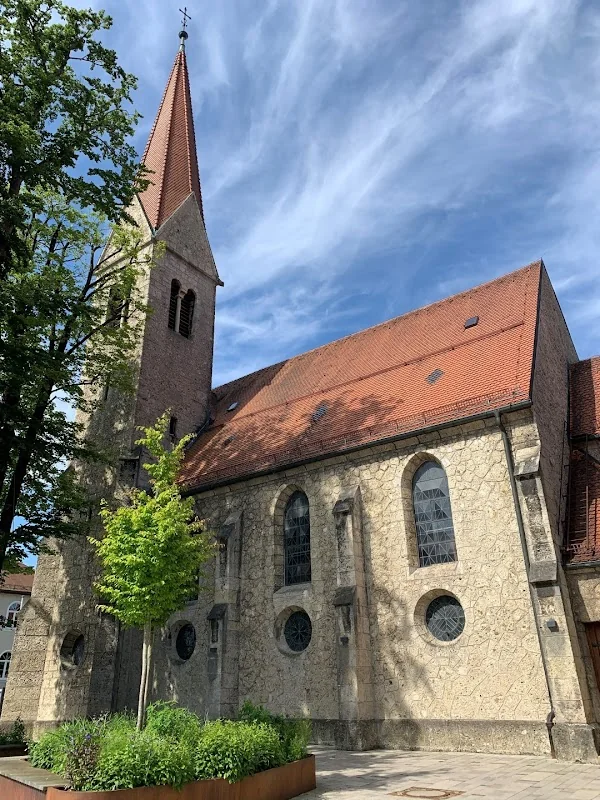
Traunstein
Martin-Luther-Platz 6, 83278 Traunstein, Deutschland
Resurrection Church Traunstein | Photos & Services
The Resurrection Church Traunstein is much more than a distinctive church building at Martin Luther Square: it is a significant piece of city history, a vibrant place of faith, and a house where music, community, and architecture are closely intertwined. Those looking for photos, history, services, or practical information will find here a place with a clear identity and strong recognition value. The church belongs to the Evangelical Lutheran Congregation of Traunstein, which, together with Chieming and Waging, carries an active community life. This makes the Resurrection Church feel less like a silent monument and more like a place where Sunday services, choir rehearsals, family offerings, and special church music formats naturally come together. Its location in the heart of Traunstein makes it easy to find, and its neo-Gothic appearance gives it a distinctive character that is impressively visible from the outside. At the same time, the architectural details, the damage from World War II, the reconstruction phases, and the musical features tell the story of a church that visibly carries its history. This blend of tradition, community, and vibrant use makes the Resurrection Church Traunstein exciting for visitors, interested parties, and congregation members. ([traunstein-evangelisch.de](https://www.traunstein-evangelisch.de/auferstehungskirche-traunstein))
History and Architecture of the Resurrection Church Traunstein
The history of the Resurrection Church begins in the 19th century with the desire for a dedicated Protestant church in Traunstein. After more than ten years of preparation, the church was built between 1897 and 1899 according to the plans of the royal building assessor Alfred Stamm and was solemnly consecrated on August 6, 1899. The city of Traunstein describes the building as neo-Gothic; the congregation adds that Stamm oriented his concept towards late Romanesque and early Gothic forms, thus using a language reminiscent of the period around 1200. This is still palpable for visitors today: the building appears clear, calm, and simultaneously strongly structured. Particularly striking is the relationship between the tower and the nave, which present themselves as two independent structures yet form a unity. This architecture gives the church its special presence in the street space and explains why it is considered an important monument of the cityscape. The materials used also contribute to this: local conglomerate on the outside, Ruhpolding red marble on the inside, along with bricks on the tower and the nave. This results in a building that is regionally rooted and art-historically independent. ([traunstein.de](https://www.traunstein.de/kultur-brauchtum/stadtgeschichte/qr-code-tafeln/auferstehungskirche/))
However, the history of the church is not only a story of construction but also a story of change, loss, and renewal. During the air raid on the train station on April 18, 1945, the church was severely damaged; the roof and windows were destroyed. Despite these setbacks, the Resurrection Church remained a place of community life and was renovated in the 1950s, 1960s, and again in the 1980s. The congregation also describes important details inside: the large colored altar window depicting the Ascension of Christ, which was lost in the war, the newly designed choir window by Heinrich von Kralik from 1952, the painting by Josef Widmann, and the tympanum with the relief of Christ's Ascension by Heinrich Schiestl. In 1961, the church received its current name, Resurrection Church. This development is also important from an SEO perspective, as it shows why search queries related to history, architecture, and photos are so closely linked: those who see the church discover not only a beautiful building but also an ensemble of memory, reconstruction, and spiritual continuity. ([traunstein.de](https://www.traunstein.de/kultur-brauchtum/stadtgeschichte/qr-code-tafeln/auferstehungskirche/))
Services and Community Life at Martin Luther Square
A central search term for the Resurrection Church Traunstein is the service, and for good reason: According to the congregation, services are held every Sunday at 10:00 AM in the Resurrection Church. Thus, the church is not only a historical building but also a regularly used spiritual center. In addition, there are special services throughout the year, such as family services four times a year and children's services on every third Sunday of the month. The congregation consciously describes these offerings as open to young and old, making the church a place where different generations come together. The community newsletter and calendar also show that the church is used for various formats: cantata services, services with special church music, Passion devotions, and festive Sundays are included. Thus, the Resurrection Church is not a static place but a space where the liturgical rhythm of the community becomes visible and audible. This regularity makes it particularly relevant for search queries regarding programs, dates, and Sunday offerings. ([traunstein-evangelisch.de](https://www.traunstein-evangelisch.de/gottesdienste/hauptgottesdienste))
The community life also includes the overarching structure of the Evangelical Lutheran Congregation of Traunstein, which appears on its website as the Congregation of Traunstein - Chieming - Waging. The Resurrection Church is the most important location in Traunstein itself, while other service locations are in Chieming and Waging. For visitors, it is important to note: the church is not only open on Sundays in a spiritual sense but also as a place of church community, where family services, children's offerings, and musical forms have a firm place. Therefore, those looking for photos discover not just a beautiful building but often also a hint of the vibrant use inside. The fact that the congregation consolidates its events on its own website and lists them in the calendar is a plus for user-friendliness and search intent alike. Thus, the Resurrection Church Traunstein becomes a location that combines classic church functions with clearly visible community work. ([traunstein-evangelisch.de](https://www.traunstein-evangelisch.de/))
Church Music, Organ, and Choirs in Traunstein
One of the strongest thematic focuses around the Resurrection Church Traunstein is church music. The congregation makes it clear that musical work here holds a high value: the choir at the Resurrection Church was founded in 1948 and has since been firmly anchored in the community. About 45 singers provide a rich musical offering, and since August 2020, the leadership has been with cantor Matthias Bertelshofer. The choir performs at concerts, services, and also at more experimental formats. Additionally, the gospel choir Rising Spirits presents itself as an open ensemble with over 30 singers and rehearses in the large community hall behind the church. These two groups already demonstrate that the Resurrection Church Traunstein is not merely a Sunday location but a music venue with its own profile. Therefore, terms like church music, choir, and ensemble are closely associated with the church for SEO. Visitors searching for a vibrant evangelical church in Traunstein will find here not only devotion but also a culture of sound. ([traunstein-evangelisch.de](https://www.traunstein-evangelisch.de/kirchenmusik/kantorei?utm_source=openai))
The musical profile is further sharpened by the organ and the acoustic presence of the building. The congregation describes the Rohlf organ as an instrument installed in 1994 with 21 registers on three manuals; in addition, the church received new bronze bells from the company Perner in Passau in 2005. The congregation's presentation also makes it clear that initially other organs were in use after World War II and that the current organ was deliberately ordered as a new instrument. This is particularly interesting for visitors because music here is not just accompaniment but a part of the building and usage history. The church is also regularly used for cantata services and special church music, and the community calendar refers to services with brass choir or other musical elements. Therefore, those looking for a place where faith and music truly belong together will find it at the Resurrection Church Traunstein. For many search queries, this is the decisive added value: not only the architecture but the audible life in the building. ([traunstein-evangelisch.de](https://www.traunstein-evangelisch.de/auferstehungskirche-traunstein))
Photos, Insights, and the Special Interior
Search queries with the addition of photos are particularly appropriate for the Resurrection Church Traunstein, as the church has a strong visual impact. Even the exterior view with the tower, nave, and neo-Gothic design language is striking, but the interior also offers many details that can be well captured in images. The congregation highlights the calm, uniform spatial impression created by the clear color scheme, red marble arcades, ribbed arches, and window frames. Additionally, the sturdy columns made of Ruhpolding red marble support the vaulted space and give the interior dignity and solidity. After the war damage and the renovations in the mid-20th century, the church is now designed in such a way that its architectural basic idea remains clearly visible. For this reason, photos here are not only decorative but explain the quality of the space: those who see the interior immediately recognize that it is a deliberately designed house of worship, not an arbitrary meeting room. The connection between historical substance and renewed design is an important part of the perception of this church. ([traunstein.de](https://www.traunstein.de/auferstehungskirche-traunstein))
On the congregation's website, there is also a dedicated section titled An Insight into the Resurrection Church, which offers a video about the church. This is helpful for visitors and seekers, as it allows for a realistic impression to be gained even before the visit. Especially for a church with a complex history, a strong musical life, and special architectural details, this visual access is valuable. The video section complements the gallery and makes it visible that the church is not only diverse in style but also in its usage. For content planning, this means: the term photos is not isolated here but connects with architecture, interior, organ, choir, and services. Those searching for images usually also want to understand what they see in the pictures. The Resurrection Church Traunstein provides ample material for this: neo-Gothic exterior, colorful light, historical components, modern organ, and a functioning community life. This interplay creates the emotional and visual strength that an SEO page for this location should have. ([traunstein.de](https://www.traunstein.de/ein-einblick-die-auferstehungskirche?utm_source=openai))
Directions, Address, and Parking around the Church
For practical searches for the Resurrection Church Traunstein, the address and accessibility are central. The church itself is located at Martin Luther Square 6 in 83278 Traunstein; the Protestant parish office Traunstein is at Martin Luther Square 2, and the large community hall is directly behind the church at Martin Luther Square 4. This spatial proximity is practical because services, administration, and community work are concentrated in a clearly recognizable environment. The city location makes the church easy to find, and it is also part of a historical and urban environment in the center of Traunstein. Those arriving by car should be aware of the parking situation in the city center. The city of Traunstein informs that public parking spaces are regulated differently, and mentions the P2 center at Karl-Theodor Square with 310 parking spaces for the center. Also relevant is the train station parking tunnel with 170 parking spaces. Thus, visitors have several realistic options when planning a service, choir rehearsal, or visit. ([ev-dekanat-traunstein.de](https://www.ev-dekanat-traunstein.de/traunstein))
The municipal parking rules are also helpful for visitors. In Traunstein, vehicles with an electric license plate can park for free for up to three hours in public parking spaces, while a maximum parking duration of two hours generally applies in the city center, and 30 minutes at the train station. The city also emphasizes that this exemption does not apply to underground garages or parking garages and that the designated maximum parking duration must be observed in the city center. This is particularly relevant for visiting the Resurrection Church because the church is located in the urban fabric, and it is therefore better to plan with the city center rules than with isolated parking searches. Those who want to arrive completely relaxed should allow enough time for parking searches and keep an eye on the city center options. For SEO, directions and parking are therefore important accompanying terms, even if the actual reason for the visit is often the service or historical fascination. The Resurrection Church Traunstein benefits from its central location, which appears both urban and ecclesiastical. ([traunstein.de](https://www.traunstein.de/tourismus-freizeit/einkaufen-shopping/parken-in-traunstein/))
Community Hall, Events, and Practical Visitor Information
Another important aspect of the Resurrection Church Traunstein is its multiple use as a church and event venue. The large hall behind the Resurrection Church at Martin Luther Square 4 is used for choir rehearsals, group offerings, children's events, and community appointments. The choir rehearses there on Tuesdays from 7:30 PM to 9:30 PM, and the gospel choir also regularly uses the large community hall. Additionally, the community calendar features appointments for movie nights, discussion groups, church council meetings, and other formats. This shows that the location stands not only for Sunday services but for a wide range of church and community activities. Therefore, those looking for a vibrant evangelical institution will find here a house with a clear structure: church in front, community life behind, administration nearby. This spatial and functional connection is particularly valuable for an SEO page because it directly links search queries for community hall, events, program, and choirs with the location. ([traunstein-evangelisch.de](https://www.traunstein-evangelisch.de/kirchenmusik/kantorei?utm_source=openai))
It is also interesting for visitors that the church is located in a culturally rich environment. Traunstein itself refers in its city information to tours, sights, and a clear urban context in which the Resurrection Church appears as a station and focal point. The church thus belongs both to the evangelical community landscape and to the cityscape of Traunstein. Those who visit it experience not only a spiritual place but also a piece of city history with a still palpable presence today. This makes the Resurrection Church interesting for many different target groups: for congregation members, for music lovers, for architecture enthusiasts, and for people looking for photos and background information. The combination of regular services, musical activity, historical substance, and good location is exactly what makes this location so strong in search. And precisely because the church stands openly in the urban fabric, it can not only be quickly found but also well combined with a walk through Traunstein. ([traunstein.de](https://www.traunstein.de/tourismus-freizeit/traunsteiner-stadtfuehrungen/stadtfuehrung/?utm_source=openai))
Sources:
- Congregation Traunstein – Resurrection Church Traunstein ([traunstein-evangelisch.de](https://www.traunstein-evangelisch.de/auferstehungskirche-traunstein))
- Large District City Traunstein – Resurrection Church ([traunstein.de](https://www.traunstein.de/kultur-brauchtum/stadtgeschichte/qr-code-tafeln/auferstehungskirche/))
- Congregation Traunstein – Main Services and Community Life ([traunstein-evangelisch.de](https://www.traunstein-evangelisch.de/gottesdienste/hauptgottesdienste))
- Congregation Traunstein – Church Music, Choir, and Gospel Choir ([traunstein-evangelisch.de](https://www.traunstein-evangelisch.de/kirchenmusik/kantorei?utm_source=openai))
- Large District City Traunstein – Parking in Traunstein ([traunstein.de](https://www.traunstein.de/tourismus-freizeit/einkaufen-shopping/parken-in-traunstein/))
- DB Bahnhof.de – Parking spaces in Traunstein ([bahnhof.de](https://www.bahnhof.de/en/traunstein/parking-spaces))
Mehr anzeigenWeniger anzeigen
Resurrection Church Traunstein | Photos & Services
The Resurrection Church Traunstein is much more than a distinctive church building at Martin Luther Square: it is a significant piece of city history, a vibrant place of faith, and a house where music, community, and architecture are closely intertwined. Those looking for photos, history, services, or practical information will find here a place with a clear identity and strong recognition value. The church belongs to the Evangelical Lutheran Congregation of Traunstein, which, together with Chieming and Waging, carries an active community life. This makes the Resurrection Church feel less like a silent monument and more like a place where Sunday services, choir rehearsals, family offerings, and special church music formats naturally come together. Its location in the heart of Traunstein makes it easy to find, and its neo-Gothic appearance gives it a distinctive character that is impressively visible from the outside. At the same time, the architectural details, the damage from World War II, the reconstruction phases, and the musical features tell the story of a church that visibly carries its history. This blend of tradition, community, and vibrant use makes the Resurrection Church Traunstein exciting for visitors, interested parties, and congregation members. ([traunstein-evangelisch.de](https://www.traunstein-evangelisch.de/auferstehungskirche-traunstein))
History and Architecture of the Resurrection Church Traunstein
The history of the Resurrection Church begins in the 19th century with the desire for a dedicated Protestant church in Traunstein. After more than ten years of preparation, the church was built between 1897 and 1899 according to the plans of the royal building assessor Alfred Stamm and was solemnly consecrated on August 6, 1899. The city of Traunstein describes the building as neo-Gothic; the congregation adds that Stamm oriented his concept towards late Romanesque and early Gothic forms, thus using a language reminiscent of the period around 1200. This is still palpable for visitors today: the building appears clear, calm, and simultaneously strongly structured. Particularly striking is the relationship between the tower and the nave, which present themselves as two independent structures yet form a unity. This architecture gives the church its special presence in the street space and explains why it is considered an important monument of the cityscape. The materials used also contribute to this: local conglomerate on the outside, Ruhpolding red marble on the inside, along with bricks on the tower and the nave. This results in a building that is regionally rooted and art-historically independent. ([traunstein.de](https://www.traunstein.de/kultur-brauchtum/stadtgeschichte/qr-code-tafeln/auferstehungskirche/))
However, the history of the church is not only a story of construction but also a story of change, loss, and renewal. During the air raid on the train station on April 18, 1945, the church was severely damaged; the roof and windows were destroyed. Despite these setbacks, the Resurrection Church remained a place of community life and was renovated in the 1950s, 1960s, and again in the 1980s. The congregation also describes important details inside: the large colored altar window depicting the Ascension of Christ, which was lost in the war, the newly designed choir window by Heinrich von Kralik from 1952, the painting by Josef Widmann, and the tympanum with the relief of Christ's Ascension by Heinrich Schiestl. In 1961, the church received its current name, Resurrection Church. This development is also important from an SEO perspective, as it shows why search queries related to history, architecture, and photos are so closely linked: those who see the church discover not only a beautiful building but also an ensemble of memory, reconstruction, and spiritual continuity. ([traunstein.de](https://www.traunstein.de/kultur-brauchtum/stadtgeschichte/qr-code-tafeln/auferstehungskirche/))
Services and Community Life at Martin Luther Square
A central search term for the Resurrection Church Traunstein is the service, and for good reason: According to the congregation, services are held every Sunday at 10:00 AM in the Resurrection Church. Thus, the church is not only a historical building but also a regularly used spiritual center. In addition, there are special services throughout the year, such as family services four times a year and children's services on every third Sunday of the month. The congregation consciously describes these offerings as open to young and old, making the church a place where different generations come together. The community newsletter and calendar also show that the church is used for various formats: cantata services, services with special church music, Passion devotions, and festive Sundays are included. Thus, the Resurrection Church is not a static place but a space where the liturgical rhythm of the community becomes visible and audible. This regularity makes it particularly relevant for search queries regarding programs, dates, and Sunday offerings. ([traunstein-evangelisch.de](https://www.traunstein-evangelisch.de/gottesdienste/hauptgottesdienste))
The community life also includes the overarching structure of the Evangelical Lutheran Congregation of Traunstein, which appears on its website as the Congregation of Traunstein - Chieming - Waging. The Resurrection Church is the most important location in Traunstein itself, while other service locations are in Chieming and Waging. For visitors, it is important to note: the church is not only open on Sundays in a spiritual sense but also as a place of church community, where family services, children's offerings, and musical forms have a firm place. Therefore, those looking for photos discover not just a beautiful building but often also a hint of the vibrant use inside. The fact that the congregation consolidates its events on its own website and lists them in the calendar is a plus for user-friendliness and search intent alike. Thus, the Resurrection Church Traunstein becomes a location that combines classic church functions with clearly visible community work. ([traunstein-evangelisch.de](https://www.traunstein-evangelisch.de/))
Church Music, Organ, and Choirs in Traunstein
One of the strongest thematic focuses around the Resurrection Church Traunstein is church music. The congregation makes it clear that musical work here holds a high value: the choir at the Resurrection Church was founded in 1948 and has since been firmly anchored in the community. About 45 singers provide a rich musical offering, and since August 2020, the leadership has been with cantor Matthias Bertelshofer. The choir performs at concerts, services, and also at more experimental formats. Additionally, the gospel choir Rising Spirits presents itself as an open ensemble with over 30 singers and rehearses in the large community hall behind the church. These two groups already demonstrate that the Resurrection Church Traunstein is not merely a Sunday location but a music venue with its own profile. Therefore, terms like church music, choir, and ensemble are closely associated with the church for SEO. Visitors searching for a vibrant evangelical church in Traunstein will find here not only devotion but also a culture of sound. ([traunstein-evangelisch.de](https://www.traunstein-evangelisch.de/kirchenmusik/kantorei?utm_source=openai))
The musical profile is further sharpened by the organ and the acoustic presence of the building. The congregation describes the Rohlf organ as an instrument installed in 1994 with 21 registers on three manuals; in addition, the church received new bronze bells from the company Perner in Passau in 2005. The congregation's presentation also makes it clear that initially other organs were in use after World War II and that the current organ was deliberately ordered as a new instrument. This is particularly interesting for visitors because music here is not just accompaniment but a part of the building and usage history. The church is also regularly used for cantata services and special church music, and the community calendar refers to services with brass choir or other musical elements. Therefore, those looking for a place where faith and music truly belong together will find it at the Resurrection Church Traunstein. For many search queries, this is the decisive added value: not only the architecture but the audible life in the building. ([traunstein-evangelisch.de](https://www.traunstein-evangelisch.de/auferstehungskirche-traunstein))
Photos, Insights, and the Special Interior
Search queries with the addition of photos are particularly appropriate for the Resurrection Church Traunstein, as the church has a strong visual impact. Even the exterior view with the tower, nave, and neo-Gothic design language is striking, but the interior also offers many details that can be well captured in images. The congregation highlights the calm, uniform spatial impression created by the clear color scheme, red marble arcades, ribbed arches, and window frames. Additionally, the sturdy columns made of Ruhpolding red marble support the vaulted space and give the interior dignity and solidity. After the war damage and the renovations in the mid-20th century, the church is now designed in such a way that its architectural basic idea remains clearly visible. For this reason, photos here are not only decorative but explain the quality of the space: those who see the interior immediately recognize that it is a deliberately designed house of worship, not an arbitrary meeting room. The connection between historical substance and renewed design is an important part of the perception of this church. ([traunstein.de](https://www.traunstein.de/auferstehungskirche-traunstein))
On the congregation's website, there is also a dedicated section titled An Insight into the Resurrection Church, which offers a video about the church. This is helpful for visitors and seekers, as it allows for a realistic impression to be gained even before the visit. Especially for a church with a complex history, a strong musical life, and special architectural details, this visual access is valuable. The video section complements the gallery and makes it visible that the church is not only diverse in style but also in its usage. For content planning, this means: the term photos is not isolated here but connects with architecture, interior, organ, choir, and services. Those searching for images usually also want to understand what they see in the pictures. The Resurrection Church Traunstein provides ample material for this: neo-Gothic exterior, colorful light, historical components, modern organ, and a functioning community life. This interplay creates the emotional and visual strength that an SEO page for this location should have. ([traunstein.de](https://www.traunstein.de/ein-einblick-die-auferstehungskirche?utm_source=openai))
Directions, Address, and Parking around the Church
For practical searches for the Resurrection Church Traunstein, the address and accessibility are central. The church itself is located at Martin Luther Square 6 in 83278 Traunstein; the Protestant parish office Traunstein is at Martin Luther Square 2, and the large community hall is directly behind the church at Martin Luther Square 4. This spatial proximity is practical because services, administration, and community work are concentrated in a clearly recognizable environment. The city location makes the church easy to find, and it is also part of a historical and urban environment in the center of Traunstein. Those arriving by car should be aware of the parking situation in the city center. The city of Traunstein informs that public parking spaces are regulated differently, and mentions the P2 center at Karl-Theodor Square with 310 parking spaces for the center. Also relevant is the train station parking tunnel with 170 parking spaces. Thus, visitors have several realistic options when planning a service, choir rehearsal, or visit. ([ev-dekanat-traunstein.de](https://www.ev-dekanat-traunstein.de/traunstein))
The municipal parking rules are also helpful for visitors. In Traunstein, vehicles with an electric license plate can park for free for up to three hours in public parking spaces, while a maximum parking duration of two hours generally applies in the city center, and 30 minutes at the train station. The city also emphasizes that this exemption does not apply to underground garages or parking garages and that the designated maximum parking duration must be observed in the city center. This is particularly relevant for visiting the Resurrection Church because the church is located in the urban fabric, and it is therefore better to plan with the city center rules than with isolated parking searches. Those who want to arrive completely relaxed should allow enough time for parking searches and keep an eye on the city center options. For SEO, directions and parking are therefore important accompanying terms, even if the actual reason for the visit is often the service or historical fascination. The Resurrection Church Traunstein benefits from its central location, which appears both urban and ecclesiastical. ([traunstein.de](https://www.traunstein.de/tourismus-freizeit/einkaufen-shopping/parken-in-traunstein/))
Community Hall, Events, and Practical Visitor Information
Another important aspect of the Resurrection Church Traunstein is its multiple use as a church and event venue. The large hall behind the Resurrection Church at Martin Luther Square 4 is used for choir rehearsals, group offerings, children's events, and community appointments. The choir rehearses there on Tuesdays from 7:30 PM to 9:30 PM, and the gospel choir also regularly uses the large community hall. Additionally, the community calendar features appointments for movie nights, discussion groups, church council meetings, and other formats. This shows that the location stands not only for Sunday services but for a wide range of church and community activities. Therefore, those looking for a vibrant evangelical institution will find here a house with a clear structure: church in front, community life behind, administration nearby. This spatial and functional connection is particularly valuable for an SEO page because it directly links search queries for community hall, events, program, and choirs with the location. ([traunstein-evangelisch.de](https://www.traunstein-evangelisch.de/kirchenmusik/kantorei?utm_source=openai))
It is also interesting for visitors that the church is located in a culturally rich environment. Traunstein itself refers in its city information to tours, sights, and a clear urban context in which the Resurrection Church appears as a station and focal point. The church thus belongs both to the evangelical community landscape and to the cityscape of Traunstein. Those who visit it experience not only a spiritual place but also a piece of city history with a still palpable presence today. This makes the Resurrection Church interesting for many different target groups: for congregation members, for music lovers, for architecture enthusiasts, and for people looking for photos and background information. The combination of regular services, musical activity, historical substance, and good location is exactly what makes this location so strong in search. And precisely because the church stands openly in the urban fabric, it can not only be quickly found but also well combined with a walk through Traunstein. ([traunstein.de](https://www.traunstein.de/tourismus-freizeit/traunsteiner-stadtfuehrungen/stadtfuehrung/?utm_source=openai))
Sources:
- Congregation Traunstein – Resurrection Church Traunstein ([traunstein-evangelisch.de](https://www.traunstein-evangelisch.de/auferstehungskirche-traunstein))
- Large District City Traunstein – Resurrection Church ([traunstein.de](https://www.traunstein.de/kultur-brauchtum/stadtgeschichte/qr-code-tafeln/auferstehungskirche/))
- Congregation Traunstein – Main Services and Community Life ([traunstein-evangelisch.de](https://www.traunstein-evangelisch.de/gottesdienste/hauptgottesdienste))
- Congregation Traunstein – Church Music, Choir, and Gospel Choir ([traunstein-evangelisch.de](https://www.traunstein-evangelisch.de/kirchenmusik/kantorei?utm_source=openai))
- Large District City Traunstein – Parking in Traunstein ([traunstein.de](https://www.traunstein.de/tourismus-freizeit/einkaufen-shopping/parken-in-traunstein/))
- DB Bahnhof.de – Parking spaces in Traunstein ([bahnhof.de](https://www.bahnhof.de/en/traunstein/parking-spaces))
Resurrection Church Traunstein | Photos & Services
The Resurrection Church Traunstein is much more than a distinctive church building at Martin Luther Square: it is a significant piece of city history, a vibrant place of faith, and a house where music, community, and architecture are closely intertwined. Those looking for photos, history, services, or practical information will find here a place with a clear identity and strong recognition value. The church belongs to the Evangelical Lutheran Congregation of Traunstein, which, together with Chieming and Waging, carries an active community life. This makes the Resurrection Church feel less like a silent monument and more like a place where Sunday services, choir rehearsals, family offerings, and special church music formats naturally come together. Its location in the heart of Traunstein makes it easy to find, and its neo-Gothic appearance gives it a distinctive character that is impressively visible from the outside. At the same time, the architectural details, the damage from World War II, the reconstruction phases, and the musical features tell the story of a church that visibly carries its history. This blend of tradition, community, and vibrant use makes the Resurrection Church Traunstein exciting for visitors, interested parties, and congregation members. ([traunstein-evangelisch.de](https://www.traunstein-evangelisch.de/auferstehungskirche-traunstein))
History and Architecture of the Resurrection Church Traunstein
The history of the Resurrection Church begins in the 19th century with the desire for a dedicated Protestant church in Traunstein. After more than ten years of preparation, the church was built between 1897 and 1899 according to the plans of the royal building assessor Alfred Stamm and was solemnly consecrated on August 6, 1899. The city of Traunstein describes the building as neo-Gothic; the congregation adds that Stamm oriented his concept towards late Romanesque and early Gothic forms, thus using a language reminiscent of the period around 1200. This is still palpable for visitors today: the building appears clear, calm, and simultaneously strongly structured. Particularly striking is the relationship between the tower and the nave, which present themselves as two independent structures yet form a unity. This architecture gives the church its special presence in the street space and explains why it is considered an important monument of the cityscape. The materials used also contribute to this: local conglomerate on the outside, Ruhpolding red marble on the inside, along with bricks on the tower and the nave. This results in a building that is regionally rooted and art-historically independent. ([traunstein.de](https://www.traunstein.de/kultur-brauchtum/stadtgeschichte/qr-code-tafeln/auferstehungskirche/))
However, the history of the church is not only a story of construction but also a story of change, loss, and renewal. During the air raid on the train station on April 18, 1945, the church was severely damaged; the roof and windows were destroyed. Despite these setbacks, the Resurrection Church remained a place of community life and was renovated in the 1950s, 1960s, and again in the 1980s. The congregation also describes important details inside: the large colored altar window depicting the Ascension of Christ, which was lost in the war, the newly designed choir window by Heinrich von Kralik from 1952, the painting by Josef Widmann, and the tympanum with the relief of Christ's Ascension by Heinrich Schiestl. In 1961, the church received its current name, Resurrection Church. This development is also important from an SEO perspective, as it shows why search queries related to history, architecture, and photos are so closely linked: those who see the church discover not only a beautiful building but also an ensemble of memory, reconstruction, and spiritual continuity. ([traunstein.de](https://www.traunstein.de/kultur-brauchtum/stadtgeschichte/qr-code-tafeln/auferstehungskirche/))
Services and Community Life at Martin Luther Square
A central search term for the Resurrection Church Traunstein is the service, and for good reason: According to the congregation, services are held every Sunday at 10:00 AM in the Resurrection Church. Thus, the church is not only a historical building but also a regularly used spiritual center. In addition, there are special services throughout the year, such as family services four times a year and children's services on every third Sunday of the month. The congregation consciously describes these offerings as open to young and old, making the church a place where different generations come together. The community newsletter and calendar also show that the church is used for various formats: cantata services, services with special church music, Passion devotions, and festive Sundays are included. Thus, the Resurrection Church is not a static place but a space where the liturgical rhythm of the community becomes visible and audible. This regularity makes it particularly relevant for search queries regarding programs, dates, and Sunday offerings. ([traunstein-evangelisch.de](https://www.traunstein-evangelisch.de/gottesdienste/hauptgottesdienste))
The community life also includes the overarching structure of the Evangelical Lutheran Congregation of Traunstein, which appears on its website as the Congregation of Traunstein - Chieming - Waging. The Resurrection Church is the most important location in Traunstein itself, while other service locations are in Chieming and Waging. For visitors, it is important to note: the church is not only open on Sundays in a spiritual sense but also as a place of church community, where family services, children's offerings, and musical forms have a firm place. Therefore, those looking for photos discover not just a beautiful building but often also a hint of the vibrant use inside. The fact that the congregation consolidates its events on its own website and lists them in the calendar is a plus for user-friendliness and search intent alike. Thus, the Resurrection Church Traunstein becomes a location that combines classic church functions with clearly visible community work. ([traunstein-evangelisch.de](https://www.traunstein-evangelisch.de/))
Church Music, Organ, and Choirs in Traunstein
One of the strongest thematic focuses around the Resurrection Church Traunstein is church music. The congregation makes it clear that musical work here holds a high value: the choir at the Resurrection Church was founded in 1948 and has since been firmly anchored in the community. About 45 singers provide a rich musical offering, and since August 2020, the leadership has been with cantor Matthias Bertelshofer. The choir performs at concerts, services, and also at more experimental formats. Additionally, the gospel choir Rising Spirits presents itself as an open ensemble with over 30 singers and rehearses in the large community hall behind the church. These two groups already demonstrate that the Resurrection Church Traunstein is not merely a Sunday location but a music venue with its own profile. Therefore, terms like church music, choir, and ensemble are closely associated with the church for SEO. Visitors searching for a vibrant evangelical church in Traunstein will find here not only devotion but also a culture of sound. ([traunstein-evangelisch.de](https://www.traunstein-evangelisch.de/kirchenmusik/kantorei?utm_source=openai))
The musical profile is further sharpened by the organ and the acoustic presence of the building. The congregation describes the Rohlf organ as an instrument installed in 1994 with 21 registers on three manuals; in addition, the church received new bronze bells from the company Perner in Passau in 2005. The congregation's presentation also makes it clear that initially other organs were in use after World War II and that the current organ was deliberately ordered as a new instrument. This is particularly interesting for visitors because music here is not just accompaniment but a part of the building and usage history. The church is also regularly used for cantata services and special church music, and the community calendar refers to services with brass choir or other musical elements. Therefore, those looking for a place where faith and music truly belong together will find it at the Resurrection Church Traunstein. For many search queries, this is the decisive added value: not only the architecture but the audible life in the building. ([traunstein-evangelisch.de](https://www.traunstein-evangelisch.de/auferstehungskirche-traunstein))
Photos, Insights, and the Special Interior
Search queries with the addition of photos are particularly appropriate for the Resurrection Church Traunstein, as the church has a strong visual impact. Even the exterior view with the tower, nave, and neo-Gothic design language is striking, but the interior also offers many details that can be well captured in images. The congregation highlights the calm, uniform spatial impression created by the clear color scheme, red marble arcades, ribbed arches, and window frames. Additionally, the sturdy columns made of Ruhpolding red marble support the vaulted space and give the interior dignity and solidity. After the war damage and the renovations in the mid-20th century, the church is now designed in such a way that its architectural basic idea remains clearly visible. For this reason, photos here are not only decorative but explain the quality of the space: those who see the interior immediately recognize that it is a deliberately designed house of worship, not an arbitrary meeting room. The connection between historical substance and renewed design is an important part of the perception of this church. ([traunstein.de](https://www.traunstein.de/auferstehungskirche-traunstein))
On the congregation's website, there is also a dedicated section titled An Insight into the Resurrection Church, which offers a video about the church. This is helpful for visitors and seekers, as it allows for a realistic impression to be gained even before the visit. Especially for a church with a complex history, a strong musical life, and special architectural details, this visual access is valuable. The video section complements the gallery and makes it visible that the church is not only diverse in style but also in its usage. For content planning, this means: the term photos is not isolated here but connects with architecture, interior, organ, choir, and services. Those searching for images usually also want to understand what they see in the pictures. The Resurrection Church Traunstein provides ample material for this: neo-Gothic exterior, colorful light, historical components, modern organ, and a functioning community life. This interplay creates the emotional and visual strength that an SEO page for this location should have. ([traunstein.de](https://www.traunstein.de/ein-einblick-die-auferstehungskirche?utm_source=openai))
Directions, Address, and Parking around the Church
For practical searches for the Resurrection Church Traunstein, the address and accessibility are central. The church itself is located at Martin Luther Square 6 in 83278 Traunstein; the Protestant parish office Traunstein is at Martin Luther Square 2, and the large community hall is directly behind the church at Martin Luther Square 4. This spatial proximity is practical because services, administration, and community work are concentrated in a clearly recognizable environment. The city location makes the church easy to find, and it is also part of a historical and urban environment in the center of Traunstein. Those arriving by car should be aware of the parking situation in the city center. The city of Traunstein informs that public parking spaces are regulated differently, and mentions the P2 center at Karl-Theodor Square with 310 parking spaces for the center. Also relevant is the train station parking tunnel with 170 parking spaces. Thus, visitors have several realistic options when planning a service, choir rehearsal, or visit. ([ev-dekanat-traunstein.de](https://www.ev-dekanat-traunstein.de/traunstein))
The municipal parking rules are also helpful for visitors. In Traunstein, vehicles with an electric license plate can park for free for up to three hours in public parking spaces, while a maximum parking duration of two hours generally applies in the city center, and 30 minutes at the train station. The city also emphasizes that this exemption does not apply to underground garages or parking garages and that the designated maximum parking duration must be observed in the city center. This is particularly relevant for visiting the Resurrection Church because the church is located in the urban fabric, and it is therefore better to plan with the city center rules than with isolated parking searches. Those who want to arrive completely relaxed should allow enough time for parking searches and keep an eye on the city center options. For SEO, directions and parking are therefore important accompanying terms, even if the actual reason for the visit is often the service or historical fascination. The Resurrection Church Traunstein benefits from its central location, which appears both urban and ecclesiastical. ([traunstein.de](https://www.traunstein.de/tourismus-freizeit/einkaufen-shopping/parken-in-traunstein/))
Community Hall, Events, and Practical Visitor Information
Another important aspect of the Resurrection Church Traunstein is its multiple use as a church and event venue. The large hall behind the Resurrection Church at Martin Luther Square 4 is used for choir rehearsals, group offerings, children's events, and community appointments. The choir rehearses there on Tuesdays from 7:30 PM to 9:30 PM, and the gospel choir also regularly uses the large community hall. Additionally, the community calendar features appointments for movie nights, discussion groups, church council meetings, and other formats. This shows that the location stands not only for Sunday services but for a wide range of church and community activities. Therefore, those looking for a vibrant evangelical institution will find here a house with a clear structure: church in front, community life behind, administration nearby. This spatial and functional connection is particularly valuable for an SEO page because it directly links search queries for community hall, events, program, and choirs with the location. ([traunstein-evangelisch.de](https://www.traunstein-evangelisch.de/kirchenmusik/kantorei?utm_source=openai))
It is also interesting for visitors that the church is located in a culturally rich environment. Traunstein itself refers in its city information to tours, sights, and a clear urban context in which the Resurrection Church appears as a station and focal point. The church thus belongs both to the evangelical community landscape and to the cityscape of Traunstein. Those who visit it experience not only a spiritual place but also a piece of city history with a still palpable presence today. This makes the Resurrection Church interesting for many different target groups: for congregation members, for music lovers, for architecture enthusiasts, and for people looking for photos and background information. The combination of regular services, musical activity, historical substance, and good location is exactly what makes this location so strong in search. And precisely because the church stands openly in the urban fabric, it can not only be quickly found but also well combined with a walk through Traunstein. ([traunstein.de](https://www.traunstein.de/tourismus-freizeit/traunsteiner-stadtfuehrungen/stadtfuehrung/?utm_source=openai))
Sources:
- Congregation Traunstein – Resurrection Church Traunstein ([traunstein-evangelisch.de](https://www.traunstein-evangelisch.de/auferstehungskirche-traunstein))
- Large District City Traunstein – Resurrection Church ([traunstein.de](https://www.traunstein.de/kultur-brauchtum/stadtgeschichte/qr-code-tafeln/auferstehungskirche/))
- Congregation Traunstein – Main Services and Community Life ([traunstein-evangelisch.de](https://www.traunstein-evangelisch.de/gottesdienste/hauptgottesdienste))
- Congregation Traunstein – Church Music, Choir, and Gospel Choir ([traunstein-evangelisch.de](https://www.traunstein-evangelisch.de/kirchenmusik/kantorei?utm_source=openai))
- Large District City Traunstein – Parking in Traunstein ([traunstein.de](https://www.traunstein.de/tourismus-freizeit/einkaufen-shopping/parken-in-traunstein/))
- DB Bahnhof.de – Parking spaces in Traunstein ([bahnhof.de](https://www.bahnhof.de/en/traunstein/parking-spaces))
Upcoming Events
No events found
Frequently Asked Questions
Reviews
No reviews found