
Streichquartett
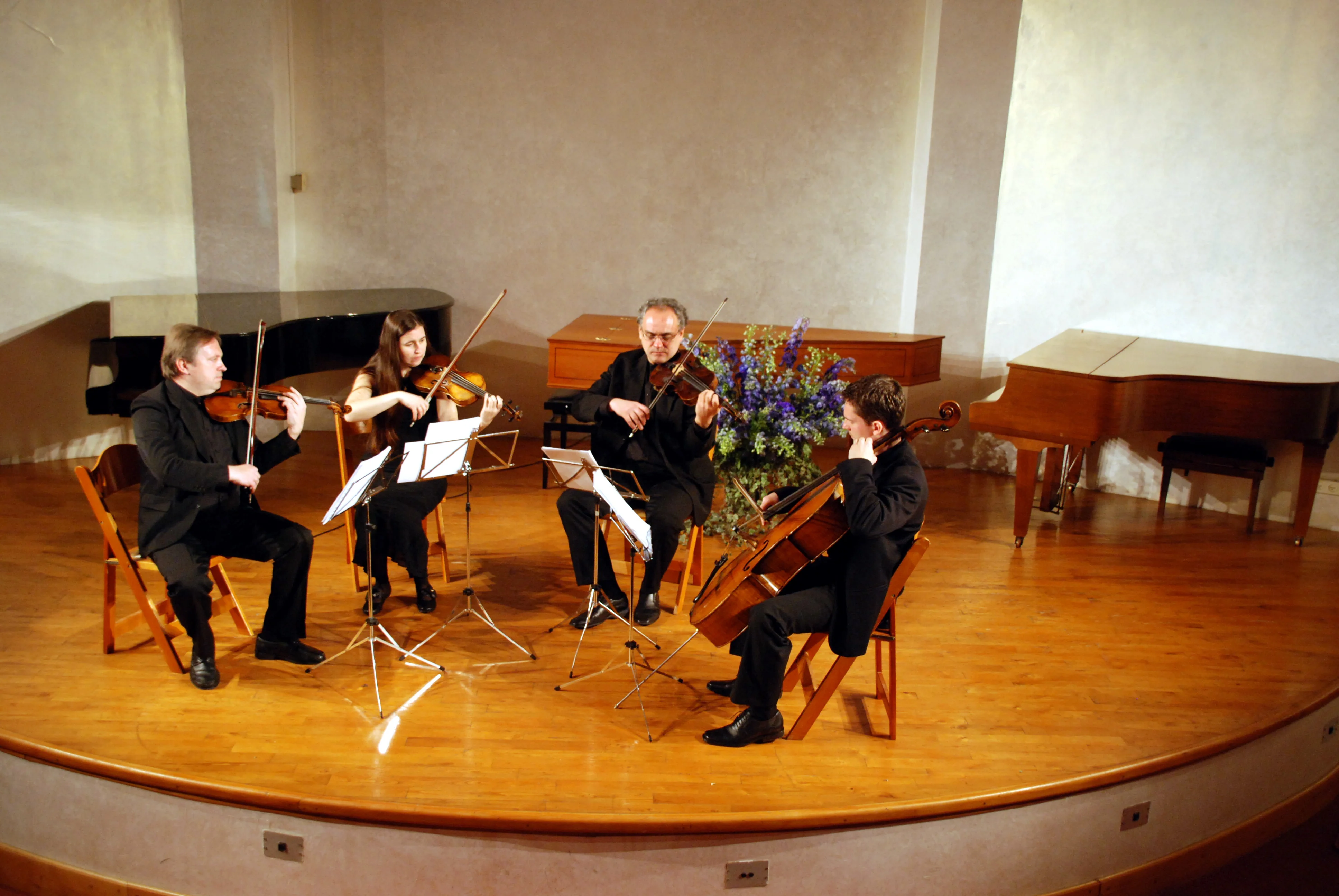
Image from Wikipedia
Image from Wikipedia
String Quartet: The Royal Discipline of Chamber Music Between Tradition, Tension, and Radical Present
An Ensemble, a Genre, a Musical Cosmos
The string quartet is much more than just a combination of two violins, viola, and cello: it is one of the most defining forms in European music history and also a touchstone for compositional mastery. From the Viennese Classical period to the present, the string quartet represents condensation, dialogue, and structural clarity, but also emotional depth, intimate expressiveness, and aesthetic freedom. As an ensemble and as a genre, it embodies a musical space where tradition and innovation continuously meet. ([de.wikipedia.org](https://de.wikipedia.org/wiki/Streichquartett?utm_source=openai))
Therefore, when one speaks of the string quartet, one also refers to a cultural form: the art of listening, reacting, and precisely balancing four independent voices. In this concentrated form, chamber music unfolds in its purest shape, with a dramaturgy that continually challenges both composers and performers anew. The genre has been considered particularly demanding since its classical manifestation because it requires high concentration in sound transparency, motivic development, and instrumental balance. ([dasorchester.de](https://dasorchester.de/artikel/das-streichquartett/?utm_source=openai))
The Historical Emergence: From the Viennese Classic to the Modern Canon
The history of the string quartet is closely tied to Joseph Haydn, whose works decisively shaped the form in the late 18th century and sharpened its profile. During this phase, the string quartet became the leading genre of chamber music and evolved into a site of compositional innovation, where formal economy and musical wit were united with new seriousness. Mozart and Beethoven continued this line, making the quartet a stage for an art that unfolds its greatest impact in reduction. ([britannica.com](https://www.britannica.com/art/quartet-music?utm_source=openai))
With Beethoven, the standards shifted once again: the quartet was no longer perceived merely as noble domestic music but as a serious medium of musical insight. It was here that the notion emerged that a string quartet is not just "cultivated entertainment" but a concentrated form of art. This historical elevation continues to shape the reception of the genre today and explains why composers have repeatedly returned to it over centuries. ([dewiki.de](https://dewiki.de/Lexikon/Streichquartett?utm_source=openai))
Musical Development: Four Voices, Four Roles, One Dialogue
In the classical string quartet, no voice is perpetually just accompaniment. Rather, a dialogue emerges where themes traverse, counterpoints intertwine, and the roles between melody, counterpoint, harmonic support, and rhythmic motor continually shift. It is precisely this equality of voices that makes the allure of the genre and gives it an almost democratic structure, which is rarely realized so consistently in music history. ([wissen-digital.de](https://www.wissen-digital.de/Streichquartett?utm_source=openai))
In the practice of composing, this implies the highest precision in arrangement, motivic work, and sound balance. The string quartet demands a composition that forms large arcs from the smallest cells and maintains tension even in quiet moments. For this reason, it has always been regarded as a test of style, formal awareness, and craftsmanship. ([dasorchester.de](https://dasorchester.de/artikel/das-streichquartett/?utm_source=openai))
The String Quartet in Modernity: Experiment, Friction, Expansion
In the 20th and 21st centuries, the string quartet remained a central place of musical modernity. Composers used the genre for dodecaphonic, freely atonal, rhythmically complex, and sonically expanded writing, without completely abandoning tradition. It is particularly in modern times that the quartet shows it is not merely a museum piece, but a vibrant laboratory for new compositional techniques, microstructures, and formal boundary crossings. ([dewiki.de](https://dewiki.de/Lexikon/Streichquartett?utm_source=openai))
Contemporary composition also holds onto the string quartet because it allows for an ideal combination of condensation and openness. New works are being created for specialized ensembles, festivals, and concert series that open the genre towards spatialization, communication, and artistic hybrid forms. Thus, the string quartet remains a place where new music, chamber music discipline, and aesthetic curiosity fuel one another. ([texte.musiktexte.de](https://texte.musiktexte.de/mt-162/249/aspekte-des-streichquartettschaffens-im-einundzwanzigsten-jahrhundert?utm_source=openai))
Discography and Repertoire: The Great Literature of the Genre
A discography in the true sense refers, for the string quartet, less to an individual artist archive than to a canon of works and recordings that reflects the entirety of music history. Key reference points include the quartets of Haydn, Mozart, Beethoven, and Schubert, later expanded by Brahms, Debussy, Ravel, Bartók, Schönberg, Webern, and many others. This repertoire line shows how the genre has evolved from classical form to the stage of modernity. ([britannica.com](https://www.britannica.com/art/quartet-music?utm_source=openai))
The critical reception of the string quartet emphasizes its special status to this day. Music press and specialized literature describe it as one of the most esteemed and yet consistently relevant forms of chamber music because it combines technical finesse, emotional directness, and historical depth. The quartet thrives on the tension between formal rigor and individual handwriting—a combination that makes it fascinating for listeners, performers, and music researchers alike. ([musikzeitung.ch](https://www.musikzeitung.ch/rezensionen/buecher-rezensionen/2020/02/unerschoepfliche-gattung?utm_source=openai))
Cultural Influence: From the Salon to the Global Stage
The string quartet has transitioned from private salons to concert halls and into the international festival and contemporary music scene. It not only shapes the canon of classical music but also contemporary programs in which commissioned works, premieres, and interdisciplinary formats expand its sonic horizons. It thus remains a cultural resonance space that connects historical authority with current relevance. ([dasorchester.de](https://dasorchester.de/artikel/das-streichquartett/?utm_source=openai))
Its influence extends far beyond the classical genre, as the principle of four-part dialogue also inspires jazz, new improvisational music, and cross-genre projects. The very openness of the ensemble makes the quartet a lasting form that continuously adapts to new listening habits, production methods, and artistic contexts. In this adaptability lies its enduring radiance. ([texte.musiktexte.de](https://texte.musiktexte.de/mt-162/249/aspekte-des-streichquartettschaffens-im-einundzwanzigsten-jahrhundert?utm_source=openai))
Current Perspectives: Why the String Quartet Will Continue into 2024 and 2025
Even in 2024 and 2025, the string quartet remains an active field for new releases, programs, and ensemble concepts. The current scene shows that quartet formations with stylistic openness, commissioned works, and curated concert series are responding to the present, understanding the genre not as an archive but as a tool for musical future. The repertoire continues to grow and confirms the unbroken relevance of the form. ([jackquartet.com](https://www.jackquartet.com/news-1/2425-season-announcement?utm_source=openai))
Especially exciting is that many contemporary ensembles see the string quartet as a laboratory for new sound languages. Electronics, improvisation, and interdisciplinary concepts expand the classical structure without giving up its essence. Thus, the genre remains a place of experimentation, chamber-music intimacy, and compositional concentration in the 21st century. ([neuestadtkultur.de](https://neuestadtkultur.de/2023/03/28/pulse-streichquartett/?utm_source=openai))
Conclusion: Why the String Quartet Continues to Fascinate Today
The string quartet is captivating because it encapsulates the essence of musical communication like few other forms. Four instruments, four personalities, one common sound—this creates an art form that has preserved its validity over centuries yet has never become static. Those who experience the string quartet encounter not just music history, but a lively dialogue of tension, discipline, and poetic freedom. ([de.wikipedia.org](https://de.wikipedia.org/wiki/Streichquartett?utm_source=openai))
Especially in live performances, this genre reveals its full impact: the subtle dynamic gradations, the immediate response of the voices to one another, and the intensity of shared breathing in the space. Anyone who hears the string quartet in concert quickly understands why this form has been regarded as the epitome of high chamber music art since the Viennese Classic. An evening with a string quartet is rarely just a concert—it becomes an encounter with one of music's noblest forms of expression. ([dasorchester.de](https://dasorchester.de/artikel/das-streichquartett/?utm_source=openai))
Official Channels of the String Quartet:
- Instagram: no official profile found
- Facebook: no official profile found
- YouTube: no official profile found
- Spotify: no official profile found
- TikTok: no official profile found
Sources:
- Wikipedia – String Quartet
- Britannica – Quartet (Music)
- das Orchester – The String Quartet
- Swiss Music Journal – Inexhaustible Genre
- MusikTexte 162 – Aspects of String Quartet Creation in the Twenty-First Century
- JACK Quartet – 2024/2025 Season Announcement
- New Amsterdam Records – Owls: Rare Birds
- Wikipedia: Image and text source
Upcoming Events
Bridgerton Music by Candlelight
Spring at Schloss Seehof: From Bach to Jazz
BRSO String Quartet Classical Concert
BRSO String Quartet Concert
Bridgerton Music & Candlelight: A Romantic Evening
Munich String Quartet with Emiko Yuasa in Seefeld
BRSO String Quartet in Chamber Concert
Bridgerton String Quartet
Rock Ballads - String Quartet