
Mathias Tretter
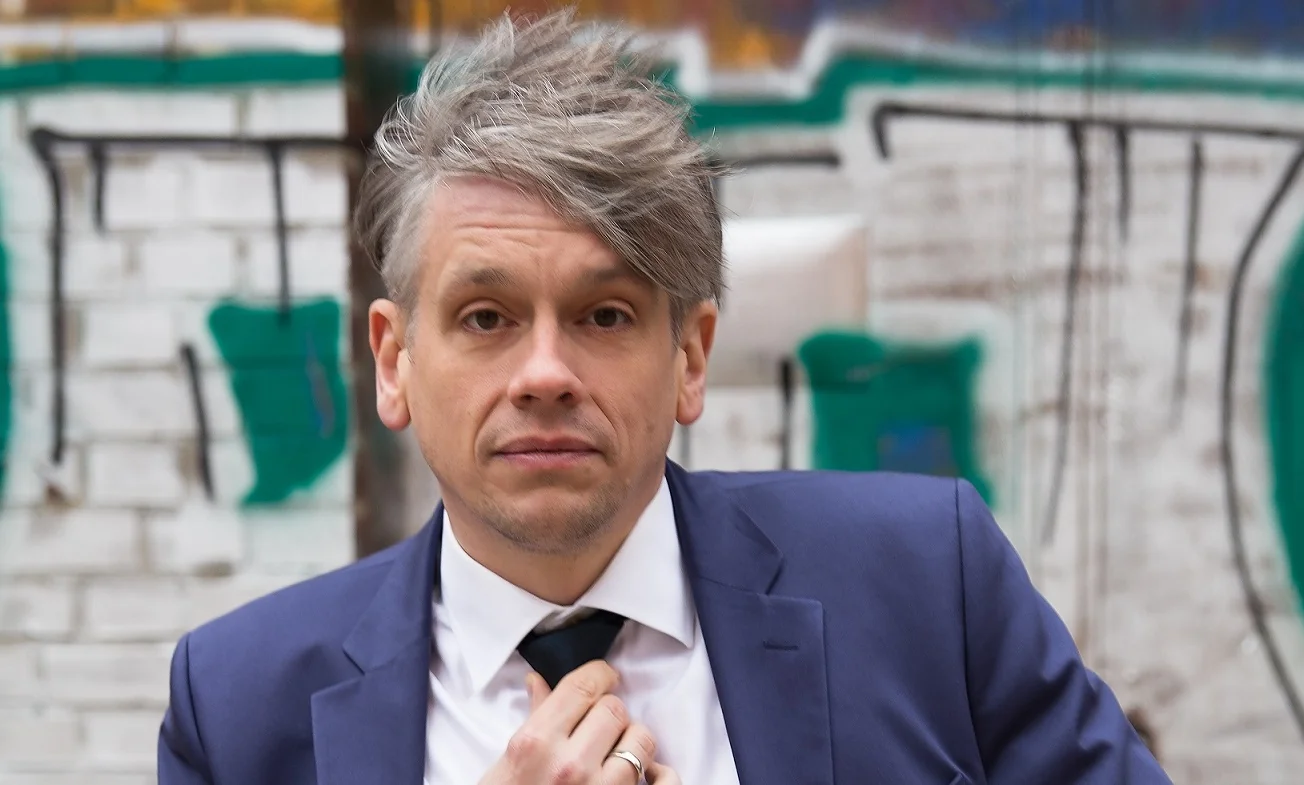
Image from Wikipedia
Image from Wikipedia
Mathias Tretter – Political Cabaret with Sharp Wit, Integrity, and Dense Punchlines
A satirist with integrity: from a Franconian word acrobat to an award-winning chronicler of our times
Mathias Tretter, born on May 19, 1972, in Würzburg, is one of the most distinctive voices in German-speaking political cabaret. His music career in a broader sense – a stage, a microphone, linguistic composition, and dramaturgical arrangement – began in Würzburg's small arts scene and led him through ensemble and solo formats to the most important cabaret stages in the German-speaking world. Tretter merges artistic development with analytical sharpness: he explores the mechanisms of populism, online public discourse, and political rhetoric without losing his human compass. His stage presence thrives on precise timing, elegant figures of speech, and the joy of intellectual counterpoint.
Trained in English and German studies in Würzburg, Edinburgh, and Heidelberg, Tretter early on condensed literary and journalistic experience into a satirical style that encompasses both cultural-historical context and careful linguistic craft. In Leipzig, he found an artistic home since 2007; simultaneously, his presence in radio, television, and on stage grew. His programs are intricately arranged “scores” of political contemporaneity, in which he sets tone, dynamics, and thematic direction as consciously as a composer does in a score.
Biography: Studies, early texts, the decision for the stage
After graduating from high school, Tretter studied English and German studies and wrote his first cabaret texts during his civil service. In Würzburg, he moderated poetry slams and radio drama evenings, worked as a literary critic, and taught evening classes at an interpreting school. This early phase honed his ear for nuances, his attention to discourses, and his sense of dramaturgy. A pivotal moment was his artistic development from literary observer to stage author and soloist, which he marked in 2003 with his debut program "Die Brille zur Macht". The musicality of his language – alliterations, shifts in rhythm, refrain-like motifs – remained his trademark and continues to shape his “composition” of analysis, satire, and scenically dense presentations. (de.wikipedia.org)
Honed in the ensemble: the First German Forced Ensemble
From 2004 to 2014, Tretter was part of the First German Forced Ensemble along with Claus von Wagner and Philipp Weber. An initially "best-of" concept quickly developed into an independent ensemble cabaret with pointed contemporary diagnostics and precise arrangements between sketches, monologues, and choreographed group dynamics. The group won significant awards – from the Salzburger Stier (2007) to the German Small Arts Prize (2010) – and shaped a whole decade of younger political cabaret. Tretter's ability to operate as confidently in a collective as he does solo sharpened his stage presence, timing, and understanding of the “instrumentation” of voices in political discourse. (de.wikipedia.org)
Solo at the height of contemporary issues: Programs that set discourses to sound
Tretter's solo programs read like a canon of contemporary analysis: "Deutschland. Ein Gummibärchen" (2006) dissected variations of national self-reflection, "Staatsfeind Nr. 11" (2008) satirized governmental and societal reflexes, and "…möchte nicht dein Freund sein" (2011) traced social media and the logic of digital intimacy. With "Selfie" (2014/15), he achieved a dramaturgically dense panorama of the self-staging culture, which earned him multiple awards. "POP" (2017) unveiled the mechanics of populism – a piece of political sound research about refrains, hooks, and rhetorical grooves of public debates. This series of works currently culminates in "Souverän", a highly condensed analysis of contemporary issues revolving around state understanding, states of emergency, and individual self-control, recorded live by WDR. (de.wikipedia.org)
“Souverän” live: Dramaturgy, culture of quotes, sound of the times
"Souverän" uses political theory not as a backdrop but as a dramaturgical building block. Tretter juxtaposes the famous dictum of the state of emergency with everyday observations, mock quotes, and politically philosophical miniatures – thus bringing the abstract score of the sovereignty debate to life. The WDR recording highlights his stage maturity: a 100-minute composition of thematic blocks, running gags, thematic ostinatos, and surprising harmonic "modulations" of argumentation. Press reviews from 2025 emphasize his witty analysis, the successful balance of satire and contemplation, as well as the dense punchline structure. The program demonstrates Tretter's ability to "orchestrate" discourse material without losing the human dimension. (www1.wdr.de)
“NachgeTRETTERt”: Year in review as a live-composed present
For years, Tretter has established his own format with "NachgeTRETTERt – the satirical year in review": a veritable suite of politics, society, pop culture, and media, live arranged with minimal props and maximum linguistic virtuosity. Critics of the latest edition emphasize how adeptly he assembles characters, quotes, and headlines into a narrative dramaturgy. The year in review serves as an improvisation-open score, in which Tretter varies the tempo, briefly resumes themes, and transitions into audience-carrying finales with scenic crescendos. (de.wikipedia.org)
Discography and publications: WortArt, EinLächeln, conanima
His discography reflects the consistent documentation of this stage work: "Deutschland. Ein Gummibärchen" (2007, WortArt) marks the early signature sound; "Staatsfeind Nr. 11" (2009, EinLächeln) sharpens the political approach. The ensemble DVDs "Mach 3!" (2010) and "Die letzte Tour" (2011) showcase Tretter's polyphonic work in a trio. The double editions "…möchte nicht dein Freund sein" (2012) and "Selfie" (2015, both conanima) demonstrate the compositional maturity of his solo form – with clear dramaturgy, sound (voice leading, prosody), and a clear text architecture. Platforms like Apple Music categorize Tretter under "Comedy," documenting the presence of his recordings and cultural reach. (de.wikipedia.org)
Awards and reviews: Authority through work and impact
The list of his awards attests to authority and artistic consistency: from the Bavarian Cabaret Prize (category Emerging Talent, 2008) to the German Cabaret Prize (Promotional Award 2009, Main Prize 2017) to the Salzburger Stier (with ensemble 2007, solo 2023). Additionally, there are the Mindener Stichling (Special Prize), German Small Arts Prize (with ensemble), the “Gaul von Niedersachsen,” the “Memminger Maul” for “Selfie,” and regional honors. Critiques from radio and press commend Tretter's "breathtaking density of punchlines," his linguistic precision, and his capacity to shed light on the “dumbing yet democratizing power of the internet” with humor and clarity. This resonance from leading media, festivals, and jury panels underscores his authority in the field of political stage art. (de.wikipedia.org)
Style, genre, technique: Language music between rhetoric and rhythm
Tretter's expertise is evident in his handling of language as musical material. He employs thematic recurrence, tempo changes, “breaks,” and quiet interludes before setting rhetorical cadences. The genre classification "cabaret" is broad in his case: he draws on stand-up-like looseness, essayistic density, parodic vocal colors, and dialogic role changes. The composition and arrangement of his evenings follow an internal dramaturgy that weaves themes like populism, identity politics, online public discourse, or state understanding into a polyphonic whole. Tretter avoids the pose of a moralist; his tone remains respectful in approach, strict in analysis, and playful in form. Thus, he unfolds a stage presence that appeals to both specialists and a broad audience. (www1.wdr.de)
Cultural influence: Cabaret as a contemporary archive
Over two decades of work make Tretter a chronicler who captures and organizes moods. His programs archive the discourses of the time: the transformation of the private sphere by social media, the theatricality of political communication, the semantic erosion of concepts like “sovereignty” or “the people.” The fact that his recordings circulate in public broadcasting media and are discussed by both regional and national press amplifies the cultural footprint. He connects experiential knowledge from the stage – reaction, breath, audience flow – with textual expertise, music-like structuring, and a trustworthiness based on source knowledge and intellectual integrity. (www1.wdr.de)
Television, radio, presence: a repertoire from "Scheibenwischer" to "Mitternachtsspitzen"
On radio and television, Tretter is regularly present – from traditional formats like "Scheibenwischer" and "Mitternachtsspitzen" to WDR 5, Deutschlandfunk Kultur, and 3sat festivals. This media polyphony opens his cabaret to various listening habits: as an evening-length “stage symphony,” as a radio concert with a live atmosphere, or as a edited TV version with focused visual language. This contributes to the sustainable visibility of his work and documents his artistic development in real-time. (de.wikipedia.org)
Current projects and dates: Tour “Scores” 2026
The ongoing tour with “Souverän” will take Tretter through numerous cities in spring and autumn 2026 – from the Munich Lustspielhaus to Cologne, Berlin, Mainz, and Nuremberg, as well as regional cultural centers. This density of performance locations showcases the breadth of his audience and his grounding in the vibrant small arts landscape. The fact that the program was prominently recorded in 2025 adds resonance to the tour: the live recording and current stage version mutually inspire each other – a interplay that secures aesthetic maturity and reach in cabaret "production". (mathiastretter.de)
Conclusion: Why experience Mathias Tretter today?
Tretter makes political theory accessible without trivializing it. He “composes” current themes with linguistic elegance, rhythmic precision, and an integrity that takes humor seriously as a means of insight. His artistic development – solo, ensemble, radio – demonstrates long-term relevance; his awards signal authority; his radio and stage recordings stand for reliability and quality. Anyone wanting to experience the present with sharpness, wit, and depth should see him live: there, the entire dynamism of his stage presence unfolds – an evening that resonates like a thoughtfully constructed finale.
Official channels of Mathias Tretter:
- Instagram: No official profile found
- Facebook: No official profile found
- YouTube: No official profile found
- Spotify: No official profile found
- TikTok: No official profile found
Sources:
- Mathias Tretter – Official Website
- WDR 5 – Souverän: Recording and program information (04.19.2025)
- Deutschlandfunk Kultur – Portrait and Interview (10.17.2013)
- Frankfurter Neue Presse – “NachgeTRETTERt!” live (12.02.2025)
- Taunus-Nachrichten – Review “Souverän” (03.13.2025)
- Wikipedia – Mathias Tretter: Biography, Programs, Awards
- Wikipedia – First German Forced Ensemble: History and Awards
- SRF – Salzburger Stier 2023: Context and excerpts
- Apple Music – Artist Profile (Category Comedy)
- Wikipedia: Image and text source
Upcoming Events
Mathias Tretter - Sovereign
Mathias Tretter – Sovereign
Mathias Tretter – Souverän
Cabaret Mathias Tretter 'Sovereign'
Mathias Tretter – Sovereign in Munich
Mathias Tretter – Sovereign
Mathias Tretter – Cabaret Evening
Mathias Tretter – Sovereign
Mathias Tretter - Sovereign