
Kaleb Erdmann
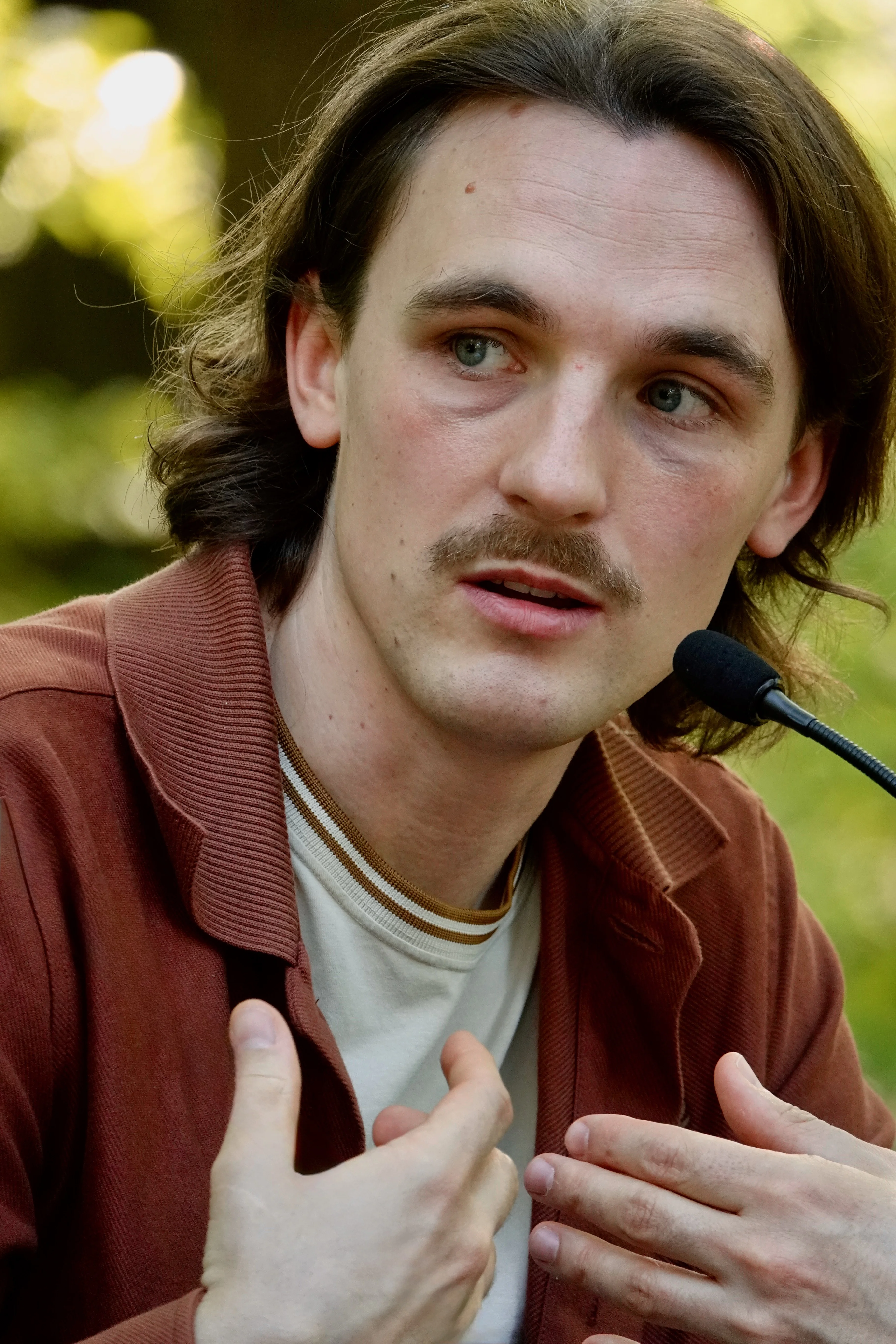
Image from Wikipedia
Image from Wikipedia
Kaleb Erdmann: A Literary Voice Between Memory, Precision, and the Present
Kaleb Erdmann and the Art of Transforming the Unspeakable into Literature
Kaleb Erdmann belongs to that young generation of German authors who do not merely narrate socially charged themes but engage with them in a literary sense. Born in 1991 in Witten and raised in the Ruhr area, Bayreuth, Erfurt, and Munich, he combines biographical movement with a clear linguistic stance. His texts revolve around memory, perception, responsibility, and the question of how personal experience can be transposed into literary form. This is precisely where the tension of his music career lies? No: in his artistic development as a writer and dramatist, who works with great concentration on contemporary themes.
Erdmann first gained recognition as an author with a keen sense for compression and perspective, later also becoming a dramatist and editor in various television and entertainment formats. His literature combines formal control with emotional urgency. He does not write loudly but precisely; not from the gesture of pose, but from the accuracy of observation. This results in a body of work that is both literarily challenging and immediately readable.
Early Years and Education: From the Ruhr Area to the Literary Scene
Erdmann’s background from Witten and his formative years in different German cities are reflected in a biography that thrives on shifts in perspective. He studied Literary Writing at the German Literature Institute in Leipzig as well as Sociology and Political Theory in Munich and Frankfurt am Main. This education sharpened his perception of social structures, social roles, and the political undercurrents of everyday life. In his texts, it becomes evident that literature for him is not separate from thought, but emerges from an intensive reflection on the world.
From an early age, his affinity for a reduced, linguistically concentrated form was evident. Erdmann works with brevity, rhythm, and targeted omission. It is precisely this restraint that creates impact: what is not articulated remains in the text as tension. His literary development thus stands in a tradition that emphasizes structural precision over ornamental fullness.
The Breakthrough with we are pioneers
His debut novel we are pioneers was published in spring 2024 by Ullstein and marked a significant step in his public perception as a prose artist. The book was awarded the Debut Prize at the lit.Cologne in March 2024, a significant testament to the early recognized literary independence of the author. In the FAZ, the text was described as an example of an almost programmatic minimalism, gaining vibrancy not from volume, but from reduction. This reception shows: Erdmann captivates through formal clarity and a masterful control of the narrative tone.
With this novel, he established himself as an author who does not rely on effects, but on compression. The literary handwriting appears disciplined, yet not cold; attentive, but not didactic. It is this balance between distance and empathy that constitutes the appeal of his writing. His debut thereby already set a benchmark that remained clearly visible throughout the course of his career.
The Evasion School: Memory, Guilt, and Literary Intensification
In 2025, The Evasion School followed as his second novel, published by Park x Ullstein, further thrusting Erdmann into the literary public eye. The book processes the school shooting at the Gutenberg Gymnasium in Erfurt, which Erdmann personally experienced as a child. The narrative power arises not from sensationalism, but from the challenging approach to a traumatic event. The novel was shortlisted for the German Book Prize 2025 and later awarded the Förderpreis of the Bremen Literature Prize 2026.
In the publisher's announcement, The Evasion School is described as a play with perspectives, as an autofictional text that simultaneously raises audience-critical and self-critical questions. This is precisely where its literary quality lies: Erdmann examines how memory is narrated, who owns the narration, and the ethical boundaries that writing about violence touches. The result is a novel that does not reassure the reader but keeps them in productive unrest.
Style and Themes: Minimalism with Maximum Precision
Kaleb Erdmann’s language works with reduction, but never with emptiness. His sentences are often clearly constructed, concise, and pointed, yet behind this formulation lies a high sensitivity to tone and perspective. This stylistic discipline creates space for subtext: silence, overwhelm, gaps in memory, and inner conflicts become integral elements of his texts. Literature in his view does not appear as ornamentation but as a precise tool of understanding.
Thematically, Erdmann moves between autofiction, contemporary literature, and social reflection. He is interested in border areas: between private memory and public debate, between identity and observation, between individual experience and collective significance. His books do not offer simple answers but insist on the complexity of the questions. It is precisely this stance that imparts authority and contemporary relevance to his work.
Theater, Television, and Narrative Versatility
In addition to prose, Erdmann is also active as a dramatist. He was a finalist at the open mike, was nominated for the Retzhofer Dramapreis for his play Unten, and later wrote the play Always Carrey On for the Berliner Ensemble. This theatrical work adds a second artistic dimension to his prose: dialogue, space, and dramatic intensification also play an important role in his literary thinking. His eye for situations and tensions is evident not only in the novel but also on stage.
Additionally, he works as an author and editor in various television and entertainment formats, including for Till Reiners’ Happy Hour at 3Sat. These experiences expand his access to language, timing, and audience. Consequently, Erdmann moves confidently between literary seriousness and media practice. His profile is not that of a closed-off writer, but that of a versatile author who masterfully commands different forms.
Current Projects, Awards, and Literary Presence
2025 and 2026 mark a particularly visible phase for Kaleb Erdmann. With The Evasion School, not only did his second novel appear, but also one of the most discussed German-language books of the literary autumn of 2025. The shortlist nomination for the German Book Prize and the Förderpreis of the Bremen Literature Prize 2026 underscore the relevance of the work far beyond the moment of debate. Ullstein's publishing communication and literary events show that Erdmann is firmly anchored in the current literary landscape.
He remains present for readings and public appearances, including at events surrounding book fairs and literary houses. His work thereby has an impact not only in the book but also in conversation with the audience. This suits an author whose texts are strongly oriented toward resonance, memory work, and ethical responsibility. Erdmann’s presence is that of a writer who does not seek literary attention but gains it through substance.
Cultural Influence and Relevance in Contemporary German-Language Literature
Kaleb Erdmann represents a literature that grapples with morally and historically sensitive topics without falling into pathos or simplification. This is especially evident in The Evasion School, which shows how contemporary literature can assume responsibility without relinquishing its aesthetic independence. His texts do not provide ready-made interpretations but open spaces for memory, doubt, and readability. This makes them equally interesting for literary criticism and readership.
His influence thus far lies less in quantity than in quality. Erdmann is among the authors who establish a clear literary profile with few, precisely placed books. The blend of intellectual sharpness, emotional discipline, and narrative precision gives weight to his work. Anyone following the development of contemporary German-language literature cannot overlook him.
Kaleb Erdmann is intriguing because he approaches difficult topics with literary calm and formal consistency. He combines biographical experience with critical reflection, developing texts that resonate long after reading. Those who wish to experience contemporary literature with depth, attitude, and linguistic precision should pay close attention to Kaleb Erdmann and experience him live at one of his events.
Official Channels of Kaleb Erdmann:
- Instagram: no official profile found
- Facebook: no official profile found
- YouTube: no official profile found
- Spotify: no official profile found
- TikTok: no official profile found