Volunteering & Volunteer Work in Traunstein
Volunteering & Volunteer Work in Traunstein – Here’s How You Can Get Involved
7 min readLaura Müller
You want to get involved in the Traunstein district but don’t know where to start? Here you’ll find reliable entry points, typical areas of activity, and the fastest way to the right task – from occasional help to structured volunteer services.
Volunteer Agency Traunstein: Central Contact Point
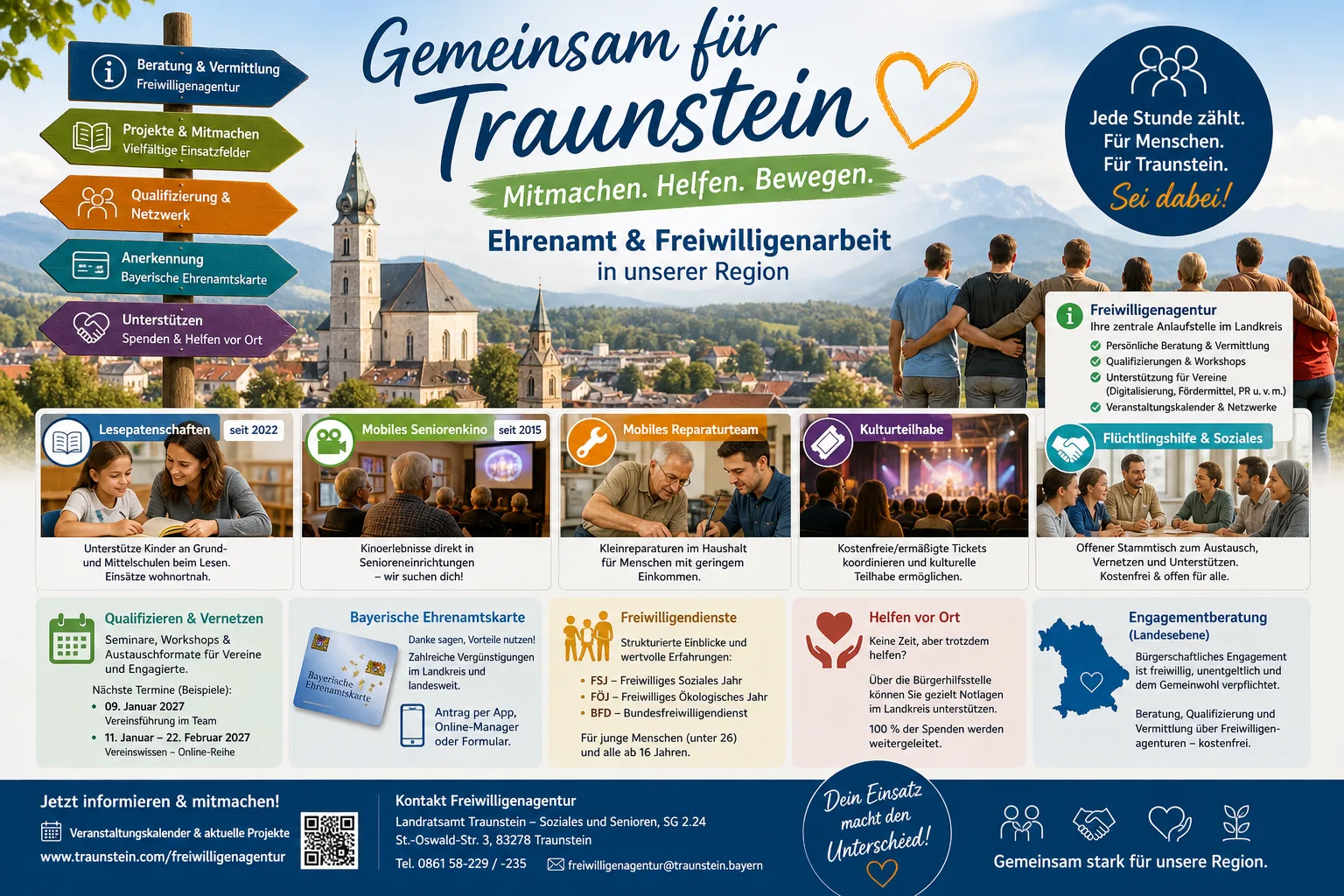
The most reliable starting point for volunteering & volunteer work in the Traunstein district is the district’s volunteer agency. They arrange suitable placements, offer confidential advice, and also support clubs and initiatives.
Contact (according to district information)
Volunteer Agency Traunstein
St.-Oswald-Str. 3, 83278 Traunstein
Phone: 0861 58-229 / 0861 58-235
What You Get There Specifically
- Engagement Counseling: Clarification of time frame, interests, prior experience, and suitable task profiles.
- Placement: Contact with organizations, projects, and initiatives in the district – with suitable roles instead of just “helping somehow.”
- Qualification: Courses/workshops on club work, communication, organization, legal basics, and practical skills.
- Orientation: Information on required certificates (e.g., extended certificate of conduct for work with children/youth) and on framework conditions.
If you’re unsure, a counseling session is usually the fastest way: You’ll leave with a concrete idea or even a suitable placement.
Ways to Get Involved: Typical Areas of Activity
Volunteers are sought in many areas in the Traunstein district. The following examples show typical tasks as they are often organized by volunteer agencies, institutions, and clubs.
Education & Reading: Reading Partnerships and Learning Support
If you enjoy working with children, reading partnerships or learning support are a very concrete entry point: You regularly help with reading, practicing, or building language confidence. Appointments are often plannable (e.g., weekly) and take place close to home.
- Suitable for: People with patience, a love of language, reliability
- Typical framework: Fixed times, clear agreements with school/provider
- Important: For activities with children, an extended certificate of conduct may be required (process via provider/coordinating office)
Seniors & Participation: Visiting Services and Local Cultural Events
Many institutions appreciate support that enables encounters: Accompanying to events in the house, having conversations, helping with small organizational tasks, or assisting at cultural afternoons (e.g., film, music, or reading events).
- Suitable for: People who like to listen, accompany respectfully, and enjoy contact
- Typical tasks: Welcoming, accompanying, small assistance, exchange before/after program items
Practical Help: Repair and Everyday Assistance
If you are handy, you can achieve a lot with small, clearly defined assignments: simple repairs, assembly help, or support with everyday tasks that are difficult to manage alone. Reliable offers work with good coordination, transparent rules, and clear boundaries (no dangerous work, no complex electrical installations without a professional).
- Suitable for: Skilled people who work reliably and safely
- Important: Clear agreements on liability, material costs, and scope of work via the coordinating office
Culture & Social Participation: Mediation and Organization
Support is also needed “behind the scenes”: Coordination of contingents, communication between cultural and social institutions, organization of processes and distribution channels. This is especially suitable if you work in a structured way and like to make things possible without being on stage yourself.
- Suitable for: Organizational talents, strong communication skills, diligence
- Typical tasks: Scheduling, passing on information, documentation within the given framework
Qualification & Networking
Good volunteering works sustainably when volunteers are supported. That’s why further training and exchange formats are a big advantage: You gain confidence in your role, get to know other volunteers, and can clarify questions before they become a problem in everyday life.
Training for Volunteers and Clubs
Typical topics offered in programs by engagement offices and districts:
- Club organization (team models, succession, member recruitment)
- Public relations & communication
- Law & responsibility in volunteering (e.g., duty of supervision, data protection basics, liability issues within the role)
- Project planning and funding opportunities
Exchange Formats (e.g., regulars’ tables/networks)
For sensitive areas such as integration or social support, exchange is especially valuable: You benefit from others’ experiences, get tips on contact persons, and remain able to act when situations become complex.
FSJ, FÖJ & Federal Volunteer Service: Structured Paths into Volunteer Work
If you want to commit for a longer period, volunteer services are a good option. They are pedagogically accompanied and have clear framework conditions (duration, seminar components, placement, pocket money/benefits depending on program and provider).
Voluntary Social Year (FSJ)
The FSJ is aimed at people who want to gain practical experience in the social sector – for example, in facilities for children/youth, seniors, or people with disabilities. It is suitable for orientation before training/studies or as a conscious practical phase.
Voluntary Ecological Year (FÖJ)
The FÖJ is suitable if you are interested in environmental and nature conservation, sustainable development, or environmental education. Placements can include educational institutions or nature conservation organizations (depending on providers and available positions).
Federal Volunteer Service (BFD)
The BFD is open to people from the age of 16 and – unlike the FSJ – is also possible for people over 27. Areas of work range from social tasks to culture to activities related to environmental and disaster protection, depending on the placements offered.
You can reliably find out which specific placements are available in the Traunstein district via the volunteer agency, the district’s websites, or the official program information from the providers.
Recognition: Volunteer Card & Support Options
Bavarian Volunteer Card
As recognition for intensive engagement, there is the Bavarian Volunteer Card. Depending on partners and region, it offers discounts and benefits. The requirements (e.g., minimum scope and duration of engagement) and the application process are officially described.
- Application is possible digitally (e.g., app/online process) or by form, depending on the offer.
- Many organizations support you in providing proof/confirmation of your engagement.
Supporting Without Your Own Time Budget
If you currently have no time for regular assignments but still want to help locally, you can find out about reputable, purpose-bound support offers in the district. Pay attention to transparency: clear purpose, comprehensible processes, and reliable contact points.
How to Find Your Suitable Engagement (3 Steps)
-
Use Counseling
Contact the volunteer agency and briefly describe: available times, interests (e.g., children, seniors, culture, environment), whether you prefer hands-on or organizational work, and whether you want to help regularly or on a project basis.
-
Start with a Clear Pilot Engagement
Choose a task with a manageable scope (e.g., a fixed appointment per week or a defined project). This way you can check if it suits you without overwhelming yourself.
-
Clarify Framework & Security
Before starting, ask about: contact person, briefing, insurance coverage within the activity, data protection/handling of sensitive information, and any required certificates. Reputable agencies answer this transparently.
Good volunteering doesn’t feel like “just another duty,” but like a meaningful task with clear boundaries and real support.
Sources
- Traunstein District – Official Website — Information on offers/contact points of the district (accessed 2026-11-25)
- Bavarian Volunteer Card (Bavaria) — Requirements, application, and partner discounts (accessed 2026-11-25)
- Federal Volunteer Service (official information page) — Framework conditions and participation information (accessed 2026-11-25)
- BMFSFJ – Voluntary Engagement & Volunteer Services — Overview of volunteer services and engagement promotion (accessed 2026-11-25)