Events on Democracy and Contemporary History in Traunstein
Upcoming Events on Democracy & Contemporary History in Traunstein
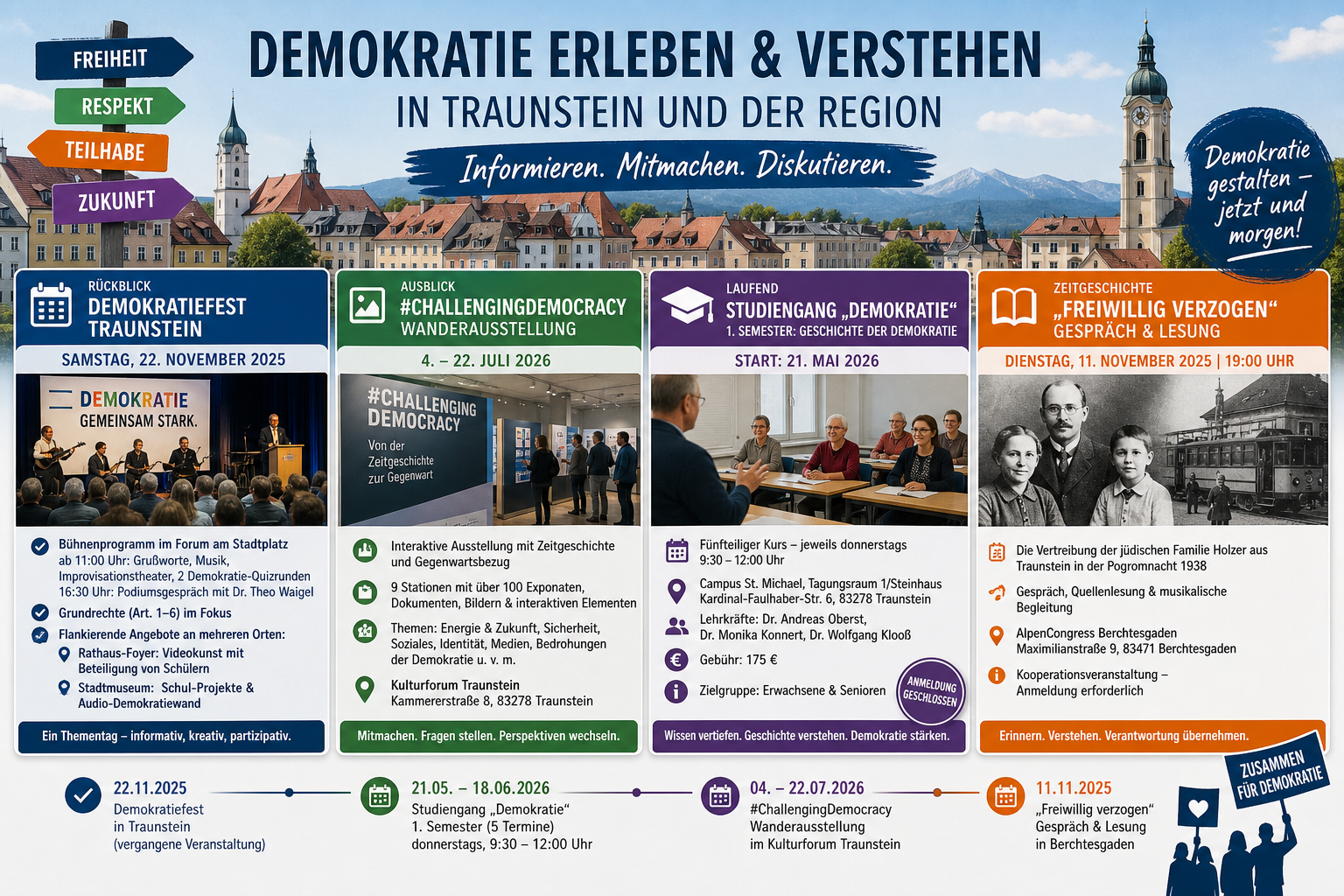
In Traunstein, new formats are continuously being developed to make democracy education and contemporary history tangible: from interactive exhibitions and discussion evenings to course offerings. This overview is aimed at residents and guests who want to get targeted information and find suitable dates in the coming weeks and months.
What to Expect from Democracy and Contemporary History Formats
Upcoming events in Traunstein on democracy and contemporary history often rely on formats that not only inform but also enable participation. Typical features include:
- Interactive elements (e.g. voting, audio stations, participation walls, moderated discussions)
- Everyday relevance to fundamental rights (e.g. freedom of expression, equal treatment, freedom of religion, protection of human dignity)
- Historical contextualization through sources, biographies, and regional perspectives
- Dialogue on current issues (e.g. social cohesion, disinformation, dealing with conflicts, security vs. freedom)
If you are out and about with family, a school class, or as a group: Pay attention to notes in announcements such as “barrier-free,” “suitable for young people,” “with registration,” or “with guided tour.” Such information often determines how well the format suits you.
Important Venues for Upcoming Dates in Traunstein
Many democracy-related and contemporary history offerings in Traunstein are announced through established cultural and educational venues. For future dates, it is especially worthwhile to keep an eye on the program information of these institutions:
- Kulturforum Traunstein (exhibitions, lectures, accompanying programs, guided tours)
- Stadtmuseum Traunstein (educational formats, special exhibitions, educational offers)
- Forum am Stadtplatz (stage programs, discussion formats, public events)
- Town Hall / municipal spaces (project presentations, participation formats, cooperations)
- Local education providers (courses, seminar series, lecture programs)
For reliable details (date, time, admission, accessibility, registration), the official event pages of the respective organizers are decisive.
Interactive Exhibitions: How to Prepare
When a traveling or special exhibition on democracy, protest culture, social change, or fundamental rights comes to Traunstein in the coming months, it is often modular: stations, media stations, objects, documents, and short thematic units. To get the most out of it:
- Plan time: Interactive stations are especially worthwhile if you don’t just “walk through.” Check in advance if there are time slots or guided tours.
- Use accompanying programs: Many exhibitions are supplemented by guided tours, lectures, or workshops. These dates are often the best introduction.
- For school classes: Ask for educational material or an age-appropriate introduction (often labeled as “educational program”).
- Use discussion spaces respectfully: For topics such as extremism, persecution, or political violence, house rules for conversations often apply. This creates safety for all participants.
It is especially helpful to know the most important articles on fundamental rights in overview before your visit (see sources), as many exhibitions build on them.
Discussion Evenings & Panels: How to Find Reliable Announcements
Panel discussions, readings, or moderated talks are among the most common future democracy formats. You can recognize reliable announcements by the fact that they:
- Clearly state the organizer, moderator, and topic
- Explain the format and goal (information, debate, workshop, audience discussion)
- Mention framework conditions (admission, duration, language, registration, barrier-free access)
- Provide contact for questions
For you as a visitor, it is worth a quick check to see if different perspectives are represented and if there is room for questions. Especially with controversial topics, the moderation determines whether the conversation remains insightful and respectful.
Courses & Study Offers: What to Look for When Registering
In addition to individual dates, course and seminar series on political education are regularly announced in Traunstein and the surrounding area. Such offers are particularly suitable if you want to deepen your understanding (e.g. history of democratic institutions, political communication, media literacy).
Checklist for Future Course Offers
- Content & learning objectives: Are topics, instructors, and objectives described transparently?
- Dates: Does the schedule (e.g. weekly, block seminar) fit your everyday life?
- Costs: Are fees, discounts, and cancellation conditions clearly listed?
- Registration: Are there deadlines or limited places?
- Target group: Is the course aimed at beginners, advanced participants, or certain age groups?
When deciding, rely exclusively on the current course information from the respective provider, as conditions and dates can change at short notice.
Contemporary History on Site: Topics Frequently Covered in Upcoming Formats
Future events on contemporary history in the region often address questions that can be particularly well conveyed locally: How do political decisions affect everyday life? What do exclusion, disenfranchisement, and persecution mean concretely in a city or district? And what lessons do we draw from this for the present and future?
Typical focal points that may appear in announcements include:
- History of democracy in Germany (Weimar, Nazi era, new beginning after 1945, developments in the Federal Republic)
- Culture of remembrance (memorial sites, biographies, local research, source work)
- Social change (e.g. political movements, social security, energy and future debates)
- Protection of democracy (e.g. dealing with extremism, democratic culture of debate, disinformation)
If you want to prepare, introductory pages on political education and primary texts such as the Basic Law are a good starting point (see sources).
Practical Tips for Your Visit
- Check dates early: Especially for guided tours, workshops, and small discussion groups, places are often limited.
- Write down questions: Take two or three questions with you before a panel – this increases the benefit, even if there is little time for the audience.
- With children/young people: Look for “participation format,” “school program,” “family tour,” or “from X years” in the announcement.
- Respectful participation: For sensitive topics (persecution, violence, discrimination), it is helpful to briefly announce content in advance if you are going with younger people.
- Reliable information: Prefer official websites of the city, venues, and organizers. Social media posts can supplement but do not replace primary information.
Sources & Further Links
- Basic Law for the Federal Republic of Germany (Gesetze im Internet) — Primary text on fundamental rights and state principles (accessed 2026-05-27)
- Federal Agency for Civic Education (bpb.de) — Background knowledge, dossiers, and materials on civic education (accessed 2026-05-27)
- City of Traunstein (official website) — Information on municipal matters and, if applicable, event calendar (accessed 2026-05-27)