Running Events in Traunstein: Dates & Tips
Running Events & Sports Events in Traunstein – Dates & Tips (Outlook)
If you want to experience Traunstein and the Chiemgau region in a sporty way, you will find a mix of city runs, company runs, and mountain run formats in the coming months and seasons. This outlook explains what to expect from typical procedures, how to plan your arrival and road closures, and how to secure a starting spot in time.
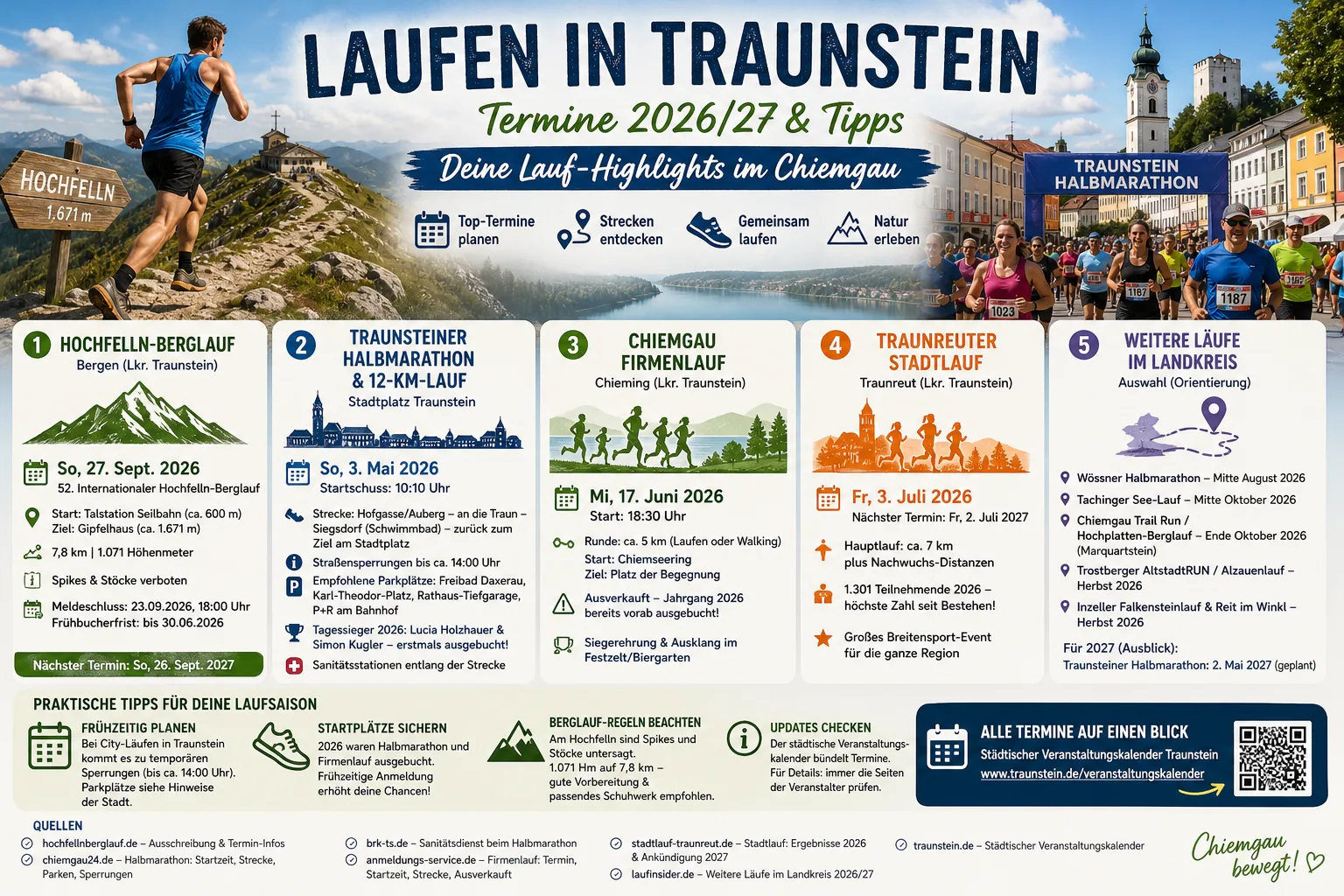
Traunstein Half Marathon: City Run with Downtown Flair
The Traunstein Half Marathon is considered one of the sporting highlights in the city: Start and finish are usually centrally located, the route combines city sections with stretches outside the narrow center. Often, a shorter distance is also offered, which is easily accessible for experienced recreational runners.
What Participants Can Expect
- Start Waves & Schedule: Many city runs start in the morning. Exact times vary by edition; check the organizer's announcement for details.
- Provision & Safety: Course marshals, medical service, and refreshment points are standard. Still, plan for personal responsibility (e.g., weather-appropriate clothing).
- Registration: With limited slots, early registration is worthwhile as soon as registration opens.
What Residents or Visitors Should Note
For runs with a downtown connection, temporary road closures, no-parking zones, and detours are realistic. Municipalities publish notices in advance (e.g., closure times, recommended parking areas, changes in bus service). If you need to pass through the city center on an event day, it's best to plan for extra time and use park-and-ride or train if possible.
Chiemgau Company Run: Joint After-Work Run in a Team
Company runs in the region are typically designed as after-work events: start in the early evening, short distance (often around 5 km), and an atmosphere where team spirit is more important than best time. Running and walking are often explicitly allowed, so beginners can also participate.
How Teams Can Prepare Effectively
- Coordinate internally early: Team sizes, joint arrival, and unified registration reduce stress shortly before the registration deadline.
- Keep training low-threshold: Two to three easy sessions per week (20–40 minutes) over several weeks are enough for many to comfortably cover the distance.
- Set realistic goals: Agree on a common goal (finish, finish together, time window) instead of building pressure.
Since company runs in popular regions can sell out quickly, it is recommended: subscribe to registration newsletters, note opening dates, and do not postpone team registration until the last week.
Traunreut City Run: Mass Sports Format with Children's and Youth Runs
City runs in the region are often organized as inclusive sports festivals: a main run over several kilometers, plus children's and youth distances, and often a supporting program in the start/finish area. This is especially attractive for families, as arrival, spectating, and participation are all bundled in one place.
Tips for Families and Clubs (for Upcoming Editions)
- Arrive early: For children's runs, picking up start documents, warm-up, and bathroom trips are time-critical.
- Define a meeting point: Set a fixed meeting point in the finish area in case groups get separated.
- Safety: Children should start with a clear emergency contact (e.g., on a wristband) and clear agreements.
Hochfelln Mountain Run: Demanding, Spectacular, Regulated
Mountain runs like the one at Hochfelln stand for short distances with a lot of elevation gain and alpine surroundings. For upcoming editions, participants should read the announcement particularly carefully: equipment rules, cut-off times, equipment recommendations, weather information, and safety concepts are crucial for mountain formats.
Why Equipment Rules (e.g., Spikes/Poles) Can Matter
On narrow paths, overtaking maneuvers, and changing surfaces, clear rules reduce the risk for everyone: they protect fellow runners, facilitate rescue operations, and help preserve sensitive trails. Which aids are allowed is decided by the respective organizer; the current announcement is always decisive.
Practical Preparation for Upcoming Mountain Run Starts
- Make training mountain-specific: Practice ascents and descents (surefootedness, knee/ankle stability), not just collect flat kilometers.
- Shoe choice: Trail/mountain running shoes with grippy soles are often more sensible than pure road models.
- Take weather seriously: In the mountains, temperature, wind, and precipitation can be very different from the valley. Plan clothing in layers.
- Personal responsibility: For alpine events: dropping out is a smart option if health or conditions require it.
Other Runs in Chiemgau: Lakes, Trails, and Old Town Atmosphere
Around Traunstein, formats are regularly held in the coming seasons that are based on recurring time windows (spring/summer for road runs, late summer/autumn for trails and mountain runs). Examples of typical event types in the region:
- Lake runs: mostly flat, close to the public, good for beginners and fast times.
- Trail runs/mountain runs: technically more demanding, with elevation gain, often weather-dependent.
- Old town and city runs: short laps, high spectator density, logistically heavily affected by closures.
Since specific event days can vary by year, official event calendars (city/municipalities) and entries in running calendars of associations are the most reliable planning sources.
Planning, Arrival, Registration: How to Use the Sports Calendar Wisely
1) Date Check: Official Sources First
Before you finalize vacation, accommodation, or team participation, always check the current announcement and the information from the organizing municipality (schedule, closures, parking, start documents, participation conditions). This is the best safeguard against last-minute changes.
2) Arrival: Stress-Free Instead of Last Minute
- Public transport/train is often the easiest solution for city center runs, as closures can make car journeys unpredictable.
- Park-and-ride or larger parking areas outside the narrowest center do not necessarily reduce walking distances, but do reduce waiting times when leaving.
- Spectator points: Choose places that can be reached without crossing the course, especially if children are involved.
3) Registration: How to Increase Your Chances of Starting
- Note the opening time (calendar entry) and register as early as possible.
- Read the rules: Late registrations, changes, and refunds differ by event.
- Assess your health realistically: If in doubt, check with a doctor beforehand whether competition stress is appropriate (especially for mountain runs or after longer breaks).
4) Fairness, Safety, Nature Conservation
Stick to the course, rules of conduct, and barriers. This not only protects participants and spectators, but also makes it easier to obtain permits for future events.