
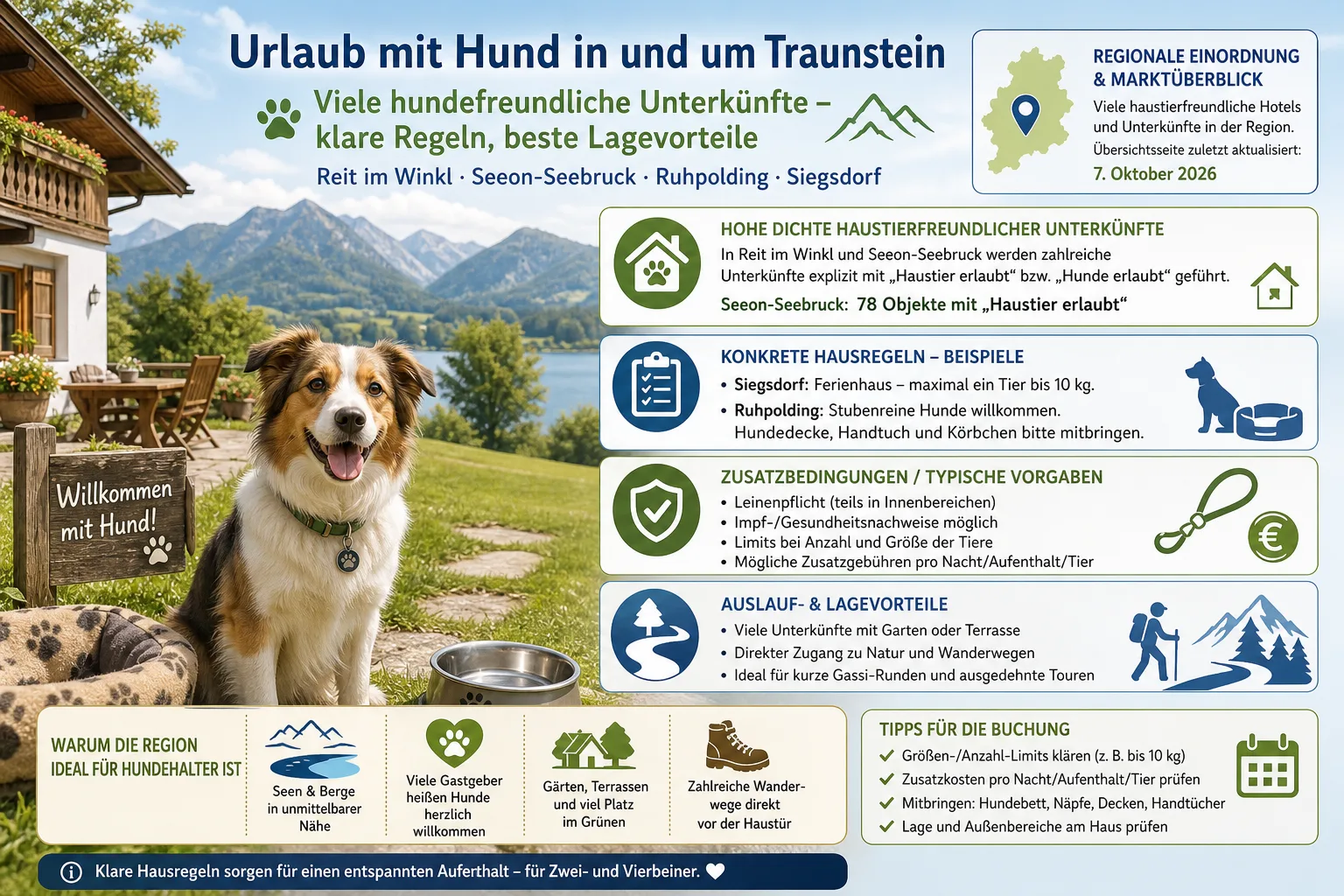
Dog exercise & pet-friendly discovery in Traunstein
Dog exercise & pet-friendly experiences in Traunstein: Event ideas for the coming months (Autumn 2026 to Summer 2027)
Would you like to experience Traunstein and the Chiemgau with your dog in the near future – planned, considerate, and with enough exercise for everyone? This guide compiles exclusively future activities: concrete event ideas for self-organized outings, seasonal “event” suggestions (e.g. morning walks, weekend tours, training walks), as well as a checklist to ensure you are legally compliant and nature-friendly on your outings.
Target group: People who live in Traunstein (or the surrounding area) or will be arriving soon and want to plan in the coming weeks/months walks, hikes, and small-scale dog meetups.
Principles for future outings: Safety, consideration, rules
Before you set a date (whether solo walk, family outing, or mini-meetup), a quick reality check is worthwhile. This increases enjoyment – and reduces conflicts with wildlife, grazing animals, cyclists, and other dog teams.
1) Leash, off-leash & signage
- Follow local signs (e.g. nature reserve/landscape protection, grazing areas, swimming zones, path guidance). If a leash requirement is posted, it applies for the specified time and area.
- Plan off-leash time only where it is responsible: clear areas, reliable recall, no wildlife crossings, no grazing animals, enough distance from playgrounds.
- For group walks (multiple dogs): better to start with leashes in hand, loosen only after “arrival” and a short check-in phase.
2) Nature and animal protection (especially relevant in Chiemgau)
- Stay on paths when sensitive areas are marked – this is a central part of protecting breeding and wild animals in many natural areas.
- Dispose of dog waste: bring bags and dispose of them in the next trash bin (do not leave them by the wayside).
- Grazing animals: keep your distance, leash dogs, walk on calmly; do not approach young animals.
3) Health & travel formalities (if you are arriving soon)
- Vaccination status & parasite protection for upcoming tours should be coordinated with your veterinary practice (e.g. depending on season/region).
- Border crossing/holidays: For travel within the EU, requirements apply (including EU pet passport, identification, valid rabies vaccination). Check the rules in good time before your travel date.
Note on reliability: Specific municipal rules (e.g. leash requirements in certain areas) may change. For every planned event: signage and current notices from the relevant authorities take precedence.
Calendar: Event ideas from October 2026 (future dates only)
The following “events” are self-organized event ideas. They are deliberately formulated so that you can flexibly adapt them to weather, fitness, and local leash rules.
October–December 2026: After-work walks & weekend outings
- From 2026-10-08 (weekdays, evenings): “City-&-Green” after-work walk (45–75 minutes). Plan: start near home, then quiet green connections/paths on the city outskirts, finish with 5–10 minutes of “sniffing time” on a long leash.
- Weekends in November 2026: “Wet and cold, but good” forest path event (60–120 minutes). Focus: non-slip paths, moderate inclines, paw check afterwards.
- Advent season 2026 (afternoons): Training walk “Confident encounters” (30–60 minutes): distance work in busier spots, then a calm finish in a quieter section.
- 2026-12-31 (during the day): “Bang-free” balancing walk (30–90 minutes, depending on the dog): start early, choose a quiet route, prepare a retreat plan for later in the day.
January–March 2027: Building fitness & calm routines
- January 2027 (weekly): “Basic fitness” event (45–70 minutes): steady pace, 2–3 short concentration exercises (sit/wait/hand target), relaxed final round.
- February 2027 (on weekends): “Outdoor nosework” (30–50 minutes): food search games along the path (without leaving trash/food remains), followed by a short exercise session.
- March 2027 (on milder days): “Long-leash explorer walk” (60–120 minutes): focus on calm exploration, leash handling, recall checks in safe situations.
April–August 2027: Early start, shade & water breaks
- April/May 2027 (mornings): “Blossom time” walk (60–90 minutes): choose an early time to reduce conflicts with heavy recreational traffic.
- June–August 2027 (early mornings or late evenings): “Heat-proof” walk (30–75 minutes): prioritize shaded routes, plan a water break, avoid asphalt, take paw/heat stress signals seriously.
- Summer 2027 (monthly): “Considerate by the water” event: short cooling options only where allowed and safe; keep distance from swimming areas and waterfowl.
Season plan: Autumn/Winter 2026, Spring/Summer 2027
Autumn 2026: Structure instead of overwhelm
For many dogs, autumn is ideal for longer distances. For your upcoming events, plan:
- Repeatability: better two similarly structured walks per week than a completely new route each time.
- Encounter management: with more wildlife scent, leash up in advance and reward alternative behaviors.
- Visibility: plan reflectors/light-up collar for dusk events.
Winter 2026/2027: Shorter, meaningful, safer
For future winter walks, sure footing and warm-up count more than kilometers:
- Warm-up: 5–10 minutes of easy walking at the start (also for sporty people).
- Paw care: rinse/dry paws after contact with road salt; avoid slippery sections.
- Rest: in cold weather, better a mental task (sniff/search game) than more speed.
Spring 2027: Consideration for nature – and impulse control
In spring, wildlife activity increases. For your planned events:
- Leash plan: long leash & good handling help you remain considerate without “pulling drama”.
- Distance instead of debate: at narrow spots, move aside early before encounters escalate.
Summer 2027: Heat management as a must
For future summer walks in the region: timing beats willpower.
- Time of day: go early or late; midday events only very short and in the shade.
- Surface: avoid hot asphalt (paw risk).
- Water: bring drinking water; do not plan natural bodies of water as a “safe standard solution” if rules/safety are unclear.
Checklist for your next event
- Route & duration suitable for weather, fitness, daily form.
- Leash set: short leash + possibly long line; well-fitting harness.
- Visibility (dusk): reflectors/light.
- Water + collapsible bowl; small rewards.
- Waste bags (more than you think) + disposal option.
- Plan B: alternative short route if it gets busier than expected.
- Legal check on site: read signage, respect protected areas.
Motto for all future outings: As much freedom as possible – as much security as necessary.
Sources & further information
- BMEL: Traveling with dogs and cats — Overview of requirements and practical tips for planned trips (accessed 2026-10-07)
- Your Europe (EU): Traveling with pets — EU rules, including pet passport/identification/vaccination (accessed 2026-10-07)
- Bavarian Nature Conservation Act (BayNatSchG) — legal framework for the protection of nature and landscape; relevant for behavior in protected areas (accessed 2026-10-07)
- Animal Welfare Act (Germany) — general basic obligations for animal protection (accessed 2026-10-07)