Cultural Education in Traunstein: Culture & Discourse
Cultural Education & Societal Discourse in Traunstein: What Will Be Important in the Coming Months
How can Traunstein anchor culture even more strongly in schools, adult education, monument preservation, and city life in the future? This outlook bundles the next sensible steps, key framework conditions in Bavaria, and concrete starting points for dialogue, participation, and cohesion.
Standpoint: The focus of this article is exclusively on upcoming developments, formats, and courses of action.
Cultural Education in Bavaria: Framework, Goals, Next Steps
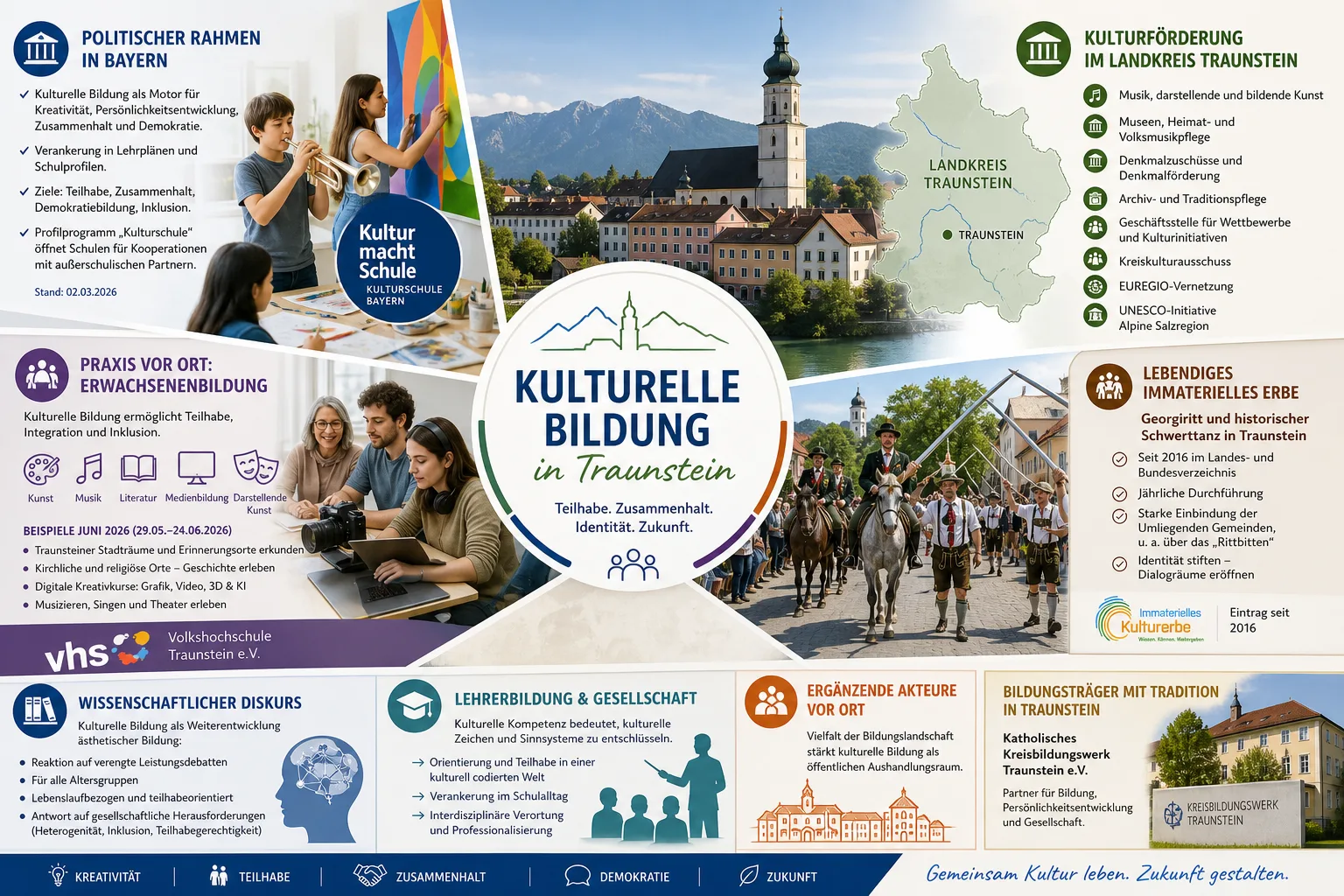
In Bavaria, cultural education is designed as a cross-sectional task: In the coming school years, it should not only run as an individual project, but be permanently anchored in the school profile, in cooperations, and in curriculum development. For Traunstein, this mainly means: Anyone planning new offerings can orient themselves towards clear educational policy targets – cultural participation, personal development, democratic competence, and media literacy.
For the next few months, it is particularly relevant how schools and extracurricular partners jointly develop sustainable formats that do not end with a single action day. In practice, the following have proven effective (and will continue to gain importance):
- Long-term cooperations between schools and cultural partners (e.g. museums, music schools, archives, associations), enabling recurring formats.
- Project-based learning with local anchoring: Topics such as city history, places of remembrance, natural and cultural landscapes, or crafts become occasions for lessons with public presentations.
- Media and digital competence as part of cultural education: future projects will more often combine storytelling, audio/video, photography, and exhibition formats.
- Participation: In the future, students should not only "take part" more often, but also select topics, take on roles (moderation, curation, technology), and be responsible for discussions.
What is crucial is an understanding of education that sees cultural signs, media, and symbolic worlds as the "reading material" of the present: Those who understand culture will be better able to classify debates about values, belonging, and democratic rules in the future – and to shape them themselves.
District of Traunstein: Infrastructure That Makes Future Projects Possible
For cultural education to reliably succeed in Traunstein in the coming years, more than good ideas are needed: It requires plannable support, responsibilities, and contact persons. This is exactly where municipal cultural work becomes a prerequisite for diversity – from cultural and heritage preservation to museums and archives, to monument preservation and project funding.
For new initiatives, it is helpful to clearly think through the future project paths:
- Music & Performing Arts: New series (concerts, workshops, youth formats) can be particularly well combined with educational offerings: rehearsal visits, audience talks, school or adult education modules.
- Museums, Collections, Archives: Future exhibitions and formats can specifically create spaces for discourse if they ask questions instead of just showing (e.g. "What does home mean in a pluralistic city?").
- Monument Preservation: Future renovation and preservation projects offer opportunities for educational modules (building research, craft techniques, energy and sustainability issues) – as public learning on the object.
- Tradition Preservation: Upcoming traditional formats can be explained, contextualized, and made accessible even more (plain language, family offerings, introductions, moderated talks).
- Competitions & Project Funding: Future calls for proposals are most effective when combined with advice, networking, and public presentation venues.
Additionally, cross-border cooperation (e.g. in the EUREGIO context) will play an even greater role in the future when it comes to enabling changes in perspective: What appears "typically" regional – and what is the result of exchange, mobility, and change? Such questions can be addressed particularly well in joint projects.
Georgiritt, Sword Dance & Intangible Cultural Heritage: Future Learning and Discourse Spaces
In Traunstein, upcoming editions of major traditional events (such as the Georgiritt in spring) will likely continue to be strong attractions – not only as tradition, but as occasions for educational and discussion formats. Especially in the context of "living traditions," particularly relevant questions will arise in the future, which cultural education can constructively address:
- Belonging & Openness: How are new residents, families, and guests invited to understand and participate?
- Religion & Plurality: How can religious references be explained so that people with different worldviews can participate without feeling excluded?
- Role Models & The Present: Which aspects of tradition will be preserved in the future – and where are careful developments sensible?
- Mediation: Which formats (introductions, exhibitions, school materials, audio guides) make backgrounds understandable without oversimplifying?
Particularly effective for the future are formats that do not let events "happen without comment," but build learning opportunities around them: moderated talks, short public classifications, exhibition and archive modules, school projects with presentations in public spaces, or digital dossiers that prepare historical sources in an understandable way.
An important principle here is fairness: Cultural education should not idealize tradition across the board nor devalue it across the board. Rather, it creates the conditions for people to make informed judgments, ask respectful questions, and negotiate together how traditions should be lived in the future.
Adult Education: Culture as an Open Space for Learning and Encounter (Outlook)
In the coming semesters, cultural education in Traunstein will grow especially where adults can participate at a low threshold: in courses, workshops, discussion series, and learning formats related to urban space. Adult education centers, church educational institutions, and other providers can reach different target groups – including people who are (re)seeking connection to the urban community.
Particularly effective focal points are emerging for the future:
- Creative Practice: Painting, drawing, writing, music, theater, photography – combined with exhibitions or readings that make results visible.
- Urban Space as a Learning Place: Thematic tours (history, religion, migration, architecture, natural and cultural landscape) as an entry point for conversation and reflection.
- Digital Formats: Podcast, video, and photo story workshops that combine media competence and expression – as a contribution to an informed, respectful public.
- Inclusion & Participation: Future offerings benefit from low barriers, clear communication, and cooperation partners from social work, associations, and self-help.
If these offerings are more closely networked in the future (e.g. joint annual themes, coordinated presentations, cooperations with schools), a recurring cultural "pulse" will emerge, making encounters more likely than chance.
Societal Discourse: How New Formats Make Dialogue More Likely
Societal discourse does not arise automatically – it needs occasions, rules, and spaces. In Traunstein, future cultural and educational formats can provide exactly that if they consciously plan for dialogue: before, during, and after projects.
For the coming months and years, these formats are particularly helpful:
- Moderated discussion series after performances, exhibitions, or lectures, with clear discussion rules and a fair balance between expertise and audience experience.
- School project presentations in public spaces (library, near the town hall, cultural venues), so that young perspectives become visible and receive serious feedback.
- "Curate instead of consume": Citizens develop small exhibitions, themed trails, or digital collections – accompanied by experts from museums/archives/education.
- Cooperations across sectors: Culture + Social + Education + Associations (e.g. intergenerational formats, language and culture tandems, inclusive workshops).
In this way, culture will become even more clearly what it can be in a democratic sense: a shared rehearsal space for changing perspectives, respectful engagement, and practicing the ability to disagree – without people having to lose face.
Outlook: Shaping Traunstein Together – Concrete and Low-Threshold
Anyone who wants to strengthen cultural education and discourse in Traunstein in the future does not need a perfect idea – just a first, feasible step. The following courses of action are designed to work without "insider knowledge" and can realistically be implemented in the coming months.
- Choose a topic: e.g. "Home & Change," "Remembering & Forgetting," "Craft & Future," "Religion & Diversity," "Nature & Cultural Landscape."
- Set a learning location: School, adult education center, museum/archive, urban space, community center, workshop, library.
- Plan a result: Reading, small concert, exhibition, neighborhood walk, podcast episode, photo series.
- Include dialogue: at least 30 minutes of moderated discussion or feedback format – with a clear invitation about what is being asked.
- Seek cooperation: One partner is enough to start; only then grow (e.g. a second school, another association, social project).
If many such small, well-supported steps emerge in parallel, a resilient network will grow in the coming years: culture as everyday practice – not as a niche. This is exactly where the opportunity lies for Traunstein: to connect traditions, institutions, and new forms of expression so that as many people as possible can find themselves and have a say.
Sources & Further Information
The following sources are suitable for reliably deepening future projects, cooperations, and terms (cultural education, intangible cultural heritage, cultural funding).
- Bavarian State Ministry for Education and Culture (KM Bayern) — Information on school framework conditions and educational goals (accessed 2026-06-03)
- Bavarian State Ministry for Science and the Arts (StMWK) — Cultural policy, cultural funding, and programs in Bavaria (accessed 2026-06-03)
- German UNESCO Commission: Intangible Cultural Heritage — Concept, objectives, and basic principles of intangible cultural heritage (accessed 2026-06-03)
- Standing Conference of the Ministers of Education and Cultural Affairs (KMK) — Joint information from the federal states on education, culture, and schools (accessed 2026-06-03)
- City of Traunstein (official website) — Orientation on municipal offerings and contact persons (accessed 2026-06-03)
- District of Traunstein (official website) — Responsibilities and information on district tasks, including culture & education (accessed 2026-06-03)