Children's University Traunstein: Experience Research in the Lecture
Children's University & Science Events in Traunstein: What Families Can Expect in the Coming Months
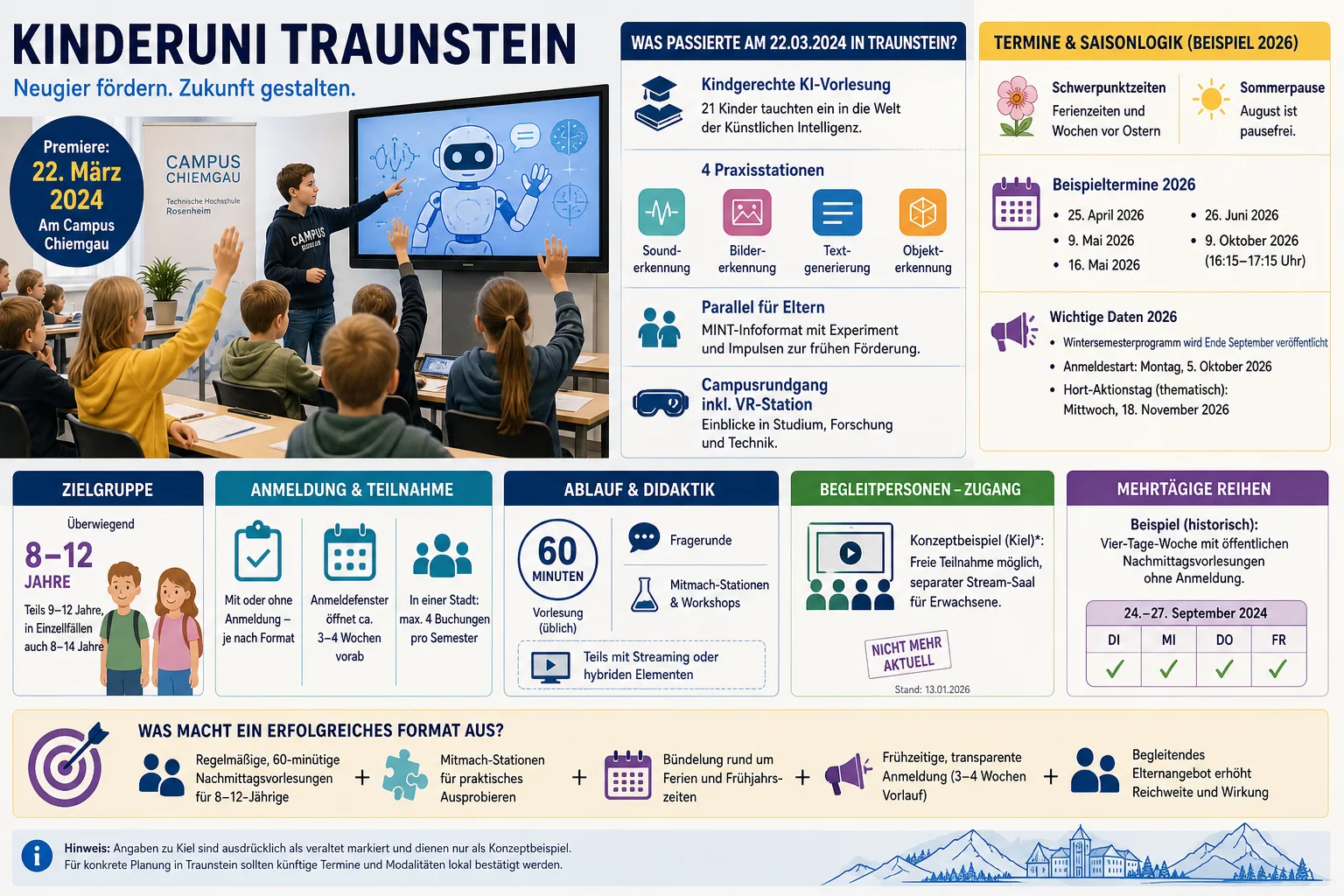
Around the Chiemgau Campus (Rosenheim University of Applied Sciences) in Traunstein, formats are emerging that make science tangible for children and families: child-friendly lectures, hands-on stations, experimental opportunities, and accompanying parent impulses.
Why Science Formats for Children in Traunstein Are Especially Important Right Now
When children experience research not just in textbooks but in a real university environment, it changes their approach to learning: questions are explicitly encouraged, trying things out becomes the core of the experience, and abstract terms like "Artificial Intelligence" (AI) or "data" gain tangible meaning.
In Traunstein, more and more formats are expected in the coming months and semesters that build exactly this bridge: short, child-friendly lectures followed by hands-on stations, supplemented by open science days, workshops, and low-threshold information offers for parents.
This Is How a Children's University Typically Works (and How You Can Prepare)
1) Introduction as a "Lecture": Short, Illustrative, with Q&A
Many children's university formats start with a compact introduction (often around an hour) that is deliberately different from regular lessons: more examples from everyday life, more questions from the audience, less technical jargon. A short Q&A session is often a fixed part.
2) Participation Instead of Just Listening: Stations, Experiments, Mini-Workshops
The second part is usually more practical: children try out at stations what they have just heard. For digital topics, this can mean, for example, that children playfully understand how computers recognize patterns (e.g., in images, sounds, or text) – without needing any prior programming knowledge.
3) Parental Accompaniment: Separate or as a Parallel Program
Modern concepts often separate children's and adults' programs spatially to strengthen children's independence. At the same time, short parent impulses are possible (e.g., "How do I support curiosity in everyday life?"), occasionally supplemented by campus tours or insights into demonstration setups (such as VR/AR).
Which Topics Work Particularly Well at Upcoming Science Events in Traunstein
- Artificial Intelligence in Everyday Life: What can AI do – and what can't it? How do misinterpretations arise? Why are data quality and fairness important?
- Robotics & Hands-On Technology: Sensors, simple control loops, "if-then" logic, small demonstrators.
- Classic Natural Sciences: Air, water, light, sound – with experiments that are safe and age-appropriate.
- Environment & Sustainability: Energy, mobility, recycling, regional ecosystems – ideally with reference to Chiemgau and the Alpine foothills.
- City & Society: How does a city come into being? How are spaces planned? How do media work? (Often surprisingly exciting for children.)
Important: Good children's formats clearly state their limits. Especially with AI topics, this includes children learning why results can sometimes be wrong and why it's important to check sources.
Planning for Families: How to Reliably Find Upcoming Dates
To make sure you don't miss upcoming events, these steps work particularly well in practice:
- Subscribe to Official Event Pages: Look out for the event calendar of the Chiemgau Campus/the Rosenheim University of Applied Sciences and for local cultural and educational portals in the region.
- Plan Ahead: For events with limited spots, registration often opens a few weeks before the date. Those who are early increase their chances of getting a spot.
- Take Age Specifications Seriously: Many children's university offers are aimed at children in primary and early secondary school age (often roughly 8–12). The exact target group varies by event.
- Prepare Questions: A small "question list" from your child (e.g., "How does a computer recognize my voice?") makes the event more interactive.
- Plan for Follow-Up: 10 minutes of conversation on the way home ("What was new? What was surprising?") reinforce what was learned much more than just listening.
Local Reference: Why Such Events Strengthen Traunstein in the Long Term
Science formats for children are more than just a nice afternoon. For Traunstein and the region, they have measurable, long-term effects:
- Educational Participation: A low-threshold offer can lower barriers – especially if "university" is otherwise perceived as distant.
- MINT Orientation: Experiencing self-efficacy early (understanding something, trying something out) increases the likelihood that children will stick with technology or science topics later on.
- Location Loyalty: When children experience their region as a place for future topics, identification grows – a plus for skilled worker development and regional innovation culture.
- Family Friendliness: Regular, well-organized educational events increase Traunstein's attractiveness as a place to live and work.
Safety, Data Protection & Good Practice in Children's Science Formats
Reputable providers typically pay attention to these points at upcoming children's events:
- Child-Appropriate Supervision: clear rules, defined responsibilities, transparent procedures.
- Data Minimization: When digital tools are used, only necessary data should be collected and the purpose explained in an understandable way.
- Age-Appropriate Language: without scaremongering, but with honest classification (e.g., that AI can make mistakes).
- Low-Barrier Organization: understandable information about duration, location, arrival, breaks, and, if necessary, accompanying options.