
Phish
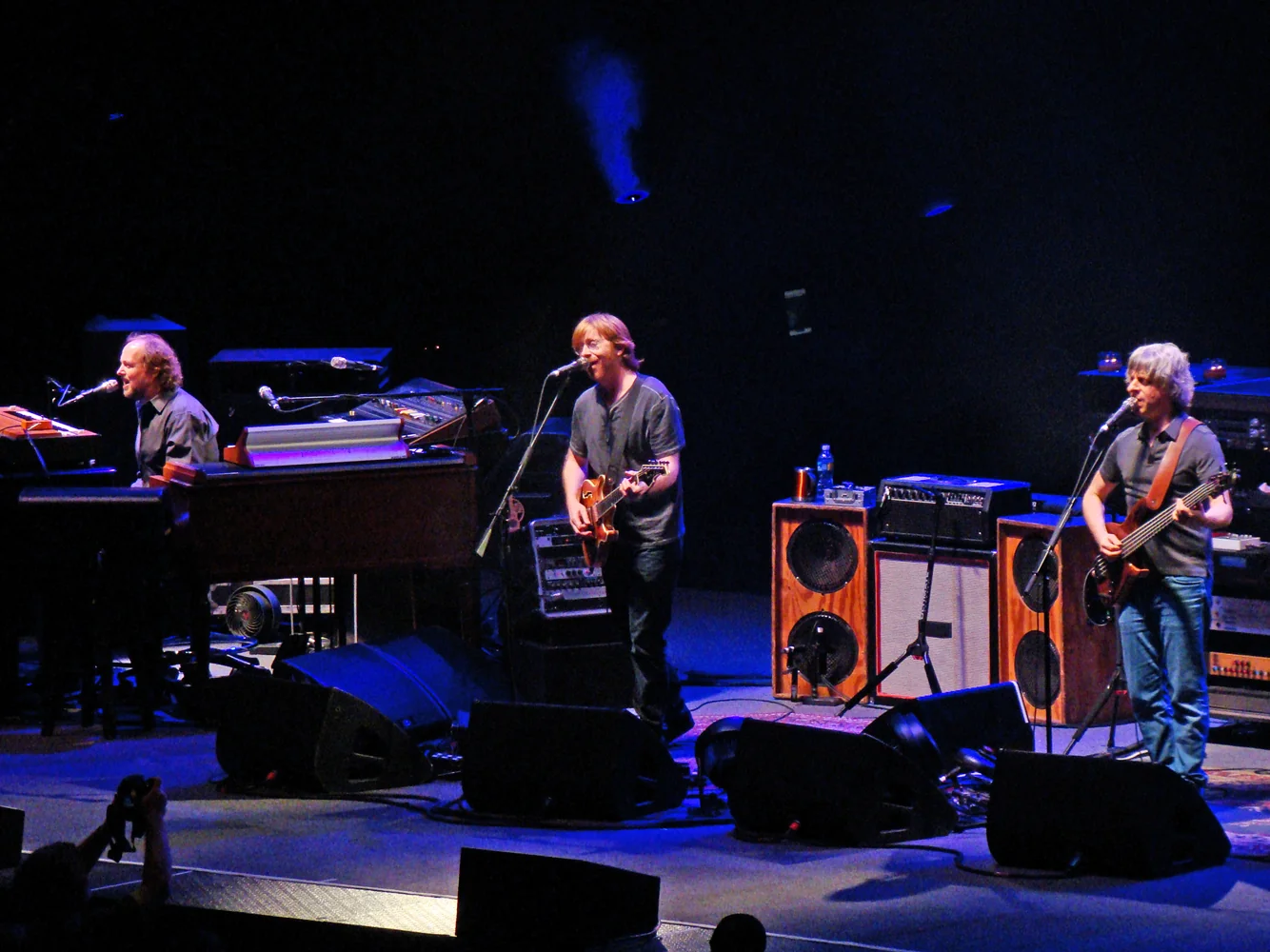
Image from Wikipedia
Image from Wikipedia
Phish: The Masterful Jam Band that Made a Whole Culture Out of Improvisation
A Band from Vermont that Redefined Rock
Phish is one of the most influential American rock bands of the last four decades. The quartet from Vermont is known primarily for its extensive improvisations, spontaneous jam sessions, and a live aesthetic that never relied on radio formats but grew through concert culture and word of mouth. Early on, the band connected rock with fusion, bluegrass, folk, blues, and progressive rock into a style that fully unfolded its brilliance on stage. ([en.wikipedia.org](https://en.wikipedia.org/wiki/Phish?utm_source=openai))
Phish represents a music career that did not follow linear pop conventions but emerged from experimentation, community, and constant artistic evolution. The band became a reference for jam band culture because it did not just play songs but opened musical spaces where risk, interaction, and collective ecstasy came together. This is precisely where their unique authority within American live music still lies today. ([en.wikipedia.org](https://en.wikipedia.org/wiki/Phish))
The Beginnings: Burlington, College Energy, and the Birth of Phish
The story begins in the mid-1980s in Burlington, Vermont, where Trey Anastasio, Mike Gordon, Jon Fishman, and later Page McConnell formed the core of the band. In 1984, they gave themselves the name Phish, just before they played their first concert together; Anastasio also designed the distinctive logo featuring a stylized fish. From student experiments and local clubs, a band emerged that early on focused on long formats, humor, musical detours, and collective interplay. ([en.wikipedia.org](https://en.wikipedia.org/wiki/Phish))
Significant impulses came from the environment of Goddard College and the Burlington alternative scene. Collaborations with Richard “Nancy” Wright, Jim Pollock, and later with sound engineer Paul Languedoc shaped the early identity of the band, as did Anastasio's Senior Project, which combined progressive rock, conceptual dramaturgy, and the myth of Gamehendge. This mix of college intelligence, scene proximity, and serious song architecture remains a core of the Phish mythos to this day. ([en.wikipedia.org](https://en.wikipedia.org/wiki/Phish))
The Breakthrough: From Regional Cult to National Live Power
The actual breakthrough did not come through MTV or constant radio rotation, but rather through a legendary regional live moment: the sold-out concert at the Paradise Rock Club in Boston on January 26, 1989. Here, the extent of the growing fan base became apparent, as fans not only listened to Phish but traveled to shows to witness the music unfolding in the moment. The journey through the club and theater circuit made the band one of the most important live formations of their time. ([en.wikipedia.org](https://en.wikipedia.org/wiki/Phish))
With Junta, Lawn Boy, and later Rift and Hoist, the group established its discography as an interplay of songwriting, compositional complexity, and stage transformation. Rift made it for the first time into the Billboard 200, and Hoist brought a first chart hit in rock radio with “Down with Disease.” Simultaneously, their live shows grew into multimedia events featuring light design by Chris Kuroda, audience interaction, and an increasingly ritualized concert dramaturgy. ([en.wikipedia.org](https://en.wikipedia.org/wiki/Phish))
The Live Aesthetic: Improvisation as an Art Form
Phish became famous because the band never remained static on stage. Songs like “You Enjoy Myself,” “Mike’s Song,” “Tweezer,” or “Carini” evolved into open forms where groove, harmonic surprise, and spontaneous modulations became more important than exact reproductions of the studio versions. The concerts relied on moment logic: a motif could be extended, deconstructed, or directed into completely new paths for minutes on end. This is the reason why Phish holds such a prominent place in jam band history. ([en.wikipedia.org](https://en.wikipedia.org/wiki/Phish))
The band cultivated its own fan economy. Instead of relying on massive radio hits, a sustainable and almost academically documented live archive emerged, whose significance was further amplified by platforms like LivePhish. The official catalog shows how many versions of individual songs have appeared over decades, underscoring the role of improvisation as a central artistic principle. ([phish.com](https://phish.com/news/watch-all-4-nights-at-the-garden/?utm_source=openai))
Discography: Studio Albums, Live Catalog, and Cult Titles
The discography of Phish is broad, idiosyncratic, and remarkably coherent for a band focused on live improvisation. Key studio albums include Junta, Lawn Boy, A Picture of Nectar, Rift, Hoist, Billy Breathes, The Story of the Ghost, Farmhouse, Joy, Sigma Oasis, and Evolve. In addition, there is an extensive live catalog that documents the band's live identity and is even more important to many fans than the studio works. ([en.wikipedia.org](https://en.wikipedia.org/wiki/Phish))
Especially notable is A Live One, which became the band's best-selling album and reached platinum status. Farmhouse also made history, as “Heavy Things” became Phish's only number to appear significantly on mainstream pop radio. Later, Evolve demonstrated that the band could mobilize new studio energy even in the 21st century: The album was released in 2024, contained four singles, and reached number 69 on the Billboard 200 in the U.S. ([en.wikipedia.org](https://en.wikipedia.org/wiki/Phish))
Current Phase: Evolve, Archive Work, and New Tour Ambitions
2024 marked an important snapshot of the present for Phish. With Evolve, the band released its sixteenth studio album; the title tracks “Evolve,” “Oblivion,” “Hey Stranger,” and “Life Saving Gun” were released as singles between April and July 2024. The album was produced by Bryce Goggin and Vance Powell, released via JEMP Records, the band’s own label. ([en.wikipedia.org](https://en.wikipedia.org/wiki/Evolve_%28Phish_album%29))
The official website also shows how active Phish remained in 2025 and 2026: an announced Summer Tour 2026, nine shows in Las Vegas at Sphere, and a new vinyl box set with New Year’s Eve 1993 Live at Worcester Centrum are among the most visible recent projects. Archive releases through LivePhish and JEMP Records remain a central part of the band's strategy. Phish is thus working on both the present and memory: new music, new touring, and old shows as curated cultural history. ([phish.com](https://phish.com/))
Style and Musical Development: Between Jazz-Funk, Progressive Rock, and Folk Refinement
Phish's style can never be reduced to a single genre. The band blends rock with fusion, bluegrass, folk, blues, and progressive rock, with arrangements often combining complex forms with surprisingly loose grooves. In their best moments, the band thinks like a prog-rock formation but plays with the openness of a jazz group and the directness of a bar band. ([en.wikipedia.org](https://en.wikipedia.org/wiki/Phish?utm_source=openai))
This very complexity shapes their artistic development. Early on, improvisational wit was at the forefront, later refined song architectures, conceptual albums, and increasingly mature harmonies were added. On Evolve, this maturity is evident in a more song-oriented production, string arrangements, and a consciously controlled tension between structured composition and open band communication. ([en.wikipedia.org](https://en.wikipedia.org/wiki/Evolve_%28Phish_album%29))
Critical Reception and Cultural Influence
Phish is a band with enormous cultural impact, even though it has long operated outside of classic mainstream mechanisms. The group developed one of the most loyal fan communities in American rock and simultaneously became a counter-model for a music culture where live experience is more important than chart logic. Music journalists have described this position for years as unique: Phish polarizes, fascinates, and maintains its relevance through the stage, not through a single success narrative. ([en.wikipedia.org](https://en.wikipedia.org/wiki/Phish?utm_source=openai))
The reception of Evolve was nuanced. While some reviews highlighted the instrumental energy and interplay, others saw weaknesses in the lyrical side or judged the album as a deliberately subdued but solid studio effort. Regardless of classification, a fundamental pattern of Phish emerges here: the band is not defined by shiny consensus opinions, but by endurance, community, and the impact of their live moments. ([relix.com](https://relix.com/reviews/detail/phish-evolve/?utm_source=openai))
Why Phish Remains Exciting to This Day
Phish remains exciting because the band takes the principle of musical presence seriously. Every show is an event, every setlist a possible reinvention, every groove an open question. In a pop world often based on repetition and control, Phish shows how radically alive a band can still sound after decades. ([phish.com](https://phish.com/song/tube/?utm_source=openai))
Those who experience Phish live do not encounter mere nostalgia but an ongoing work in movement. This blend of technical brilliance, collective intuition, and almost ritualistic stage presence is what makes it compelling. Phish is not a band you simply listen to; Phish is a band you must experience. ([en.wikipedia.org](https://en.wikipedia.org/wiki/Phish))
Official Phish Channels:
- Instagram: https://www.instagram.com/phish
- Facebook: https://www.facebook.com/phish
- YouTube: https://www.youtube.com/user/phish
- Spotify: https://open.spotify.com/artist/5wbIWUzTPuTxTyG6ouQKqz
- TikTok: https://www.tiktok.com/@phish