
Münchener Kammerorchester
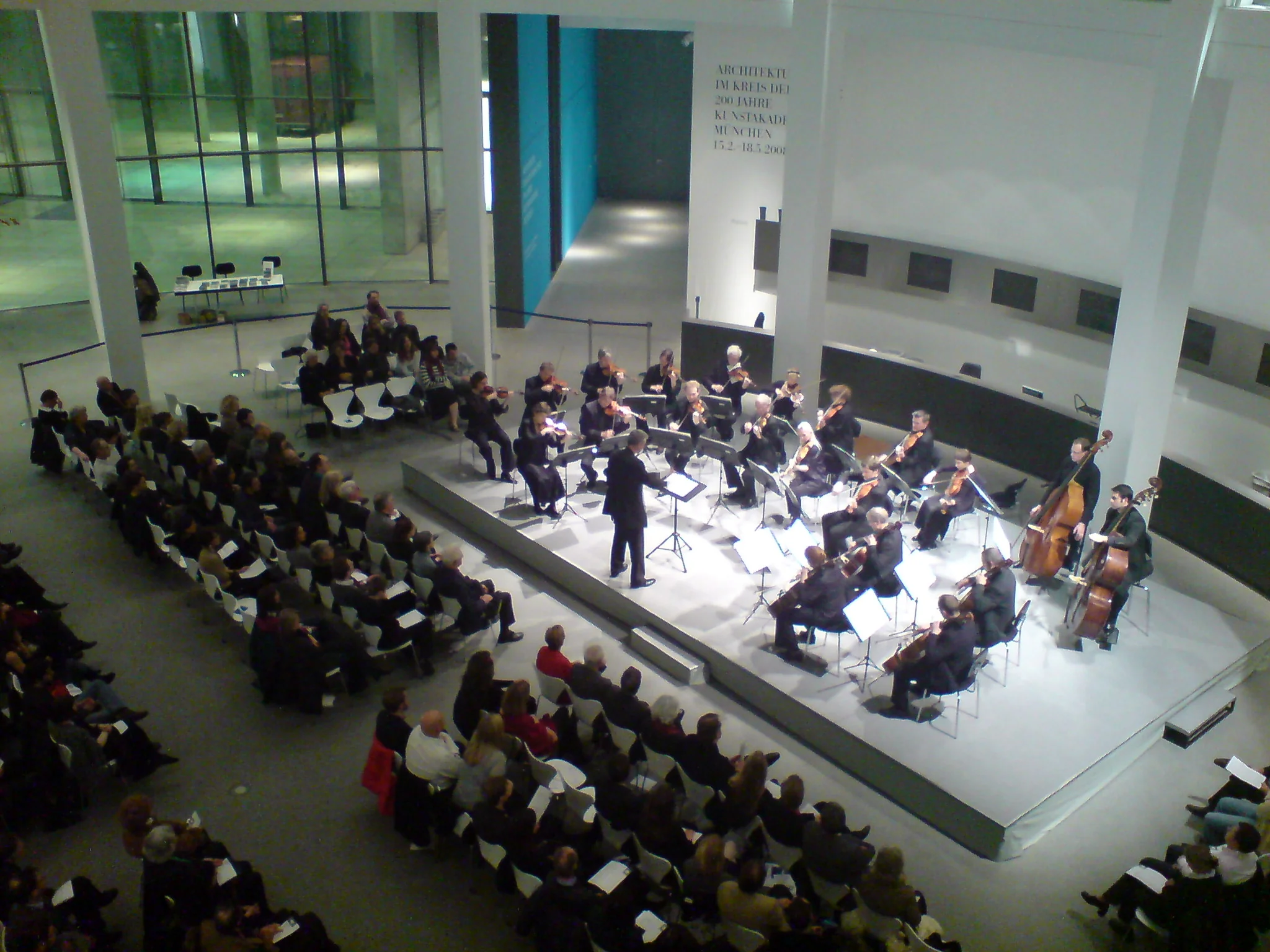
Image from Wikipedia
Image from Wikipedia
Munich Chamber Orchestra: Munich Sound Culture between Tradition, Present, and New Beginnings
A distinctive orchestra with character, courage, and a unique signature
The Munich Chamber Orchestra (MKO) is one of the defining ensembles in the German orchestral landscape. Since its founding in 1950, the ensemble has evolved from a chamber music formation into an internationally recognized orchestra, celebrating its 75th anniversary in 2025. Today, the MKO consists of 28 permanent musicians and is known for its stylistic flexibility, transparency, and programming curiosity. ([de.wikipedia.org](https://de.wikipedia.org/wiki/M%C3%BCnchener_Kammerorchester))
Its profile is based on a rare balance of historical sensitivity and contemporary relevance. Classical, Romantic, and contemporary music are not presented side by side in the repertoire, but rather engage in a lively dialogue. This is exactly where the Munich Chamber Orchestra derives its radiance: as an ensemble that not only performs but also interprets, elucidates, and opens cultural spaces. ([de.wikipedia.org](https://de.wikipedia.org/wiki/M%C3%BCnchener_Kammerorchester))
The Emergence of a Munich Institution
The history of the orchestra begins with Christoph Stepp, who founded the ensemble in 1950. A decisive formative process was shaped by Hans Stadlmair, who led the MKO from 1956 to 1995 and refined its artistic substance over decades. With Christoph Poppen taking the helm in 1995, the juxtaposition of classical repertoire and contemporary music moved more into focus; thus, the orchestra gained the aesthetic tension that continues to define its reputation today. ([de.wikipedia.org](https://de.wikipedia.org/wiki/M%C3%BCnchener_Kammerorchester))
Later, Alexander Liebreich and Clemens Schuldt served as chief conductors before the MKO transitioned to a model with three Associated Conductors starting in the 2022/23 season. Jörg Widmann, Enrico Onofri, and Bas Wiegers now represent different artistic approaches that keep the ensemble consciously open and multifaceted. This structure demonstrates how strongly the orchestra values versatility, exchange, and continuity. ([de.wikipedia.org](https://de.wikipedia.org/wiki/M%C3%BCnchener_Kammerorchester))
Musical Development: Chamber Music Thinking on an Orchestral Scale
The MKO understands orchestral performance as an extension of chamber music. This principle is more than just a buzzword: it shapes articulation, balance, phrasing, and the attentive listening among the ensemble. This results in a sound picture that is slender, precise, and simultaneously energetic, with a high level of clarity even in complex scores. ([m-k-o.eu](https://www.m-k-o.eu/media/diskographie/))
The artistic uniqueness of the orchestra lies particularly in the combination of music from earlier centuries with contemporary compositions. The MKO does not seek to reproduce old works in a museum-like fashion, but rather to provide vibrant interpretations. Old works appear in a new light, new works gain historical depth, and both realms nourish each other. ([de.wikipedia.org](https://de.wikipedia.org/wiki/M%C3%BCnchener_Kammerorchester))
Programmatic Curiosity and Munich Affiliation
At the center of Munich's concert activities is the Prinzregententheater as the main venue. Additionally, series such as "Modern Night Music" at the Pinakothek der Moderne and the "MKO Songbook" at Schwere Reiter are part of the offerings. These formats clearly indicate that the orchestra not only performs concerts but also curates musical contexts. ([de.wikipedia.org](https://de.wikipedia.org/wiki/M%C3%BCnchener_Kammerorchester))
The 2025/26 season is titled "Wonderland" and aligns with the ensemble's curiosity for unusual perspectives. The website highlights current projects such as the portrait concert for Toru Takemitsu, concerts with András Schiff/Anderszewski, and the anniversary concert for the 75th birthday. With this, the MKO positions itself clearly as an ensemble that views anniversaries not as a look back but as a space for new ideas. ([m-k-o.eu](https://www.m-k-o.eu/))
Commissions, Premieres, and Contemporary Music
A key feature of the artistic identity is the numerous composition commissions. In recent years and decades, the orchestra has added works by composers such as Tan Dun, Pascal Dusapin, Georg Friedrich Haas, Salvatore Sciarrino, Christian Wolff, Milica Djordjevic, Tigran Mansurian, Clara Iannotta, Mark Andre, Stefano Gervasoni, Márton Illés, Miroslav Srnka, Lisa Streich, Johannes Maria Staud, and Dieter Ammann to its repertoire canon. ([de.wikipedia.org](https://de.wikipedia.org/wiki/M%C3%BCnchener_Kammerorchester))
Thus, the MKO has accomplished far more than just performing new works: it has actively contributed to the creation of contemporary chamber orchestra literature. This emphasis is especially evident in concerts without a conductor, where the musicians take responsibility for form, impulse, and inner dramaturgy under the leadership of their concertmaster. This fosters a highly concentrated, collective music culture. ([de.wikipedia.org](https://de.wikipedia.org/wiki/M%C3%BCnchener_Kammerorchester))
Discography and Recordings: A Sonic Archive of Attitude
The discography of the Munich Chamber Orchestra consistently documents its artistic mission. Recordings featuring works by Karl Amadeus Hartmann, Sofia Gubaidulina, Giacinto Scelsi, Valentin Silvestrov, Isang Yun, Joseph Haydn, Toshio Hosokawa, Tigran Mansurian, and Thomas Larcher have been released by ECM Records; additionally, a complete recording of Beethoven's piano concertos with Alexander Lonquich is included. These releases demonstrate a repertoire understanding that consciously intertwines historical legacy and modern tonal language. ([m-k-o.eu](https://www.m-k-o.eu/media/diskographie/))
In 2025, a new collaboration began with Enrico Onofri and harmonia mundi featuring the Mozart serenades, including "Eine kleine Nachtmusik," the "Posthorn Serenade," and the "Haffner Serenade." A multi-part edition is already anticipated for 2026, in which Onofri juxtaposes Beethoven’s symphonies with works by Italian contemporaries. Such projects showcase the international relevance of the MKO both in the studio and on stage. ([m-k-o.eu](https://www.m-k-o.eu/media/diskographie/))
Critical Reception: Recognition for Transparency and Expressiveness
The press particularly praises the MKO for its sound transparency, stylistic variability, and ability to infuse music with fresh tension. On the official press page, the orchestra is described as a “butterfly” among Munich's top orchestras; at the same time, the Süddeutsche Zeitung highlights the metamorphosis from a divertimento-oriented ensemble to a guarantor of captivating programs. Bachtrack notes that the orchestra could have long been awarded Michelin stars for its performances of contemporary compositions. ([m-k-o.eu](https://www.m-k-o.eu/media/presse/))
Even the more recent press voices remain enthusiastic: Die Abendzeitung praises the brilliant, transparent coloring and the forward-driving pulse, while the Münchner Merkur speaks of “the unheard” that was celebrated by the audience at the Prinzregententheater in 2026. This response underscores that the MKO is not perceived as an interchangeable ensemble, but rather as an artistic authority with a clear stance and high recognizability. ([m-k-o.eu](https://www.m-k-o.eu/media/presse/))
Tours, Collaborations, and International Presence
With around fifty concerts per year, the Munich Chamber Orchestra has a presence far beyond Munich. Guest performances have taken the ensemble to Europe, Asia, South America, and the USA; particularly strong is the collaboration with the Goethe-Institut and with renowned festivals and venues in Munich. This international reach is not ancillary but an integral part of the artistic identity. ([de.wikipedia.org](https://de.wikipedia.org/wiki/M%C3%BCnchener_Kammerorchester))
Additionally, there are collaborations with soloists such as Isabelle Faust, Alexander Lonquich, Jean-Guihen Queyras, Christian Tetzlaff, and Steven Isserlis. These partnerships strengthen the orchestra's reputation as an ensemble at the highest interpretive level. It is particularly in such formations that the unique blend of precision, flexibility, and a sense of musical dramaturgy unfolds. ([de.wikipedia.org](https://de.wikipedia.org/wiki/M%C3%BCnchener_Kammerorchester))
Cultural Influence and Artistic Authority
The Munich Chamber Orchestra has sustainably shaped the chamber orchestra culture in Germany. It represents a repertoire understanding that does not sort works by epochs but by resonant spaces, ideas, and aesthetic tensions. Thus, the ensemble acts as a mediator between tradition and modernity, between the concert hall and societal discourse. ([de.wikipedia.org](https://de.wikipedia.org/wiki/M%C3%BCnchener_Kammerorchester))
Institutionally, the MKO also possesses authority: the accolades range from the 2023 Bavarian State Prize for Music to the 2018 ICMA, as well as Echo Klassik Awards and earlier prizes for the best concert program design. These honors reflect not only success but also a long-standing artistic reliability. ([de.wikipedia.org](https://de.wikipedia.org/wiki/M%C3%BCnchener_Kammerorchester))
Fan Voices
No verifiably official social media profiles with substantial fan comments from search results have been used for this section. Therefore, the description remains grounded in the secured press and source material and consciously refrains from unsubstantiated fan quotes. ([m-k-o.eu](https://www.m-k-o.eu/media/presse/))
Conclusion: Why the Munich Chamber Orchestra Remains So Exciting
The Munich Chamber Orchestra combines the focus of a chamber ensemble with the breadth of a top orchestra. Its artistic development speaks of courage for renewal, precise sound work, and a clear attitude towards contemporary music. Those who experience the MKO do not hear a routine orchestra but rather an ensemble that continually interrogates its repertoire. ([de.wikipedia.org](https://de.wikipedia.org/wiki/M%C3%BCnchener_Kammerorchester))
Especially in live performances, the refinement of the strings, the tension of the programs, and the dramatic precision of the interpretation unfold. Therefore, the Munich Chamber Orchestra remains a must-see for music lovers seeking openness, virtuosity, and stylistic intelligence. It is worth experiencing this orchestra in concert. ([m-k-o.eu](https://www.m-k-o.eu/))
Official Channels of the Munich Chamber Orchestra:
- Instagram: https://www.instagram.com/mko_muenchen
- Facebook: https://www.facebook.com/muenchenerkammerorchester/
- YouTube: https://www.youtube.com/channel/UC9rhSQJBjt0r8GSZvYC5Vzw
- Spotify: No official profile found
- TikTok: No official profile found
Sources:
Upcoming Events
7th Subscription Concert
8th Subscription Concert
Munich Chamber Orchestra - Chamber Music Festival at Villa Stuck
2nd Prizewinner Concert with the Munich Chamber Orchestra - 75th International Music Competition of ARD
MKO / Goldscheider / Onofri / Rossini, Strauss, Spontini, Beethoven / 1. Subscription
Weidener Meisterkonzerte e.V. at the Max-Reger-Halle: Munich Chamber Orchestra with Beethoven in Weiden
Weiden Master Concerts EV 4: Munich Chamber Orchestra
Munich Chamber Orchestra in Weiden