
Leo Lionni
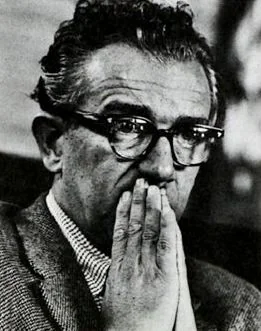
Image from Wikipedia
Image from Wikipedia
Leo Lionni: The Poet of Form, Color, and Narrative Clarity
An Artist Between Modernity, Illustration, and Timeless Children's Literature
Leo Lionni is considered one of the formative figures in modern picture book art. Born in 1910 in Amsterdam and passed away in 1999 in Radda in Chianti, he combined graphic elegance, narrative reduction, and humanistic warmth into a distinctive body of work. As a graphic artist, painter, designer, and writer, he moved between Europe and the USA for decades, shaping an artistic language that continues to captivate readers and experts alike. His career resembles a polyphonic artwork: intellectual, sensual, and formally precise.
Encountering Leo Lionni means meeting not just a children's book author but an artist who set new standards with color, space, and composition. His picture books, in particular, made him world-famous and established a reputation that extends far beyond children's literature. Lionni's work symbolizes a rare synergy of stylistic authority, poetic simplicity, and cultural sustainability. This is exactly where his lasting fascination lies.
From Amsterdam to Italy: Early Years and Intellectual Formation
Leo Lionni was born in Amsterdam to a Jewish diamond cutter and a singer. The family moved to Italy early, and Lionni grew up in a European tension of languages, cultures, and political upheavals. This mobility had a lasting impact on his later thinking, as did his education, which initially led him not directly into art but into economics. He completed his studies in Genoa in 1935 and received a doctorate in economics.
However, economics was just one chapter in a much larger artistic biography. Lionni quickly immersed himself in the visual world of modernity and developed a sensitivity to reduction, rhythm, and visual dramaturgy. Even in Italy, he made a name for himself as a painter before shifting his focus more toward design. This early versatility explains why his later picture books do not appear as mere illustrations but as carefully composed visual narratives.
New York, Fortune, and the School of Visual Precision
In 1939, Lionni moved to the United States and built a career as an advertising graphic designer and art director. He worked for renowned agencies and later for the magazine Fortune, where he served as art director from 1948 to 1960. During this phase, he learned the language of clear messaging, concise image composition, and typographic concentration at the highest level. Even outside of his permanent position, he was in demand as a designer, working on projects for international brands and institutions.
His significance in American graphic history extends well beyond individual assignments. Lionni combined the rigor of editorial design with the experimental spirit of the avant-garde, making him a key figure bridging advertising, art, and visual culture. He worked in an environment characterized by innovation and modernism, demonstrating exceptional sensitivity to composition. These experiences laid the foundation for his later work as a picture book author.
The Late Breakthrough as a Picture Book Artist
The true international breakthrough came remarkably late: Lionni published his first picture book, Little Blue and Little Yellow, in 1959 at the age of 49. The story arose from an improvised tale for his grandchildren and already exhibits all the characteristics of his style: simple forms, clear color areas, and a narrative that creates emotional depth with just a few elements. The success of this book marked the beginning of a new phase in Lionni's career, during which he became one of the most important names in children's literature.
Over the following decades, he created more than 40 books for children. Works such as Swimmy, Frederick, Alexander and the Wind-Up Mouse, and A Color of His Own became classics because they address existential themes in seemingly effortless visual language. Lionni told stories about belonging, individuality, solidarity, imagination, and self-assertion, never coming across as didactic. His books speak directly to children, but they also function as sophisticated cultural texts for adults.
The Work: From Little Blue and Little Yellow to Between Worlds
The bibliographic range of Lionni's work is impressive and consistent. Following Little Blue and Little Yellow, he published, among others, Inch by Inch, Swimmy, Frederick, The Biggest House in the World, Fish Is Fish, Pezzettino, A Color of His Own, Tillie and the Wall, and Matthew’s Dream. Each of these books bears its own formal signature, yet remains immediately recognizable as Lionni's work. His approach to collage, cut-out, and color fields is particularly striking, transforming his pages into small stages of perception.
His late work Between Worlds, published in 1997, almost programmatically summarizes his artistic existence. The title alludes to the many liminal spaces in which Lionni lived: between countries, disciplines, visual worlds, and narrative forms. His autobiography also reflects this movement. Lionni never considered himself a specialist in a single medium but as an artist with an open horizon, intertwining drawing, painting, sculpture, photography, and book art.
Style, Technique, and Artistic Signature
Leo Lionni's style is defined by reduction, balance, and emotional precision. His characters are often animals or small beings that may appear simple at first glance, yet pose complex questions in their deeper content. The visual language employs cut-out shapes, calm areas, and a dramaturgy that derives significance from the minimal. This is where his mastery shines: Lionni transformed minimalism into resonance rather than emptiness.
From an art historical perspective, his work is also remarkable. Lionni combined elements of modernism, collage, and graphic abstraction with an accessible narrative style that remains comprehensible to both children and adults. His compositions possess an almost musical order in a figurative sense: repetition, variation, contrast, and resolution structure the pages like sentences in a finely crafted piece. This clarity explains why his books remain present in educational, family, and museum contexts to this day.
Awards, Recognition, and Cultural Authority
Lionni's work received early and repeated recognition. He won four Caldecott Honor Awards for Inch by Inch, Swimmy, Frederick, and Alexander and the Wind-Up Mouse, along with the AIGA Gold Medal Award, one of the most prestigious honors in graphic design. Such awards emphasize that Lionni was recognized not only as a children's book author but also as an outstanding visual designer.
His influence is also institutionally visible. The Smithsonian American Art Museum, the Carle Museum, and other significant organizations recognize him as a central figure in American and international illustration history. The reception of his books spans educational contexts to art historical analyses. It is often noted that Lionni found a visual language that takes children seriously while remaining aesthetically sophisticated.
Cultural Influence and Sustainable Impact
Leo Lionni has significantly shaped the modern picture book. His stories about individuality, community, and self-discovery are still relevant today because they do not rely on trendy effects but on universal experience. Characters like Frederick or Swimmy have long become cultural symbols that continue to thrive in schools, exhibitions, publishing houses, and the collective memory. Lionni did not create mere children's stories but small lessons in humanity in visual form.
His role as a mentor and role model remains important. Exhibition texts and biographical tributes consistently emphasize how strongly Lionni inspired other artists, including Eric Carle. His interdisciplinary career shows that graphic design, literary imagination, and aesthetic vision are not separate spheres. This is why his work possesses a rare enduring presence that transcends generations.
Current exhibitions and book projects surrounding Leo Lionni demonstrate that his work continues to be newly interpreted and staged. For his 100th birthday and beyond, museums, publishers, and media have once again focused on his visual worlds. Lionni thus remains not only a classic but a living reference point for illustration, design, and narrative clarity. His books feel timeless because they pose the big questions with quiet, consummate authority.
Conclusion: Why Leo Lionni Continues to Inspire
Leo Lionni is fascinating because he created art of lasting depth from simplicity. His career tells stories of migration, reorientation, and later mastery; his books of empathy, individuality, and visual intelligence. Engaging with Lionni means discovering not only a classic of children's literature but an exceptional artist with great formal discipline and poetic breadth. His works deserve to be read, viewed, and rediscovered again and again.
In live exhibitions, book presentations, and museum contexts, the power of his visual language is particularly evident. There, it becomes clear how modern his collages, how refined his compositions, and how warm his stories remain. Leo Lionni is an artist who connects generations and has elevated the language of picture books to a high cultural level. Experiencing him means witnessing the quiet grandeur of art in its purest form.
Official Channels of Leo Lionni:
- Instagram: no official profile found
- Facebook: no official profile found
- YouTube: no official profile found
- Spotify: no official profile found
- TikTok: no official profile found
Sources:
- Leo Lionni - Official Website
- Leo Lionni - Books and Works Overview
- Leo Lionni - Official Video Page
- The Eric Carle Museum of Picture Book Art - Leo Lionni
- Smithsonian American Art Museum - Leo Lionni
- Wikipedia - Leo Lionni
- Deutschlandfunk - Leo Lionni passed away 20 years ago
- Verlagsgruppe Oetinger - Leo Lionni
- Penguin Random House - Leo Lionni
- AIGA / Creative Hall of Fame - Leo Lionni
Upcoming Events
Mouse Stories