
Hosea Ratschiller
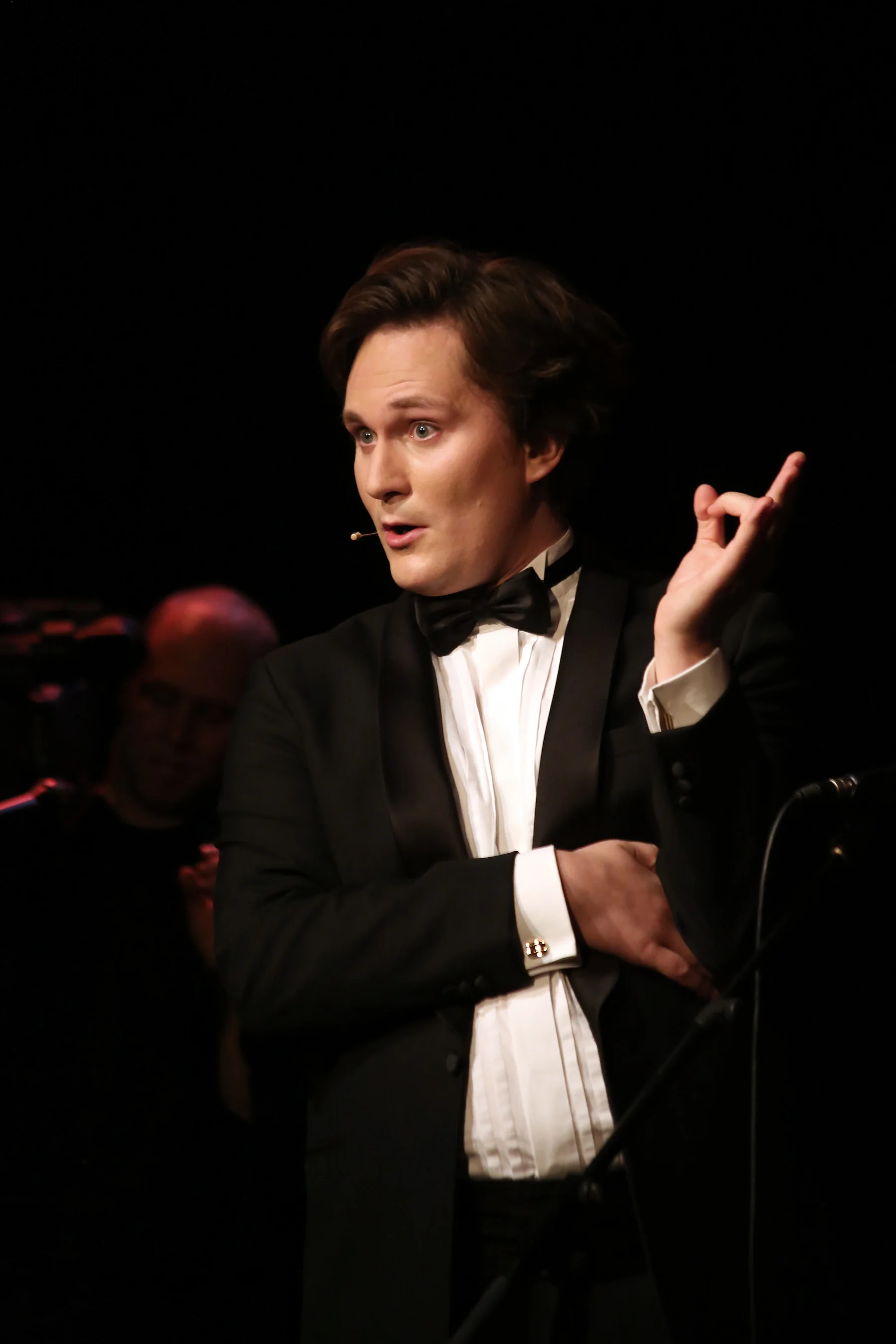
Image from Wikipedia
Image from Wikipedia
Hosea Ratschiller: Satire, Stage Presence, and the Art of Precise Presence
An Austrian cabaret artist with a sharp eye on the zeitgeist and society
Hosea Ratschiller, born on October 11, 1981, in Klagenfurt am Wörthersee, is one of the most distinctive voices in Austrian cabaret. The actor, satirist, columnist, moderator, and radio creator combines stage work, radio, television, and literature into a distinctive artistic signature that is based on keen observation, a sense of rhythm, and linguistic precision. His career is closely linked to public broadcasting, the cabaret scene in Vienna, and a form of humor that views social criticism not as a slogan but as a precisely articulated stream of punchlines. (de.wikipedia.org)
Biography: From study to public voice
Ratschiller dropped out of a program in history, philosophy, and theater studies in Vienna and subsequently completed civilian service at the Sanatorium of the Jewish Community. Since 2000, he has worked at the youth station FM4 of ORF, and since 2009 also for Ö1. This early foundation in radio shaped his language: quick, mentally agile, pointed, and at the same time marked by a noticeable literary care. (de.wikipedia.org)
His professional development does not show a linear one-way street but a wide field between authorship, moderation, voice work, and live performance. For ORF formats like Wir sind Kaiser and Dorfers Donnerstalk, he wrote as an author, while at the same time becoming a fixed figure in the Austrian media landscape with radio columns and satirical shows. This versatility makes him an artist who functions not only on stage but also in the acoustic space. (de.wikipedia.org)
Career start: Radio as a school of timing
Ratschiller's work was early on characterized by collective projects and experimental radio concepts. From 1998 to 2003, the weekly live show Club Karate aired on Radio Orange 94.0; later, he was not only an employee at FM4 but also sometimes the head of program design. In 2006, he conceived the interactive column FM4 Ombudsmann together with Martin Puntigam, followed by the weekly satirical show FM4 Chance 08 and the daily O-Ton podcast Die Ausweitung der Fanzone in 2007 and 2008. (de.wikipedia.org)
These years in radio are central to Ratschiller's artistic development as they laid the groundwork for his stage presence. Those who must react precisely in live radio develop a sense for timing, pauses, escalation, and precision landing. This very timing later shapes his solo programs, where language not only conveys content but becomes a comedic and critical motor in itself. (de.wikipedia.org)
The breakthrough on stage: Solo programs with dramaturgical coherence
His stage work began in 2001 with the play Mäht sich weg and led through ensemble projects like the Supernacht der Weihnachtsstars and the opera Schock – Ein Hunderennen in Innsbruck to a series of solo programs. Liebe Krise (2009), Das gehört nicht hierher (2011), Die FM4 Ombudsmann Dienstreise (2012), Heute: Hosea Ratschiller (2013), Der allerletzte Tag der Menschheit (Jetzt ist wirklich Schluss!) (2014), Doppelleben (2015), Ein neuer Mensch (2019), HOSEA (2023), and HAPPY PLACE (2025) mark a continuous artistic intensification. (de.wikipedia.org)
Especially Heute: Hosea Ratschiller was described by his own website as an artistic breakthrough. The program remixes earlier solo works as well as radio and television projects, showcasing exactly the working method that characterizes Ratschiller's style: self-interrogation, social diagnosis, and an intelligent play with his own persona. Press reviews refer to it as “stand-up satire at its finest,” a combination of intelligent social criticism and comedic lightness. (hosearatschiller.at)
Award-winning cabaret art and cultural authority
Ratschiller's position in the Austrian cabaret landscape is also reflected in awards. In 2012, he received the Austrian Cabaret Prize and the Kleine Scharfrichterbeil; in 2016, he won the program award of the Austrian Cabaret Prize for Der allerletzte Tag der Menschheit together with RaDeschnig; in 2017, he received the Salzburger Stier, also with RaDeschnig; and in 2020, he again won the program award of the Austrian Cabaret Prize for Ein neuer Mensch. These awards document not only success but also a continuous recognition by the expert public. (de.wikipedia.org)
The critics repeatedly highlight the density of his texts. His program page cites, among others, the Salzburger Nachrichten pointing out the “density of self-questioning and world analysis” and Der Standard with the phrase of a contemporary diagnosis. Other voices from Wiener Zeitung, Falter, Die Presse, Kronen Zeitung, and Süddeutsche Zeitung emphasize that Ratschiller works within the tension of cabaret form and social analysis. (hosearatschiller.at)
Discography, publications, and the media extension of the work
Even though Ratschiller is not a musician in the classical sense, his work has a discographic and publishing trace that is important for classification. In 2015, the CD Der allerletzte Tag der Menschheit was released, followed in 2022 by the book Den Vater zur Welt bringen co-authored with Klaus Ratschiller published by Molden/Styria. He had previously published books with Martin Puntigam as well as the title Der allerletzte Tag der Menschheit: Jetzt ist wirklich Schluss! illustrated by Stefanie Sargnagel. (de.wikipedia.org)
These publications demonstrate an artistic practice that is not bound to a single medium. The texts work with irony, political sharpness, and a clear affinity for observational literature. This creates a web of work in which stage, radio, book, and recordings complement each other and translate the same tone into different formats. (de.wikipedia.org)
Television, film, and moderation: Presence beyond cabaret
Ratschiller is also present in television and film. Since 2017, he has been hosting the program Pratersterne on ORF, which continued in 2024 in a new format and location at the Red Bar in the Volkstheater. In the program, he welcomes stars and newcomers from the cabaret and comedy scene, positioning himself as a host of a vibrant stage culture. (de.wikipedia.org)
This is complemented by roles and contributions in formats like Boͤsterreich as well as the film Harri Pinter, Drecksau. As a moderator of events such as Diagonale, the Media Literacy Award, Crossing Europe, Vienna Independent Shorts, and the Vienna Video and Film Days, he proves to be a confident voice in cultural discourse. This breadth grants his career a remarkable public presence without diluting his core cabaret competence. (de.wikipedia.org)
Style and artistic development: Satire with literary elegance
Ratschiller's style thrives on dense language, precise character management, and a consistent connection between personal perspective and political gaze. His programs are not just a series of loose acts but often dramaturgically cohesive evenings that intertwine inner conflicts, social codes, and the state of the present. This is precisely where his special quality lies: He formulates cabaret not as a mere commentary form but as narrative art. (hosearatschiller.at)
The press describes his work as highly amusing and at the same time unsettling, as a precise social portrait, and as intelligent social criticism. Ratschiller thus moves within a tradition that recalls literary cabaret classics while remaining stylistically contemporary. The combination of improvisational joy, radio timing, and linguistic accuracy makes his stage a place where humor is always also analysis. (hosearatschiller.at)
Cultural influence: An artist between criticism, public discourse, and Austrian self-image
Ratschiller belongs to that generation of Austrian stage artists who comprehend cabaret as a place of democratic self-understanding. His topics range from political apathy, youth, careers, and yearning to the hot-button issues of everyday life, always with a view to the social fabric. This way, he appeals to an audience that seeks not only entertainment but also insights in satire. (hosearatschiller.at)
His influence is also evident in the way he combines various media spaces: radio, television, stage, and books work together rather than against each other. The result is a profile that stands exemplary for contemporary Austrian culture: intellectual, audience-friendly, humorous, and formally disciplined. Those who follow Ratschiller experience not just a mere joke machine, but a masterfully constructed total work. (de.wikipedia.org)
Current projects and publications
Among the recent and current highlights are the new Pratersterne episodes starting from September 2024 in the Red Bar at Volkstheater, as well as the solo program HAPPY PLACE, which premiered at the Stadtsaal in 2025. This keeps Ratschiller visible at the center of live culture, connecting contemporary observation with a new stage form. His continued presence in the press also shows that his name remains firmly established in Austria's cultural landscape. (de.wikipedia.org)
Conclusion: Why Hosea Ratschiller remains intriguing
Hosea Ratschiller is fascinating because he understands cabaret as a serious art form without losing its lightheartedness. His career connects radio, television, literature, and stage into a multifaceted portrait of an artist who probes the state of the present with wit, precision, and stance. Those who experience him live encounter a performer with sharp timing, literary sensitivity, and the rare ability to unite laughter and thought in a single moment. (de.wikipedia.org)
Official channels of Hosea Ratschiller:
- Instagram: https://www.instagram.com/hosearatschiller/
- Facebook: https://www.facebook.com/HoseaRatschiller/
- YouTube: No official profile found
- Spotify: No official profile found
- TikTok: No official profile found
Sources:
- Wikipedia – Hosea Ratschiller
- Hosea Ratschiller – Kabarett / official website
- Büro Schwarz – Hosea Ratschiller
- Der Standard – “The Social Will Become a Subversive Matter”
- Der Standard – “Hello, What Are You Reading, Hosea Ratschiller?”
- Die Presse – “A Remix of Himself”
- Salzburger Nachrichten – Hosea Ratschiller in Salzburg
- Wikipedia: Image and text source
Upcoming Events
Hosea Ratschiller – Happy Place in Munich