
Georg Philipp Telemann
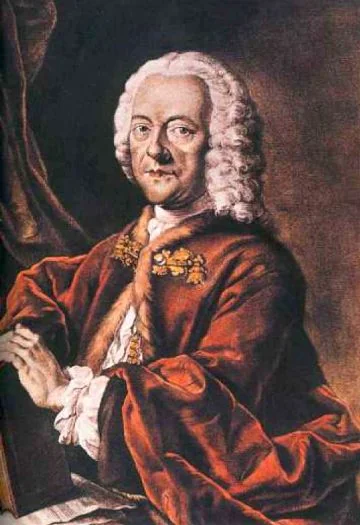
Image from Wikipedia
Image from Wikipedia
Georg Philipp Telemann – Architect of the European Baroque
How an Indefatigable Innovator with Musicality, Publishing Courage, and Stage Presence Shaped the Sound of the 18th Century
Georg Philipp Telemann (March 24, 1681 greg./March 14 jul. – June 25, 1767) grew up in Magdeburg and developed a music career characterized by self-study, artistic development, and remarkable productivity. His journey took him through nearly all the relevant centers of Baroque musical life, from Hildesheim, Leipzig, Sorau (Żary), Eisenach, Frankfurt am Main to Hamburg. As a composer, conductor, opera director, music publisher, and networker, he combined German, French, and Italian stylistic idioms with folkloric elements – thus creating a distinctive personal style that captivated Europe and continues to shape the repertoire today.
Early Years: Emerging Talent – Hildesheim, Leipzig, and Initial Successes
Even as a young man, Telemann showed extraordinary talent, which was specifically nurtured in Hildesheim during his school years at the Gymnasium Andreanum. There he learned several instruments, wrote his first works, and refined his understanding of composition, arrangement, and counterpoint technique. In Leipzig, he began studying law, but his stage presence and organizational energy quickly propelled him into musical life: He founded a Collegium musicum, conducted opera performances, and provided church music for the university church – early career milestones where his sense of dramaturgy, orchestration, and tonal balance already displayed remarkable insight.
Courts, Cities, Offices: Sorau, Eisenach, Frankfurt – The Path to Director Musices
Telemann's artistic development gained depth when he moved to the courts of Sorau and Eisenach. There, he refined his knowledge of court representative music, composing concerti, overture suites, and cantatas with distinctive rhetoric. In 1712, he took up the position of municipal music director in Frankfurt: He shaped the local Collegium musicum into a capable ensemble and professionalized the concert scene. Crucially, he began to publish his compositions through self-publishing – a step that solidified his authority as a composer and entrepreneur, spreading his works throughout Europe.
Hamburg as a Lifework: Cantor Johannei, Opera Direction, and a Hub of Music Publishing
In 1721, Telemann took on one of the most prestigious musical positions in the German-speaking world in Hamburg: Cantor Johannei and Director Musices. He provided the five main churches with exquisite church music, directed the opera, and gave public concerts – a dense production network that allowed his repertoire to grow in both breadth and depth. His music career culminated in a sovereign blend of composition, performance practice, and music management. In 1722, he declined the call to Leipzig – an indication of his evolved self-understanding as a leading authority in the North German music scene.
International Fame: Paris 1737/38 and the Art of Stylistic Blending
An eight-month stay in Paris marked a turning point: As the first German composer, he presented his own music in the Concert Spirituel and captivated the Parisian audience. In France, he confronted his sound ideal with current instrumental aesthetics, refining articulation, phrasing, and ornamentation. His return to Hamburg solidified his status as a European voice, creating an expressive synthesis of French elegance, Italian virtuosity, German contrapuntal rigor, and Polish folk elements.
Milestones of the Discography in a Historical Sense: Tafelmusik, Der getreue Music-Meister, and Der harmonische Gottesdienst
Telemann's "Musique de table" (Tafelmusik, 1733) consolidates in three parts each an overture suite, a concerto, a quartet, a trio, and a sonata – a curated sound dramaturgy that intelligently balances courtly representation, chamber music intimacy, and orchestral splendor. With "Der getreue Music-Meister" (1728/29), the first printed music periodical, he tested a serial publishing format that combined pedagogical utility and repertoire maintenance. "Der harmonische Gottesdienst" (1725/26) includes a cycle of cantatas for liturgical use, demonstrating Telemann's mastery in text interpretation, vocal composition, and figural bass line. These collections are paradigmatic for his understanding of production, distribution, and musical education.
Opera and Stage: Comedy, Character, and Timing – Pimpinone as a Case Study
With "Pimpinone oder Die ungleiche Heirat" (Premiere 1725), Telemann created a playful intermezzo that combines witty dialogue, social types, and pointed affect dramaturgy. Concisely designed numbers, clear character profiles, and singer-friendly lines showcase his theatrical intelligence. Telemann's operatic aesthetics avoid empty virtuosity and aim for character, text clarity, and situational irony – qualities that make his stage works appealing for contemporary productions.
Style and Technique: Timbres, Affects, and the Art of Arrangement
Telemann's orchestration communicates through lyrical melodies, colorful instrumentation, and affect-sensitive rhythms. He masters the French overture practice, the Italian concerto form (solo-tutti contrasts, sequences), the German contrapuntal school, and Polish folk dance idioms. In composition, he employs idiomatic writing – "Give every instrument what it can bear" – thus creating a production that motivates performers and engages listeners directly. His arrangements impress through the balance of obbligato voices, basso continuo, and clear voice leading.
Cultural Influence and Reception: From the 18th Century to the Present
To his contemporaries, Telemann was regarded as an authority: friend of the great Baroque masters, godfather of Carl Philipp Emanuel Bach, and a mediator between Baroque and Enlightenment. After being critically viewed in the 19th century, the 20th century saw a systematic rediscovery. Today, festivals, competitions, reference recordings, and musicological projects confirm his relevance. His works serve as repertoire sources for ensembles worldwide because they allow interpretative diversity – from historically informed performance practice to modern sound aesthetics.
Today on Stage: Festivals, Competitions, Awards – Vibrant Care for Telemann
In his birthplace of Magdeburg, Telemann's enduring influence is manifested in the Magdeburg Telemann Festival (March 13–22, 2026). The festival will focus on the tension between "Music and Power" and will open at the opera house with Il Gardellino under Peter Van Heyghen – a statement on the contemporary relevance of his musical language. The International Telemann Competition further supports the next generation of historical performers and makes the Essercizii Musici and chamber music tradition practically accessible. The Georg Philipp Telemann Prize honors individuals who significantly interpret and disseminate his music today – a signal of cultural continuity and excellence.
Catalog of Works and Genre Breadth: From Church Music to Chamber Music
Telemann's catalog of works (TWV/TVWV) includes nearly all genres of his time: cycles of church cantatas, passion music, large-scale festive music, operas, serenades, overture suites, concertos, quartets, trio sonatas, solo sonatas, duets, as well as clavier and organ works. His productivity is legendary; nevertheless, the quality consistently impresses with inspired thematic creation, agile harmonies, and refined instrumentation. Particularly characteristic are quartets and trios, where he intertwines voices polyphonically while maintaining melodic clarity – a hallmark of his compositional style.
Performance Practice and Interpretation: What Modern Ensembles Learn
Telemann's music rewards interpretive curiosity: articulation between speech rhythm and dance impulse, embellishments as affective peaks, tempo relations with respect to rhetoric and architectural arcs. His scores demand a keen ear for timbres – traverso, oboe d’amore, chalumeau, and viola da gamba – as well as tasteful continuo realization. Ensembles that seek balance between historical awareness and spontaneous musical enjoyment capture the essence of his aesthetic.
Why Telemann Fascinates Today: Relevance, Diversity, Resonance
Telemann's artistic development reflects the 18th century as an era in motion: between court and city, church and stage, publication and performance. His discography, in terms of source editions and reference recordings, is continually growing, his music inspires young award winners, and festivals weave dialogues between history and the present. The combination of creativity, dramaturgical tact, and a practice-oriented understanding of production makes him one of the most accessible yet sophisticated masters of the Baroque.
Conclusion: A Sound Architect to Rediscover – Live, Immediate, Inspiring
Telemann's music thrives on presence: It tells stories, sketches characters, and unfolds a pull in both ensemble and church contexts that is hard to escape. Those who experience his Tafelmusik, quartets, or cantatas live can feel the elegance of the forms, the warmth of the melodies, and the intelligence of the arrangements. He is an artist who challenges musicians while simultaneously providing pleasure to the audience – compelling reasons to continually rediscover him in concerts, at festivals, and through new recordings.
Official Channels of Georg Philipp Telemann:
- Instagram: No official profile found
- Facebook: No official profile found
- YouTube: No official profile found
- Spotify: No official profile found
- TikTok: No official profile found
Sources:
- Wikipedia (DE) – Georg Philipp Telemann
- Encyclopaedia Britannica – Georg Philipp Telemann
- Center for Telemann Care and Research – Telemann in Magdeburg
- concerti – Magdeburg Telemann Festival 2026
- Operabase – Opening Concert Telemann Festival 2026
- Die Welt – Magdeburg Telemann Festival Addresses "Music and Power" (Announcement, Jan 2026)
- Die Welt – Telemann Prize for Michael Alexander Willens (Announcement, 2025/26)
- SWR Culture – 13th International Telemann Competition (2025)
- Wikipedia (DE) – Pimpinone oder Die ungleiche Heirat
- Wikipedia: Image and Text Source
Upcoming Events
Cantata Service Reminiszere: Telemann in the Passion Season
Cantata Service in Lent – Sunday Laetare