
Carmen
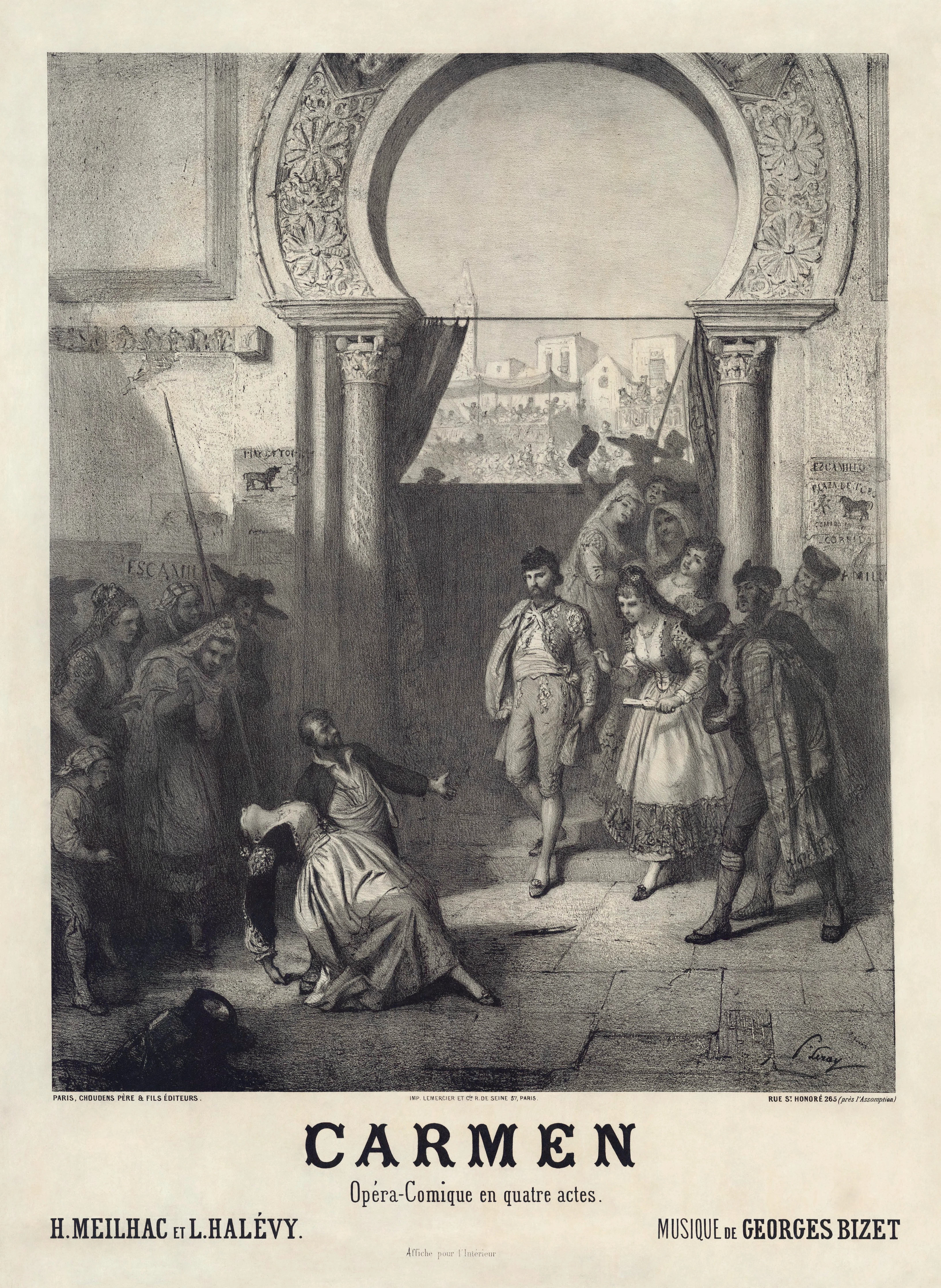
Image from Wikipedia
Image from Wikipedia
Carmen – the opera that changed musical theater forever
Georges Bizet's masterpiece between scandal, passion, and worldwide fame
Carmen is no ordinary opera; it is a turning point in music history: Georges Bizet's four-act work with a French libretto by Henri Meilhac and Ludovic Halévy, based on Prosper Mérimée's novella from 1845, sparked outrage and rejection at its premiere on March 3, 1875, at the Opéra-Comique in Paris. However, it was precisely the ruthless realistic depiction of its environment, the dramatic intensification, and the tragic consequence that soon made the work one of the greatest triumphs in the opera repertoire. Today, Carmen ranks among the most performed and recognized operas in the world. ([britannica.com](https://www.britannica.com/topic/Carmen-opera-by-Bizet))
The creation of a revolutionary opera
Bizet composed Carmen during a phase when he was searching for new forms of French musical theater, deliberately testing the conventional lightness of the Opéra-comique. Although the work remained formally committed to the genre, it combined spoken dialogues with large musical numbers, shattering their familiar framework through social harshness, erotic tension, and relentless tragedy. The historical explosive nature of this opera lies precisely in that fact: It does not depict a decorative theatrical world, but rather people in conflict over desire, freedom, jealousy, and violence. ([britannica.com](https://www.britannica.com/topic/Carmen-opera-by-Bizet))
The sources regarding its creation are clear: Bizet drew on Mérimée's novella, collaborated with the experienced librettists Meilhac and Halévy, and was inspired by Spanish-influenced rhythms and soundscapes to musically contour the settings. Thus, the opera was created not merely as a stage piece but as a carefully constructed music drama, where orchestral colors, melodic clarity, and characteristic motifs deepen the psychological unfolding of the drama. It is this blend of craftsmanship precision and immediate emotional impact that continues to shape the work's fascination today. ([britannica.com](https://www.britannica.com/topic/Carmen-opera-by-Bizet))
The premiere in 1875: a cool reception leading to later triumph
The world premiere on March 3, 1875, at the Paris Opéra-Comique was initially met with hostility from both the audience and critics. Contemporary reactions expressed outrage over the perceived immorality of the heroine, the workers' and smuggler's world, as well as the explicit depiction of sexual freedom and social marginality. Bizet did not live to see the later rehabilitation of his work: He died on June 3, 1875, just three months after the premiere, convinced he had composed a disaster. ([britannica.com](https://www.britannica.com/topic/Carmen-opera-by-Bizet))
This early failure gives Carmen a nearly mythical dramatic arc of recognition. What initially appeared as scandalous in Paris was soon interpreted internationally as an artistic breakthrough. After the initial shock, the opera returned to the stage in triumphant form and became a touchstone for singers, conductors, and directors, sharpening their interpretations of theater, psychology, and musical style. ([operaphila.org](https://www.operaphila.org/whats-on/on-stage-2017-2018/carmen/composer/))
Why Carmen became a worldwide success
Bizet's score possesses an extraordinary balance of catchiness and sophistication. The famous numbers such as the Habanera and the Toreador song have long detached from the opera itself and continue to live on as cultural icons, but their success is rooted in a larger context: The entire work is dramatically constructed to create tension, with scenes of seductive dance, military rigor, collective energy, and intimate collapse. The musical language remains clear, sensual, and rich in color, without losing complexity. ([britannica.com](https://www.britannica.com/topic/Carmen-opera-by-Bizet))
The crux lies in the character of Carmen herself. She represents independence, physical presence, and social inflexibility, while also embodying the tragedy of a woman who submits neither to claims of possession nor to moral rules. ENO describes the opera as a work about passion, jealousy, and violence, whose provocative power initially shocked and, precisely for that reason, established its status as a revolutionary masterpiece. This tension between freedom and fate makes the opera modern to this day. ([eno.org](https://www.eno.org/operas/carmen-4/))
Discography: a work with an inexhaustible recording tradition
Carmen is among the most frequently recorded operas of all time. The discographic history dates back to an almost complete German acoustic recording from 1908, documenting how early the work was understood as a reference object of the repertoire in both phonograph and later video formats. The multitude of recordings showcases not only popularity but also openness to interpretation: Each generation of singers and conductors finds new focal points between lightness, passion, realism, and tragedy. ([en.wikipedia.org](https://en.wikipedia.org/wiki/Carmen_discography))
The relevance of the discography also lies in the fact that Carmen is always seen as a benchmark for vocal personality and orchestral discipline. Whether in historically informed recordings, major studio productions, or filmed stage versions: the work demands distinct character portrayal, rhythmic precision, and a dramatic line that foreshadows its fateful conclusion from the outset. Thus, Carmen is not only a stage hit but also a reference work in the history of recordings. ([en.wikipedia.org](https://en.wikipedia.org/wiki/Carmen_discography))
Musical language and stylistic significance
Bizet's composition combines French elegance with sharply drawn realism. The orchestra does not merely provide accompaniment, but serves as a psychological commentary: It paints spaces, moods, and inner states and supports the dramatic turning points with great clarity. The musical language remains melodically rich, precise in its motifs, and simultaneously exact in characterizing the figures. ([britannica.com](https://www.britannica.com/biography/Georges-Bizet))
The effect of the opera also lies in its form: The succession of ensembles, arias, choral scenes, and dance-like episodes generates a lively theater that does not rely on heavy symbolism and hits directly for that reason. Bizet utilized insights into Spanish timbres and regional rhythms to give the scenery a specific color. This resulted in a work that exceeds mere exotic surface and is viewed as a prime example of dramatic condensation to this day. ([britannica.com](https://www.britannica.com/topic/Carmen-opera-by-Bizet))
Cultural influence: from the opera stage to world culture
Carmen has reshaped opera history because it confronted the notion of "serious" musical theater with a realistic, socially charged narrative style. Britannica emphasizes the groundbreaking realism of the work that sustainably influenced the development of opera, while other sources highlight that the opera quickly sparked international enthusiasm after the initial rejection. Its scenes, melodies, and characters have long become part of the cultural memory. ([britannica.com](https://www.britannica.com/topic/Carmen-opera-by-Bizet))
Even in 2024 and 2025, Carmen remains a vibrant repertoire piece on major opera stages: The New National Theatre Tokyo is presenting a production for the 2024/25 season, Virginia Opera is opening its 2024/25 anniversary season with the work, and The Dallas Opera has announced a historically inspired new production for the 150th anniversary in 2025/26. This shows how firmly the opera is anchored in current play schedules and how flexibly it adapts to new interpretations. ([cms.nntt.jac.go.jp](https://cms.nntt.jac.go.jp/english/productions/opera/carmen.html?utm_source=openai))
Conclusion: A work full of ardor, risk, and eternal relevance
Carmen captivates because it is simultaneously gripping musical theater, social drama, and melodic mastery. The opera unites a distinctive character portrayal, a sonically brilliant score, and a cultural-historical scandal that turned into a triumph. Those who experience this work live encounter not only one of the most famous operas of all time but also one of the strongest proofs of how radical and modern opera can sound. ([britannica.com](https://www.britannica.com/topic/Carmen-opera-by-Bizet))
The fascination of Carmen lies in its restlessness: Each performance anew raises the question of how freedom, desire, and power collide on stage. That is precisely why this work remains an event for both opera lovers and the curious alike. Anyone who has the chance to experience Carmen live should seize it. ([britannica.com](https://www.britannica.com/biography/Georges-Bizet))
Official channels of Carmen:
- Instagram: no official profile found
- Facebook: no official profile found
- YouTube: no official profile found
- Spotify: no official profile found
- TikTok: no official profile found
Sources:
- Britannica – Carmen, opera by Bizet
- English National Opera – Bizet’s Carmen
- Opera Philadelphia – Georges Bizet
- Metropolitan Opera – The Opera’s Plot and Creation
- Wikipedia – Carmen discography
- Toledo Opera – Season announcement with Carmen
- New National Theatre, Tokyo – Carmen
- The Dallas Opera – Historically Inspired Carmen Opens the 2025/2026 Season
- Wikipedia: Image and text source
Upcoming Events
Man. Woman. One.
An evening for genuine encounters in Traunstein: Man. Woman. One. connects impulses, exchange, and new perspectives on relationships. #Traunstein
Sounds of Romanticism - Schumann, Weber & Piazzini
Immerse yourself in the music of Romanticism with Schumann, Weber, and pianist Carmen Piazzini in Darmstadt.
Summer Stage on Campus: Carmen à trois
Don't miss Carmen à trois on the campus of TH Aschaffenburg. A musical-humorous experience awaits you!
Summer Stage on Campus: Carmen à trois
Visit the summer stage on the campus of the Technical University of Aschaffenburg and experience classical music and humor in a unique atmosphere.
Book Edge Painting with Carmen Knorr
A creative evening for book lovers in Deggendorf: Design colored edges yourself, discover ideas and go home with a unique piece. 03.09.2026, 30 €. #Deggendorf
Book Edge Painting in Deggendorf
Create your own color edge in the Deggendorf City Library: 4-hour creative workshop with Carmen Knorr, love for books, and true book art. #Deggendorf #BookEdge
Reopening of the Natural History Department
An evening full of children's laughter and natural wonders in Hof: The new Natural History Department invites families to marvel, craft, and discover. 09/17/2026, free admission. #FamilyExperience
Stories of Eves – On the Trail of Eves
Experience the 'Stories of Eves' with artworks by Carmen Luna on 09.29.2026 at the Haslach district library.
Art Meets Book: Painting Book Edges for Beginners
A course for book lovers in Landshut: Painting book edges, Fore Edge Painting, and creative tranquility. On 02.10.2026, a special #BookArt experience awaits.
arthaus EXTRA "Plainclothes"
An intense arthouse evening in Heilbronn: Plainclothes tells of desire, fear, and control with great visual power. 05.10.2026, 18:00, 9 €. #Cinema