
Ades Zabel
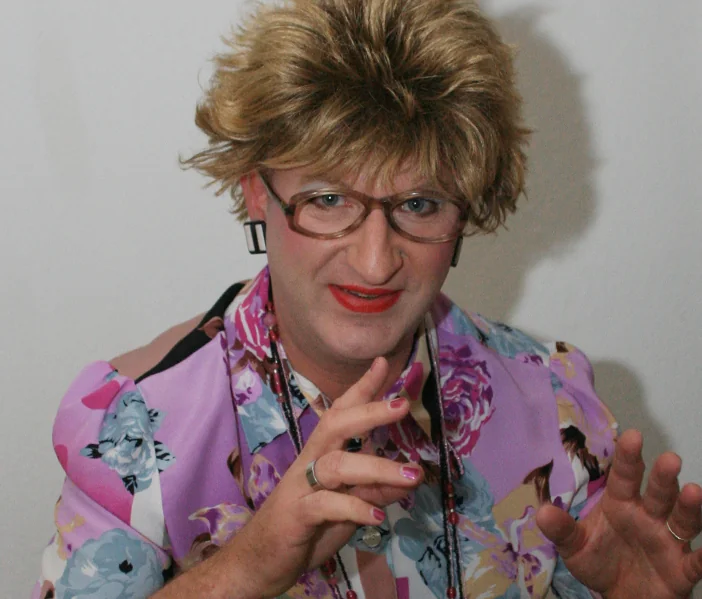
Image from Wikipedia
Image from Wikipedia
Ades Zabel – Berlin Cult Figure Between Drag, Cabaret, and Subversive Performance Art
An Artist Who Not Only Reflects Berlin but Has Shaped It
Ades Zabel, born on September 26, 1963, in Berlin and originally named Andreas Zabel, is one of the most distinctive figures in Berlin's queer, cabaret, and off-theater scene. As an actor, drag artist, comedian, DJ, and author, he has developed a unique onstage persona over the decades, blending Berlin's milieu, trash aesthetics, and precise satire into his own artistic language. His character Edith Schröder, in particular, made him famous far beyond the capital and solidified his status as a cult artist with high recognition. (de.wikipedia.org)
His career did not begin through traditional acting pathways but emerged from the spirit of the Berlin underground. Early on, Zabel mixed Super-8 films, film screenings, comedy, and improvised stage formats into an independent cosmos that engaged with both the reality of the neighborhood and the German pop and entertainment culture. This mixture of improvisation, knowledge of the milieu, and comedic exaggeration makes his work in music culture and theater so exciting to this day. (de.wikipedia.org)
From KaDeWe and Moviemento to the Berlin Off-Scene
Before Ades Zabel became a stage phenomenon, he trained as a men's clothing salesman at KaDeWe and worked for ten years as a projectionist at the Berlin Moviemento cinema alongside Tom Tykwer. This early connection to cinema, pop culture, and urban storytelling shaped his perspective on characters, timing, and staging. Since the 1980s, he has performed as a comedian and drag artist; starting in 1996, he has held numerous shows in Berlin and guest performances as well as hosting gigs across Germany. (filmportal.de)
As early as 1980, Zabel presented his first Super-8 film alongside Bob Schneider, and by 1992, 14 collaborative films were completed. This collaboration led to the Teufelsberg Produktion, a Berlin comedy and cabaret group that early on occupied its own cultural niche with underground films, parodies, and off-theater programs. The three-part film "Drei Drachen vom Grill" ultimately made the duo known beyond scene circles and highlighted Zabel's sense of ironic recontextualization of German television and everyday life. (de.wikipedia.org)
Edith Schröder: The Character That Created Cult Status
In 1980, Ades Zabel invented the stage character Edith Schröder, a long-term unemployed woman from Neukölln, who remains central to many shows today. The character is more than a drag role: Edith encapsulates the Berlin dialect, social observation, milieu satire, and an extremely precise comedic rhythm. With her, Zabel created an artistic figure that is embedded in both contemporary Berlin culture and the tradition of revue, drag, and cabaret. (de.wikipedia.org)
The character was further developed in programs such as "Edith Schröder Superstar," "Wenn Ediths Glocken läuten," "Linie 8," "Hostel Hermannstraße," "Die wilden Weiber von Neukölln," "Fly, Edith, Fly – vom Ballermann zum BER," and "Tatort Neukölln." Many of these productions were performed at the BKA Theater and were directed, among others, by Bernd Mottl, with interludes by Jörn Hartmann. This resulted in a continuous body of work that can be read as a Berliner serial story with live characteristics. (de.wikipedia.org)
The BKA Theater as Artistic Home
Since 1991, Ades Zabel first took to the stage at the Berlin BKA Theater, and since 2003, the so-called "Neuköllnicals" have been regularly featured there. The BKA has thus become a central venue for his work, where off-theater, cabaret, trash comedy, and socially observed neighborhood storytelling mutually reinforce each other. The close relationship between the artist and the venue is a key reason why Zabel's works have built such a stable fanbase. (de.wikipedia.org)
Even in 2026, this presence will remain clearly visible: On his official homepage and in the BKA's schedule, numerous dates are listed for "Hallo 2026 – mit Edith ins neue Jahr!", "Die wilden Weiber von Neukölln," "Drei Drachen vom Grill," "FRAU LUNA," and other projects. This demonstrates that Zabel is not a nostalgic figure but an active performer with ongoing repertoire maintenance and new series of dates. This continuity is particularly valuable for an artist's biography as it makes artistic development visible not only historically but in real-time. (ades-zabel.de)
Filmography, Directorial Works, and Media Extensions
Ades Zabel's work does not end on stage. His film projects include "Mutti – Der Film" (2003), "Fucking Different!", "18.15 Uhr ab Ostkreuz," "Ediths Glocken," "Der Gründer," and appearances in "Babylon Berlin." In several of these works, he not only took on acting roles but also direction, screenwriting, and production, underscoring his versatility as an author and visual thinker. (filmportal.de)
Notably, Zabel has consistently adapted his own stage roles for the screen. In "18.15 Uhr ab Ostkreuz," he appears in a dual role; "Ediths Glocken – Der Film" transitioned his stage world into a new format. This media agility transforms him into an artist who translates local figures into film, theatrical, and performative languages without losing the core of the character. (filmportal.de)
DJ, Hosting, and Berlin Scene Culture
Since 1999, Ades Zabel has also worked as a DJ, performing at parties in Berlin's gay scene as DJ Adessa Zabel. Additionally, since 2006, he has conducted neighborhood tours in the role of Edith Schröder, bringing his artistic character directly into public spaces. This extension of the stage character into urban performance formats demonstrates how closely his work is tied to Berlin as a social and cultural landscape. (filmportal.de)
Here lies a significant part of his authority: Zabel does not work with detached observation but with lived urban experience, scene closeness, and long-standing stage practice. His projects combine entertainment, studies of the milieu, and camp aesthetics while maintaining a focus on social fractures. As a result, he has carved out a place in Berlin's cultural history that extends far beyond pure comedy. (tagesspiegel.de)
Style, Reception, and Cultural Influence
Critical reception often describes Zabel as a cult figure of Berlin's subculture, whose characters encapsulate the city's raw humor. Media outlets like Tagesspiegel, Berliner Zeitung, and specialized websites like filmportal.de locate him within a tradition of trash, parody, and queer performance that has developed its own aesthetic authority from the off-theater scene. Particularly, Edith Schröder is considered a stage figure that melds Berlin's everyday reality with satirical exaggeration. (tagesspiegel.de)
Culturally, Ades Zabel is particularly relevant because he has consistently dissolved the boundaries between cabaret, drag, cinema, and musical theater. His works show how much popular culture, local identity, and queer stage art can benefit from one another when executed with craftsmanship and narrative pleasure. This sustainability of his impact lies in how he has converted Berlin neighborhood comedy into a distinctive, recognizable cultural format. (de.wikipedia.org)
Discography, Publications, and Critical Contextualization
In the classical sense, Ades Zabel does not possess a music discography with studio albums or chart singles, as his work primarily consists of stage programs, films, and performance formats. Therefore, his "work list" is crucial for a comprehensive artistic evaluation: Super-8 films, the Teufelsberg Produktion, "Drei Drachen vom Grill," the Neuköllnicals, film roles, as well as DJ work and hosting gigs. This structure replaces the conventional pop discography with a multifaceted repertoire of live, film, and scene art. (filmportal.de)
This form of artistic production has made Ades Zabel a fixed entity in Berlin's cultural architecture. The combination of recognizability, satirical sharpness, local rooting, and consistent character development creates a body of work that endures over decades. Those who wish to understand how a long-lasting cult emerges from Berlin's subculture will find in Ades Zabel a particularly impressive example. (bz-berlin.de)
Ades Zabel remains fascinating because he turns every role into a social miniature and each evening into a piece of Berlin's contemporary archaeology. His stage presence thrives on timing, presence, and the unmistakable feel for characters that are both comedic, vulnerable, and sharply observed. Those who experience him live not only witness entertainment but also a slice of Berlin's cultural history in the present. (ades-zabel.de)
Official Channels of Ades Zabel:
- Instagram: https://www.instagram.com/adeszabel/?hl=de
- Facebook: https://www.facebook.com/ades.zabel
- YouTube: No official profile found
- Spotify: No official profile found
- TikTok: No official profile found
Sources:
Upcoming Events
Berlin, You Cool Pig
Berlin, You Cool Sau