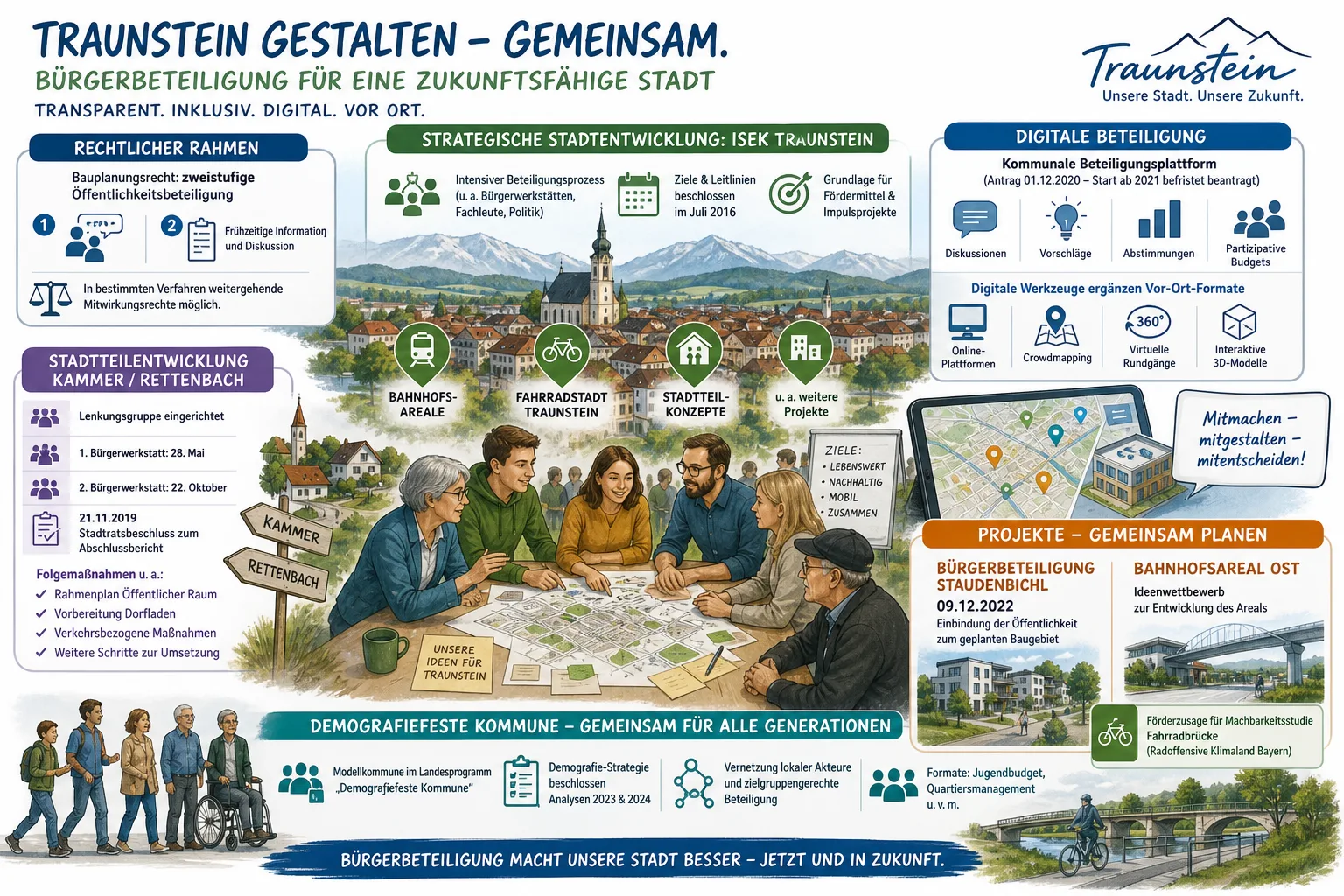
Citizen Participation and Urban Development in Traunstein
Citizen Participation & Urban Development in Traunstein: How You Can Help Shape the Next Steps
How can Traunstein be planned so that everyday life, climate, mobility, and quality of life fit together—and how can you effectively contribute your perspective? This overview explains which participation pathways are typically available in the upcoming planning phases, which formats make sense, and how contributions from citizens can be incorporated into decisions in the future.
Why Citizen Participation Is Crucial for Upcoming Decisions
Urban development touches on many interests at once: housing, transport, green spaces, economy, culture, and the design of public spaces. For projects to be sustainable in the long term, modern planning increasingly relies on early and repeated participation—not just as an information offering, but as a structured opportunity to provide feedback, discuss alternatives, and make goal conflicts visible.
For Traunstein, this means in perspective: Those who use the city (as residents, commuters, apprentices, entrepreneurs, seniors, or visitors) can contribute on several levels in the future—from pointing out a dangerous school route to ideas for quality of stay at the train station or in neighborhoods.
- Planning Quality: Local knowledge complements expert reports (e.g., on traffic, noise, climate).
- Acceptance: Objections and risks become apparent earlier and can be examined in alternatives.
- Comprehensibility: When steps and considerations are transparently documented, decisions become more understandable.
Legal Framework: What Is Mandatorily Provided for in Upcoming Procedures
Many urban planning decisions are made through formal planning procedures, especially through development plans or changes to the land use plan. Public participation is legally required. In future procedures, two participation phases are usually relevant:
- Early Public Participation: Goals, alternatives, and anticipated impacts are presented; feedback can be particularly effective because alternatives are still open.
- Public Display: A concrete draft is available; comments can be submitted in writing and must be considered in the weighing process.
In addition to formal participation, informal formats can (and are in many municipalities) be used, such as workshops, walks, online dialogues, or moderated small groups. These do not replace formal rights but can help collect topics earlier and prepare them more understandably.
ISEK & Strategic Guidelines: What Typically Follows in the Next Years
An integrated urban development concept (ISEK) serves as a strategic framework in many cities: It bundles guiding principles, prioritizes fields of action (e.g., mobility, public space, housing), and can form the basis for structuring projects and utilizing funding frameworks. For the next planning steps, it is especially important: Strategies only become effective when they are translated into concrete projects—with clear responsibilities, timeframes, participation formats, and measurable goals.
If Traunstein further develops future projects from such a framework, the following topics are typically particularly relevant for participation:
- Train Station and Arrival Areas (routes, safety, quality of stay, transfer hubs)
- Bicycle and Pedestrian Traffic (network gaps, crossings, parking facilities, accessibility)
- Neighborhood and District Development (meeting points, local supply, mixed use)
- Housing & Land Development (density, green, traffic, social infrastructure)
For participation to work in the coming phases, it is worthwhile for participants to formulate contributions as concretely as possible: Where exactly is a problem? At what time of day? Who is affected? What alternative would be conceivable? The more precise the contribution, the better it can be professionally examined and translated into alternatives.
Districts & Neighborhoods: What Participation Can Look Like in Kammer, Rettenbach, and Other Areas
Districts and neighborhoods often have different priorities than the city center: safe routes to school and clubs, good bus connections, meeting points, local supply, calm traffic, and a functioning public space. In upcoming district or neighborhood processes, formats are often combined to reach different groups:
- Citizen Workshops (topic islands such as traffic, green, social infrastructure)
- Neighborhood Walks (marking problems and potentials directly on site)
- Steering or Accompanying Groups (continuous exchange over several months)
- Youth and Senior Formats (target group-appropriate times, places, and language)
For future packages of measures, it is helpful if results are visibly "fed back": What was taken up? What is being examined? What is possible in the short term, what only in the long term—and why? This feedback is key to ensuring that participation is experienced as fair and reliable.
Concrete Development Topics: What Typically Comes Next for the Train Station Area and New Residential Areas
Train Station Area and Station Sites
Around the train station, commuter traffic, tourism, bus, bicycle, and pedestrian routes converge. In upcoming steps (e.g., feasibility studies, competitions, preliminary drafts), questions such as the following are typically at the forefront:
- How can route connections be made safer and more intuitive (also at night and in bad weather)?
- How does transferring between train, bus, bicycle, and pedestrian routes work without conflicts?
- Which mix of uses strengthens the area (services, places to stay, possibly supplementary functions)?
- How are accessibility and climate resilience (shade, greenery, rainwater) planned for?
For participants, it is worthwhile to document their own routes on such topics (e.g., typical route from platform to bus, shortcuts, bottlenecks) and describe concrete situations. This is often directly usable for planners.
New Residential and Development Areas (e.g., Staudenbichl as a Typical Case)
For new residential areas or densification areas, several interests are typically weighed in upcoming procedures: housing needs, traffic, noise, landscape, rainwater, green spaces, social infrastructure, and access. Participation is particularly effective here if contributions relate to clear review questions, such as:
- Which access variant reduces through traffic on sensitive streets?
- Where are safe crossings needed for children, seniors, and cyclists?
- How can green and open spaces be located so that they are usable and not just "leftover areas"?
- Which phasing (construction stages) minimizes burdens and creates infrastructure that can be used early?
It is also good if participation documents are understandable in the future: uniform legends, short summaries, clear submission deadlines, and an overview of which decisions are actually still open in which phase.
How You Can Effectively Participate in the Coming Months and Years
- Get involved early: Don’t wait to react to finished drafts. The early phase is often decisive for alternatives.
- Be specific: Name places, describe situations, submit photos or sketches (if provided), suggest criteria.
- Make interests transparent: Is safety, peace, accessibility, greenery, or accessibility most important to you? Priorities help with weighing options.
- Sketch compromise lines: “If X, then Y” is often more helpful than a simple yes/no.
- Ask questions: Ask for understandable explanations of how contributions are evaluated and weighed.
Even those who only use Traunstein temporarily (e.g., as commuters or visitors) can provide valuable perspectives—such as on orientation at the station, route guidance, quality of stay, or bottlenecks at events and peak times.