
Traunstein
Buchfelln, 83278 Traunstein, Deutschland
Seven Sorrows of Mary | Chapel & Rosary
The Seven Sorrows of Mary in Buchfelln is not a large pilgrimage basilica, but a simple, historically grown Marian chapel on the road from Traunstein to Knappenfeld. It is precisely this size that makes it so interesting for seekers: Those looking for chapel, church, rosary, prayer, or devotion will find here a place where regional piety and lived parish practice meet. The chapel belongs to the surroundings of the city church of Traunstein, is dedicated to the patronage of the Seven Sorrows of Mary on September 15, and is still used for mass celebrations today. Its history dates back at least to the early modern period, but the current building is the result of several renovations, expansions, and preservation initiatives. Thus, Buchfelln is a typical example of a small rural chapel that has been supported by the community over generations and continues to offer a quiet, credible place for prayer and remembrance in the present.
([stadtkirche-traunstein.de](https://www.stadtkirche-traunstein.de/index.php?id=7))Chapel of the Seven Sorrows of Mary in Buchfelln: Location, Patronage, and Classification
The official classification is important because search queries for seven sorrows of mary church or chapel of the seven sorrows of mary often mean both, but ultimately seek a quiet place for devotion. In Buchfelln, there is indeed a chapel, not a large parish church. The city church of Traunstein lists it as a chapel in Buchfelln among the churches and chapels of the parish, and the location is described by sources as Buchfelln near Traunstein. This makes orientation simple: Those traveling in Traunstein will not find an urban event venue here, but a rural, clearly located Marian chapel with ecclesiastical use and a pronounced local identity. For SEO, this combination is valuable because it simultaneously serves the search intent for place, type, and spiritual occasion.
([stadtkirche-traunstein.de](https://www.stadtkirche-traunstein.de/index.php?id=7))The patronage is more than just a title. On September 15, the church commemorates the Sorrows of Mary, and the liturgical tradition understands this day as an opportunity to reflect on Mary's suffering alongside Christ's path to salvation. For Buchfelln, this means: The name of the chapel refers not only to a Marian image but to a concrete spiritual attitude. Therefore, terms like rosary, prayer, and devotion fit so well into this context. In practice, people here are not looking for a program booklet, seating plan, or ticket shop, but for a place where memory, silence, and prayer converge. This situation should be evident in any good local description.
([vatican.va](https://www.vatican.va/content/paul-vi/en/apost_exhortations/documents/hf_p-vi_exh_19740202_marialis-cultus.html?utm_source=openai))The connection between patronage and use is also important for visitors. Where a chapel is dedicated to the memory of the Seven Sorrows of Mary, an atmosphere is created that consciously remains contemplative. Unlike a large city church, Buchfelln is characterized not by abundance and size, but by clarity, closeness, and continuity. The parish explicitly names the chapel as a place where mass celebrations take place in the summer months. This makes the name of the patronage tangible in everyday life: it does not remain on the calendar page, but is continued in worship, prayer, and well-maintained architecture. For seekers of local Marian piety, this is the crucial information.
([stadtkirche-traunstein.de](https://www.stadtkirche-traunstein.de/index.php?id=7))From the First Place of Devotion to the Current Building
The earliest traces in Buchfelln show that piety was present there long before the current building. A visitation protocol from 1713 describes no chapel in the modern sense at this location, but a stone Marian figure or an oratory. Remarkable is the lively practice: On feast days, people gathered in the afternoons and prayed the rosary. This is central to the interpretation of the place because it shows the chapel not as a later tourist backdrop, but as the result of a developed prayer culture. Even early on, it was about communal remembering, praying, and gathering at a Marian site.
([marterl.at](https://www.marterl.at/suche/detail-1?cHash=b7bad3dde44a73eb5e36a7c6d0c0459d&oid=3013))Later sources depict the building history with slightly differing dates, but agree in essence: From a small field chapel, a solid, masonry place of devotion was created. The city church of Traunstein reports of a field chapel from 1720, which was later replaced by a stone building; the monument portal cites a secured construction of the current chapel in 1831. For an SEO text, it is crucial not to artificially smooth the development but to emphasize continuity: A simple place of prayer grew step by step into a chapel that was associated with the farmers of the surrounding area and the Buchfellnerhof and was maintained over generations.
([stadtkirche-traunstein.de](https://www.stadtkirche-traunstein.de/index.php?id=7))After World War II, the place entered a new phase of preservation and use. According to the parish, the chapel was expanded and consecrated in 1947; the monument portal adds that permission for the celebration of Holy Mass was granted in 1948 and a sacristy was added in 1959. Later, the chapel was transferred to a community of ownership and preservation. These stages are significant for today's perception because they show that Buchfelln is not a closed monument space, but a well-maintained, still active place with a strong local culture of responsibility. It is precisely in the connection of sacred use and civic preservation that its special authenticity lies.
([stadtkirche-traunstein.de](https://www.stadtkirche-traunstein.de/index.php?id=7))Rosary, Prayer, and the Significance of the Seven Sorrows of Mary
The name of the chapel directly refers to one of the most well-known Marian devotions of the church. The liturgical memory of the Sorrows of Mary on September 15 invites reflection on Mary's participation in the suffering and death of Jesus. The Roman tradition considers this day a particularly suitable moment to reconsider the mystery of salvation under the cross. For the language of search queries, this means: Those looking for prayer, novena, rosary, or devotion are not only searching for a place but for a spiritual form that connects pain, comfort, and hope. Buchfelln provides a concretely tangible, historical setting for this.
([vatican.va](https://www.vatican.va/content/paul-vi/en/apost_exhortations/documents/hf_p-vi_exh_19740202_marialis-cultus.html?utm_source=openai))The local tradition makes this spiritual profile very concrete. As early as 1713, the evening or afternoon gathering of people praying the rosary was described at this location. In this respect, the search term seven sorrows of mary rosary for Buchfelln is by no means coincidental, but historically plausible. The chapel bears a name that considers the prayer itself: Mary under the cross, the rosary as a meditative form, and the communal devotion as a social practice. Precisely for this reason, the place is well-suited for quiet contemplation and personal piety, without the need for a large tourist stage.
([marterl.at](https://www.marterl.at/suche/detail-1?cHash=b7bad3dde44a73eb5e36a7c6d0c0459d&oid=3013))The current use also connects to this tradition. The parish states that regular mass celebrations take place in Buchfelln during the summer months. This is remarkable for a small rural chapel because it shows that the place is not only historically interesting but also lives liturgically. Those who pray on site do not experience a purely memorial atmosphere, but a space where memory and presence touch. This is exactly what gives the SEO value of such pages: They not only answer the question of the name but also the question of spiritual content. Buchfelln represents a form of devotion that is simple, local, and reliable.
([stadtkirche-traunstein.de](https://www.stadtkirche-traunstein.de/index.php?id=7))Mass Celebrations, Visits, and Practical Information for Traunstein
The location is simple for visitors and simultaneously typically rural: The chapel is located in Buchfelln on the road from Traunstein to Knappenfeld. This makes it easy to reach as part of a quiet outing or a short prayer visit, without the need for a complex infrastructure. The available sources do not mention any event operations, evening box office, or tourist opening hours, but primarily the sacred use. This is precisely where the charm of the place lies. Those seeking a chapel like this do not expect a classic event schedule but an honest, quiet place with a clear history and current ecclesiastical reference.
([stadtkirche-traunstein.de](https://www.stadtkirche-traunstein.de/index.php?id=7))For concrete planning, the current worship schedule of the city church of Traunstein is the best orientation. There, Buchfelln is listed in the worship entries, and the parish refers to regular mass celebrations in the summer months. Information about a dedicated parking lot, large visitor areas, or special travel regulations is not explicitly mentioned in the available sources. Therefore, it is sensible to plan the visit as with many small village chapels: with some flexibility, a brief consideration of the quiet surroundings, and the knowledge that the place is primarily intended for liturgical use and quiet devotion. This sobriety is not a weakness but part of the authenticity.
([stadtkirche-traunstein.de](https://www.stadtkirche-traunstein.de/index.php?id=115&utm_source=openai))Those looking for photos or reviews should also consider the scale of this chapel. Small sacred buildings rarely thrive on lengthy user comments but on documented historical details, imagery, and ecclesiastical classification. The monument portal provides photos and object information, while the parish site shows the chapel in the context of the churches and chapels of Traunstein. This way, one gets exactly what is most important for a place like Buchfelln: visual orientation, historical classification, and the indication of continued vibrant use. Search queries for photos or reviews ideally lead to the official or heritage conservation sources, not to superficial quick evaluations.
([stadtkirche-traunstein.de](https://www.stadtkirche-traunstein.de/index.php?id=7))Architecture, Furnishings, Photos, and Special Details
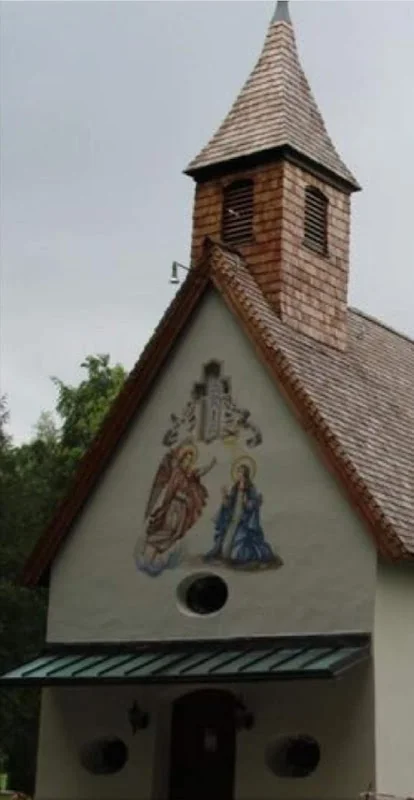
Architecturally, the chapel is surprisingly detailed despite its size. The monument portal describes a masonry, church-like building oriented north-south with an entrance area, semicircular apse, central section, and sacristy addition. The whole is covered by a steep shingle roof with a bell tower and three bells. In the gable triangle, there is a depiction of the Annunciation, above which are two scrolls, and a cross integrated into the wall, painted with the name Mary and stars. This mixture of simplicity and richness of symbols makes the chapel immediately recognizable in photos and explains why it has such a distinctive appearance in the region.
([marterl.at](https://www.marterl.at/suche/detail-1?cHash=b7bad3dde44a73eb5e36a7c6d0c0459d&oid=3013))Inside, this principle continues. A baroque Pietà on a simple altar forms the centerpiece, next to which stands a large cross with a framed wooden figure of Christ in the three-nail type. A grille separates the altar area from the community room, where several rows of benches are arranged. The windows are adorned with saint depictions, and simple stations of the cross can be found in wooden frames on the side walls. In the entrance area, votive tablets, thank-you notes, a stone slab for the war victims of the surrounding farms, and a framed history of the chapel are added. This creates a space that is neither overloaded nor stark but carries many layers of meaning in its simplicity.
([marterl.at](https://www.marterl.at/suche/detail-1?cHash=b7bad3dde44a73eb5e36a7c6d0c0459d&oid=3013))The monument data also mentions approximate dimensions of four meters in height, seven meters in width, and fourteen meters in depth, as well as a very good state of preservation. In addition, there is the official protection status as a monument. For seekers comparing Buchfelln with other Marian sites, this is an important classification: It is not about monumental architecture here, but about a carefully maintained gem with high inner density. This mixture of historical substance, religious function, and illustrative imagery makes the chapel so interesting online. It is small but by no means inconspicuous.
([marterl.at](https://www.marterl.at/suche/detail-1?cHash=b7bad3dde44a73eb5e36a7c6d0c0459d&oid=3013))Photos, Reviews, and Local Search Intent
Those looking for photos or reviews usually want to see how the place looks first. In Buchfelln, this is particularly important because a small Marian chapel unfolds its effect primarily through atmosphere, architectural form, and care. The monument portal provides imagery and technical details, while the parish site shows the place in a sacred context. For seekers, this is more helpful than a mere star rating: One recognizes the silhouette of the shingle roof, the bell tower, the Pietà, and the simple interior design and can thus classify the place objectively. Especially with a religious small building, this visual and historical orientation is often more important than a brief opinion.
([marterl.at](https://www.marterl.at/suche/detail-1?cHash=b7bad3dde44a73eb5e36a7c6d0c0459d&oid=3013))The multitude of Google variants around the Seven Sorrows of Mary also shows that users often associate a local reference with a religious motive. Sometimes the question of the church is in the foreground, sometimes that of a chapel, sometimes prayer or devotion. Buchfelln answers this search particularly clearly because the factual situation is clear: Chapel in Buchfelln, patronage September 15, regular summer masses, long history, and listed substance. This combination is understandable for both search engines and people alike. The search intent is thus not only served but precisely channeled.
([stadtkirche-traunstein.de](https://www.stadtkirche-traunstein.de/index.php?id=7))From an SEO perspective, Buchfelln is therefore a good example of how a local sacred site should be described online. The most important search terms are not event, program, or ticket, but chapel, church, rosary, prayer, devotion, photos, and historical classification. A text that takes this seriously not only provides keywords but real added value. It explains why the place exists, how it has grown, and why it remains relevant to this day. This is precisely the strength of this chapel: It is small enough for silence and large enough for history.
([stadtkirche-traunstein.de](https://www.stadtkirche-traunstein.de/index.php?id=7))For the search intent surrounding the Seven Sorrows of Mary, Buchfelln is therefore a clear hit: Those looking for a chapel, a prayer destination, historical classification, or photos receive here a small but very content-rich answer. The location in Traunstein, the patronage on September 15, the early rosary tradition, the war expansion, and the well-maintained furnishings combine to form a locally anchored Marian chapel that does not need to make a loud appearance to be relevant. Especially at a time when many search queries for chapel, devotion, or prayer simultaneously demand emotional and practical orientation, Buchfelln is a convincing example of a place where both come together.
([stadtkirche-traunstein.de](https://www.stadtkirche-traunstein.de/index.php?id=7))Sources:
Mehr anzeigenWeniger anzeigen
Seven Sorrows of Mary | Chapel & Rosary
The Seven Sorrows of Mary in Buchfelln is not a large pilgrimage basilica, but a simple, historically grown Marian chapel on the road from Traunstein to Knappenfeld. It is precisely this size that makes it so interesting for seekers: Those looking for chapel, church, rosary, prayer, or devotion will find here a place where regional piety and lived parish practice meet. The chapel belongs to the surroundings of the city church of Traunstein, is dedicated to the patronage of the Seven Sorrows of Mary on September 15, and is still used for mass celebrations today. Its history dates back at least to the early modern period, but the current building is the result of several renovations, expansions, and preservation initiatives. Thus, Buchfelln is a typical example of a small rural chapel that has been supported by the community over generations and continues to offer a quiet, credible place for prayer and remembrance in the present.
([stadtkirche-traunstein.de](https://www.stadtkirche-traunstein.de/index.php?id=7))Chapel of the Seven Sorrows of Mary in Buchfelln: Location, Patronage, and Classification
The official classification is important because search queries for seven sorrows of mary church or chapel of the seven sorrows of mary often mean both, but ultimately seek a quiet place for devotion. In Buchfelln, there is indeed a chapel, not a large parish church. The city church of Traunstein lists it as a chapel in Buchfelln among the churches and chapels of the parish, and the location is described by sources as Buchfelln near Traunstein. This makes orientation simple: Those traveling in Traunstein will not find an urban event venue here, but a rural, clearly located Marian chapel with ecclesiastical use and a pronounced local identity. For SEO, this combination is valuable because it simultaneously serves the search intent for place, type, and spiritual occasion.
([stadtkirche-traunstein.de](https://www.stadtkirche-traunstein.de/index.php?id=7))The patronage is more than just a title. On September 15, the church commemorates the Sorrows of Mary, and the liturgical tradition understands this day as an opportunity to reflect on Mary's suffering alongside Christ's path to salvation. For Buchfelln, this means: The name of the chapel refers not only to a Marian image but to a concrete spiritual attitude. Therefore, terms like rosary, prayer, and devotion fit so well into this context. In practice, people here are not looking for a program booklet, seating plan, or ticket shop, but for a place where memory, silence, and prayer converge. This situation should be evident in any good local description.
([vatican.va](https://www.vatican.va/content/paul-vi/en/apost_exhortations/documents/hf_p-vi_exh_19740202_marialis-cultus.html?utm_source=openai))The connection between patronage and use is also important for visitors. Where a chapel is dedicated to the memory of the Seven Sorrows of Mary, an atmosphere is created that consciously remains contemplative. Unlike a large city church, Buchfelln is characterized not by abundance and size, but by clarity, closeness, and continuity. The parish explicitly names the chapel as a place where mass celebrations take place in the summer months. This makes the name of the patronage tangible in everyday life: it does not remain on the calendar page, but is continued in worship, prayer, and well-maintained architecture. For seekers of local Marian piety, this is the crucial information.
([stadtkirche-traunstein.de](https://www.stadtkirche-traunstein.de/index.php?id=7))From the First Place of Devotion to the Current Building
The earliest traces in Buchfelln show that piety was present there long before the current building. A visitation protocol from 1713 describes no chapel in the modern sense at this location, but a stone Marian figure or an oratory. Remarkable is the lively practice: On feast days, people gathered in the afternoons and prayed the rosary. This is central to the interpretation of the place because it shows the chapel not as a later tourist backdrop, but as the result of a developed prayer culture. Even early on, it was about communal remembering, praying, and gathering at a Marian site.
([marterl.at](https://www.marterl.at/suche/detail-1?cHash=b7bad3dde44a73eb5e36a7c6d0c0459d&oid=3013))Later sources depict the building history with slightly differing dates, but agree in essence: From a small field chapel, a solid, masonry place of devotion was created. The city church of Traunstein reports of a field chapel from 1720, which was later replaced by a stone building; the monument portal cites a secured construction of the current chapel in 1831. For an SEO text, it is crucial not to artificially smooth the development but to emphasize continuity: A simple place of prayer grew step by step into a chapel that was associated with the farmers of the surrounding area and the Buchfellnerhof and was maintained over generations.
([stadtkirche-traunstein.de](https://www.stadtkirche-traunstein.de/index.php?id=7))After World War II, the place entered a new phase of preservation and use. According to the parish, the chapel was expanded and consecrated in 1947; the monument portal adds that permission for the celebration of Holy Mass was granted in 1948 and a sacristy was added in 1959. Later, the chapel was transferred to a community of ownership and preservation. These stages are significant for today's perception because they show that Buchfelln is not a closed monument space, but a well-maintained, still active place with a strong local culture of responsibility. It is precisely in the connection of sacred use and civic preservation that its special authenticity lies.
([stadtkirche-traunstein.de](https://www.stadtkirche-traunstein.de/index.php?id=7))Rosary, Prayer, and the Significance of the Seven Sorrows of Mary
The name of the chapel directly refers to one of the most well-known Marian devotions of the church. The liturgical memory of the Sorrows of Mary on September 15 invites reflection on Mary's participation in the suffering and death of Jesus. The Roman tradition considers this day a particularly suitable moment to reconsider the mystery of salvation under the cross. For the language of search queries, this means: Those looking for prayer, novena, rosary, or devotion are not only searching for a place but for a spiritual form that connects pain, comfort, and hope. Buchfelln provides a concretely tangible, historical setting for this.
([vatican.va](https://www.vatican.va/content/paul-vi/en/apost_exhortations/documents/hf_p-vi_exh_19740202_marialis-cultus.html?utm_source=openai))The local tradition makes this spiritual profile very concrete. As early as 1713, the evening or afternoon gathering of people praying the rosary was described at this location. In this respect, the search term seven sorrows of mary rosary for Buchfelln is by no means coincidental, but historically plausible. The chapel bears a name that considers the prayer itself: Mary under the cross, the rosary as a meditative form, and the communal devotion as a social practice. Precisely for this reason, the place is well-suited for quiet contemplation and personal piety, without the need for a large tourist stage.
([marterl.at](https://www.marterl.at/suche/detail-1?cHash=b7bad3dde44a73eb5e36a7c6d0c0459d&oid=3013))The current use also connects to this tradition. The parish states that regular mass celebrations take place in Buchfelln during the summer months. This is remarkable for a small rural chapel because it shows that the place is not only historically interesting but also lives liturgically. Those who pray on site do not experience a purely memorial atmosphere, but a space where memory and presence touch. This is exactly what gives the SEO value of such pages: They not only answer the question of the name but also the question of spiritual content. Buchfelln represents a form of devotion that is simple, local, and reliable.
([stadtkirche-traunstein.de](https://www.stadtkirche-traunstein.de/index.php?id=7))Mass Celebrations, Visits, and Practical Information for Traunstein
The location is simple for visitors and simultaneously typically rural: The chapel is located in Buchfelln on the road from Traunstein to Knappenfeld. This makes it easy to reach as part of a quiet outing or a short prayer visit, without the need for a complex infrastructure. The available sources do not mention any event operations, evening box office, or tourist opening hours, but primarily the sacred use. This is precisely where the charm of the place lies. Those seeking a chapel like this do not expect a classic event schedule but an honest, quiet place with a clear history and current ecclesiastical reference.
([stadtkirche-traunstein.de](https://www.stadtkirche-traunstein.de/index.php?id=7))For concrete planning, the current worship schedule of the city church of Traunstein is the best orientation. There, Buchfelln is listed in the worship entries, and the parish refers to regular mass celebrations in the summer months. Information about a dedicated parking lot, large visitor areas, or special travel regulations is not explicitly mentioned in the available sources. Therefore, it is sensible to plan the visit as with many small village chapels: with some flexibility, a brief consideration of the quiet surroundings, and the knowledge that the place is primarily intended for liturgical use and quiet devotion. This sobriety is not a weakness but part of the authenticity.
([stadtkirche-traunstein.de](https://www.stadtkirche-traunstein.de/index.php?id=115&utm_source=openai))Those looking for photos or reviews should also consider the scale of this chapel. Small sacred buildings rarely thrive on lengthy user comments but on documented historical details, imagery, and ecclesiastical classification. The monument portal provides photos and object information, while the parish site shows the chapel in the context of the churches and chapels of Traunstein. This way, one gets exactly what is most important for a place like Buchfelln: visual orientation, historical classification, and the indication of continued vibrant use. Search queries for photos or reviews ideally lead to the official or heritage conservation sources, not to superficial quick evaluations.
([stadtkirche-traunstein.de](https://www.stadtkirche-traunstein.de/index.php?id=7))Architecture, Furnishings, Photos, and Special Details
Architecturally, the chapel is surprisingly detailed despite its size. The monument portal describes a masonry, church-like building oriented north-south with an entrance area, semicircular apse, central section, and sacristy addition. The whole is covered by a steep shingle roof with a bell tower and three bells. In the gable triangle, there is a depiction of the Annunciation, above which are two scrolls, and a cross integrated into the wall, painted with the name Mary and stars. This mixture of simplicity and richness of symbols makes the chapel immediately recognizable in photos and explains why it has such a distinctive appearance in the region.
([marterl.at](https://www.marterl.at/suche/detail-1?cHash=b7bad3dde44a73eb5e36a7c6d0c0459d&oid=3013))Inside, this principle continues. A baroque Pietà on a simple altar forms the centerpiece, next to which stands a large cross with a framed wooden figure of Christ in the three-nail type. A grille separates the altar area from the community room, where several rows of benches are arranged. The windows are adorned with saint depictions, and simple stations of the cross can be found in wooden frames on the side walls. In the entrance area, votive tablets, thank-you notes, a stone slab for the war victims of the surrounding farms, and a framed history of the chapel are added. This creates a space that is neither overloaded nor stark but carries many layers of meaning in its simplicity.
([marterl.at](https://www.marterl.at/suche/detail-1?cHash=b7bad3dde44a73eb5e36a7c6d0c0459d&oid=3013))The monument data also mentions approximate dimensions of four meters in height, seven meters in width, and fourteen meters in depth, as well as a very good state of preservation. In addition, there is the official protection status as a monument. For seekers comparing Buchfelln with other Marian sites, this is an important classification: It is not about monumental architecture here, but about a carefully maintained gem with high inner density. This mixture of historical substance, religious function, and illustrative imagery makes the chapel so interesting online. It is small but by no means inconspicuous.
([marterl.at](https://www.marterl.at/suche/detail-1?cHash=b7bad3dde44a73eb5e36a7c6d0c0459d&oid=3013))Photos, Reviews, and Local Search Intent
Those looking for photos or reviews usually want to see how the place looks first. In Buchfelln, this is particularly important because a small Marian chapel unfolds its effect primarily through atmosphere, architectural form, and care. The monument portal provides imagery and technical details, while the parish site shows the place in a sacred context. For seekers, this is more helpful than a mere star rating: One recognizes the silhouette of the shingle roof, the bell tower, the Pietà, and the simple interior design and can thus classify the place objectively. Especially with a religious small building, this visual and historical orientation is often more important than a brief opinion.
([marterl.at](https://www.marterl.at/suche/detail-1?cHash=b7bad3dde44a73eb5e36a7c6d0c0459d&oid=3013))The multitude of Google variants around the Seven Sorrows of Mary also shows that users often associate a local reference with a religious motive. Sometimes the question of the church is in the foreground, sometimes that of a chapel, sometimes prayer or devotion. Buchfelln answers this search particularly clearly because the factual situation is clear: Chapel in Buchfelln, patronage September 15, regular summer masses, long history, and listed substance. This combination is understandable for both search engines and people alike. The search intent is thus not only served but precisely channeled.
([stadtkirche-traunstein.de](https://www.stadtkirche-traunstein.de/index.php?id=7))From an SEO perspective, Buchfelln is therefore a good example of how a local sacred site should be described online. The most important search terms are not event, program, or ticket, but chapel, church, rosary, prayer, devotion, photos, and historical classification. A text that takes this seriously not only provides keywords but real added value. It explains why the place exists, how it has grown, and why it remains relevant to this day. This is precisely the strength of this chapel: It is small enough for silence and large enough for history.
([stadtkirche-traunstein.de](https://www.stadtkirche-traunstein.de/index.php?id=7))For the search intent surrounding the Seven Sorrows of Mary, Buchfelln is therefore a clear hit: Those looking for a chapel, a prayer destination, historical classification, or photos receive here a small but very content-rich answer. The location in Traunstein, the patronage on September 15, the early rosary tradition, the war expansion, and the well-maintained furnishings combine to form a locally anchored Marian chapel that does not need to make a loud appearance to be relevant. Especially at a time when many search queries for chapel, devotion, or prayer simultaneously demand emotional and practical orientation, Buchfelln is a convincing example of a place where both come together.
([stadtkirche-traunstein.de](https://www.stadtkirche-traunstein.de/index.php?id=7))Sources:
Upcoming Events
No events found
Frequently Asked Questions
Reviews
No reviews found