
Grabenstätt
Erlstätt, 83355 Grabenstätt, Deutschland
Parish Church of St. Peter and Paul Erlstätt | History & Photos
The Parish Church of St. Peter and Paul in the valley in Erlstätt is not just a randomly beautiful village church, but a place with clear historical depth and strong local ties. It belongs to the parish association of St. Francis of Assisi and is closely related to the parish of Erlstätt, which is still actively used today. Chiemsee-Alpenland Tourism describes the church as one of the oldest village churches in the Chiemgau region; it was built around 1480 during the late Gothic period. At the same time, the official monument list shows that not only a structure but also an archaeologically relevant site with predecessor buildings is preserved here. This is particularly exciting for visitors because several layers of time overlap at a single location: medieval substance, baroque additions, later changes to the exterior, and a still vibrant parish use. Those looking for photos, history, opening hours, or practical tips will find not only a beautiful excursion destination but also a remarkable cultural site in southeastern Bavaria. The church connects local identity, art history, and quiet devotion in a way that is not common in the Chiemgau. ([chiemsee-alpenland.de](https://www.chiemsee-alpenland.de/entdecken/alle-sehenswuerdigkeiten/pfarrkirche-st.-peter-und-paul-im-thale-in-erlstaett-776681eccd))
Why the Parish Church of St. Peter and Paul Erlstätt is historically significant
The historical significance of the parish church begins with its classification as one of the oldest village churches in the Chiemgau region. According to Chiemsee-Alpenland Tourism, the building dates back to around 1480 and had already been a cooperative church of Haslach for a long time at that point. This shows that the church did not become the religious center of the village only later, but was embedded in an older ecclesiastical structure. This early integration gives the site a special historical continuity: here, village history, pastoral care, and regional building development meet. For the search for the keyword history, it is also important that the building comes from a phase in which many new church constructions in the Chiemgau reflected the late Gothic bloom of the region. The church is therefore not only old but also typical of a formative era of regional sacred architecture. Thus, when one observes the Erlstätt church, one sees a place where architecture and parish history have supported each other for centuries. ([chiemsee-alpenland.de](https://www.chiemsee-alpenland.de/entdecken/alle-sehenswuerdigkeiten/pfarrkirche-st.-peter-und-paul-im-thale-in-erlstaett-776681eccd))
Additionally, the Bavarian Monument List refers to an underground medieval and early modern archaeological situation in the area of the Catholic Parish Church of St. Peter and Paul in the valley in Erlstätt and its predecessor buildings. This is an important indication because it means that not only the visible building today but also the ground beneath it must be understood as a historical repository. Such findings are often as valuable for the research of a site as the building itself, as they can document earlier usage phases, building conditions, or burial contexts. Furthermore, the churchyard wall with burial niches mentioned in the monument register makes the ecclesiastical space visible as a developed cemetery and memorial site. For visitors, this also explains why the church, despite its quiet location, has a strong presence: it is not isolated but part of a sacred ensemble that has grown over centuries. That is precisely why it is often sought under terms like monument, history, and photos. ([geodaten.bayern.de](https://geodaten.bayern.de/denkmal_static_data/externe_denkmalliste/pdf/denkmalliste_merge_189119.pdf))
Late Gothic building with west tower and churchyard wall
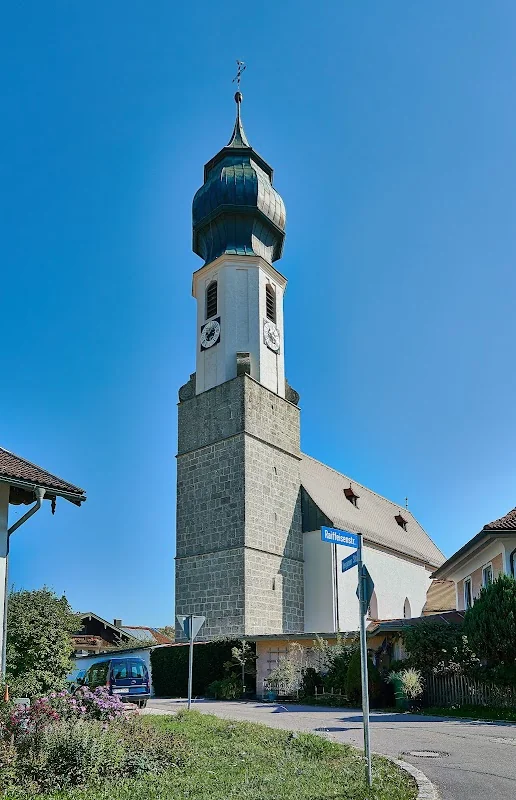
Architecturally, the Parish Church of St. Peter and Paul Erlstätt is a clearly readable late Gothic building with later modifications. The monument list of the Bavarian State Office for Monument Preservation describes it as a late Gothic block construction with a west tower from the late 15th century, whose tower upper floor was baroque in style. This combination is what makes the exterior view appealing: the core remains late medieval, while the tower received a different design language in later times. The result is not a smooth unity but a historically grown appearance that openly shows the building's renovation history. For the perception on site, this is important because the building does not appear like a reconstructed ideal type but like an authentic testimony of long usage. Those interested in the keywords late Gothic and onion dome will find here not an abstract style description but a concrete example of the connection between late Gothic body and baroque tower design. ([geodaten.bayern.de](https://geodaten.bayern.de/denkmal_static_data/externe_denkmalliste/pdf/denkmalliste_merge_189119.pdf))
The surroundings of the church also contribute to the architectural statement. The official monument list names the churchyard wall with burial niches as part of the ensemble. This directs attention to the fact that the church should not only be understood as a standalone building but as the center of a sacred place. Churchyard walls often structure the transition between public village space and liturgical area in rural regions; here, the wall enhances the impression of a protected, historically deep-rooted church area. Chiemsee-Alpenland Tourism adds that the exterior has been altered multiple times throughout its existence. This information is valuable because it explains why the building today bears both medieval and later design levels. Therefore, those photographing the church should not only focus on the front view but also on the interplay of tower, wall, and overall volume. This layering makes the building attractive for architecture enthusiasts and for search queries related to photos. ([chiemsee-alpenland.de](https://www.chiemsee-alpenland.de/entdecken/alle-sehenswuerdigkeiten/pfarrkirche-st.-peter-und-paul-im-thale-in-erlstaett-776681eccd))
Baroque furnishings and the Christ half-figure around 1300
The interior of the church is, according to official descriptions, the place where the oldest and the younger art history meet particularly clearly. Chiemsee-Alpenland Tourism names as the most beautiful work inside the church a strict, serious half-figure of Christ from around 1300. This note alone makes it clear that Erlstätt is not just a pretty village church with standardized furnishings, but possesses an art-historically remarkable core. The Christ figure dates back significantly before the construction around 1480 and thus refers to an even older piety and image tradition. For visitors, this is a strong moment: one enters a late Gothic church space and encounters a work that dates back to around 1300. This long time span is one of the most important features of the parish church and explains why it is also relevant for art-historically interested guests. The combination of building age and interior art creates a rare impression of historical depth. ([chiemsee-alpenland.de](https://www.chiemsee-alpenland.de/entdecken/alle-sehenswuerdigkeiten/pfarrkirche-st.-peter-und-paul-im-thale-in-erlstaett-776681eccd))
This older core figure is complemented by baroque saint figures and the high altar, on which, according to tourism information, Peter and Rupert dominate. The thief stone is also highlighted as an interesting and remarkable late medieval work. This means that inside one encounters not just a single highlight but several art-historical layers that together create a coherent overall picture. The baroque saint works set colorful and formal accents, while the high altar makes the liturgy and the patronage of the church visible. The thief stone, in turn, refers to a visual language that enriches the church space beyond the usual framework. For search queries like baroque furnishings or photos, this very complexity is crucial, as visitors want to know not only that there is something beautiful but also what they can actually see. Erlstätt offers a clearly defined but historically rich interior. ([chiemsee-alpenland.de](https://www.chiemsee-alpenland.de/entdecken/alle-sehenswuerdigkeiten/pfarrkirche-st.-peter-und-paul-im-thale-in-erlstaett-776681eccd))
Opening hours, parking, and parish office in Grabenstätt
For practical visits, the official tourism site provides particularly clear information. The Parish Church of St. Peter and Paul in the valley is open daily from 8 AM to 6 PM, as well as during service times and by request through the Catholic parish office in Erlstätt. This is important for travelers and excursionists because the church is described not only as a quiet monument but as an openly accessible place. Those who stop by spontaneously have good chances of visiting within the specified time frame. Equally important are the parking tips: According to Chiemsee-Alpenland Tourism, there are free parking spaces available in limited numbers. This is a relevant point for a village church because the parking situation in small, historically grown places is often limited. Therefore, those arriving by car should come either early or with some flexibility. This directly answers practical search queries like opening hours and parking. ([chiemsee-alpenland.de](https://www.chiemsee-alpenland.de/entdecken/alle-sehenswuerdigkeiten/pfarrkirche-st.-peter-und-paul-im-thale-in-erlstaett-776681eccd))
The church organization on site is also well understandable. The parish office of St. Peter and Paul in the valley Erlstätt is located at Grabenstätter Str. 6 in 83355 Grabenstätt; the official site states the opening hours as Tuesday from 9:00 AM to 12:00 PM and Thursday from 1:00 PM to 4:00 PM. The parish secretary Karin Neuhauser is also mentioned, along with the phone number 0861-5322. For visitors who have questions about services, inquiries, or a possible visit outside regular opening hours, this information is very helpful. At the same time, the official information shows that the church is embedded in a lively administrative structure and is organized not only touristically but also pastorally. This is particularly important for Google searchers who want to know about specific contacts, availability, and visiting times. ([erzbistum-muenchen.de](https://www.erzbistum-muenchen.de/pfarrei/hl-franz-von-assisi/Kontakt/pfarreien/st-peter-und-paul-im-thale-erlstaett/pfarrbuero-erlstaett))
Parish association, services, and church life in Erlstätt
The Parish Church of St. Peter and Paul in the valley is part of a larger ecclesiastical context. The official site of the Archdiocese of Munich and Freising assigns it to the parish association of St. Francis of Assisi, along with Bergen, Grabenstätt, and Vachendorf. This classification is more than an organizational footnote, as it shows that the church does not function as an isolated landmark but as an active parish church in a regional network. The parish association forms the framework for services, pastoral care, administration, and community life. This embedding is important for search queries related to church patronage, services, or current events, as visitors thereby recognize that Erlstätt remains a real utilized ecclesiastical place. The official parish site also refers to ongoing church communication, showing that the parish remains continuously informed and accessible. ([erzbistum-muenchen.de](https://www.erzbistum-muenchen.de/pfarrei/hl-franz-von-assisi/Kontakt/pfarreien/st-peter-und-paul-im-thale-erlstaett))
The importance for community life can also be seen in the official announcements and event notices. The Archdiocese publishes concrete information for Erlstätt regarding services, parish committees, and other offerings, which proves the ongoing use of the church. For visitors, this is interesting because a church space with an active community often possesses a different atmosphere than a purely museum-like place. In Erlstätt, it is also the case that liturgical use, monument-protected building substance, and local identity reinforce each other. Those searching for the keyword reviews often mean the impression a place leaves on others; here, it is precisely this mixture of open church, monument-protected substance, and lived parish life that creates the decisive impression. The church is not just an object to look at but a place where the centuries-old religious framework remains recognizable to this day. ([erzbistum-muenchen.de](https://www.erzbistum-muenchen.de/pfarrei/hl-franz-von-assisi/Kontakt/pfarreien/st-peter-und-paul-im-thale-erlstaett))
Photos, reviews, and why the church stands out in the Chiemgau
Those looking for photos of the Parish Church of St. Peter and Paul Erlstätt will primarily react to the clear external features that make the building so distinctive: the late Gothic core, the west tower with baroque upper floor, and the churchyard with burial niches mentioned in the monument list. This combination creates images that appear simultaneously calm, historical, and very locally rooted. Inside, the half-figure of Christ from around 1300 adds to this, with its strict aura forming a strong counterpoint to the baroque furnishings. This is attractive for photography enthusiasts because here one does not see an interchangeable standard church but an ensemble with clear temporal contrasts. The official tourism description explicitly speaks of the repeatedly altered exterior and the striking artworks inside. Therefore, those seeking good pictures will find not only decorative details but a building that offers clear motives both architecturally and art-historically. ([chiemsee-alpenland.de](https://www.chiemsee-alpenland.de/entdecken/alle-sehenswuerdigkeiten/pfarrkirche-st.-peter-und-paul-im-thale-in-erlstaett-776681eccd))
The search for reviews also presents a different picture in the case of a village church than at a large event location. Here, it is less about service ratings in a commercial sense but rather about the personal impression of atmosphere, silence, historical depth, and accessibility. The official opening hours of daily from 8 AM to 6 PM and the available, albeit limited, free parking significantly facilitate the visit. Together with the integration into the parish association and the monument status, a place emerges that is not just quickly checked off but consciously perceived. For the Chiemgau, the church is therefore a small but very characterful cultural heritage: unobtrusive, historically rich, and authentic. These qualities make it so visible in search queries related to photos, history, and Erlstätt. ([chiemsee-alpenland.de](https://www.chiemsee-alpenland.de/entdecken/alle-sehenswuerdigkeiten/pfarrkirche-st.-peter-und-paul-im-thale-in-erlstaett-776681eccd))
Sources:
- Chiemsee-Alpenland Tourism - Parish Church of St. Peter and Paul in the valley in Erlstätt
- Archdiocese of Munich and Freising - St. Peter and Paul in the valley Erlstätt
- Archdiocese of Munich and Freising - Parish Office Erlstätt
- Bavarian State Office for Monument Preservation - Monument List Upper Bavaria
Mehr anzeigenWeniger anzeigen
Parish Church of St. Peter and Paul Erlstätt | History & Photos
The Parish Church of St. Peter and Paul in the valley in Erlstätt is not just a randomly beautiful village church, but a place with clear historical depth and strong local ties. It belongs to the parish association of St. Francis of Assisi and is closely related to the parish of Erlstätt, which is still actively used today. Chiemsee-Alpenland Tourism describes the church as one of the oldest village churches in the Chiemgau region; it was built around 1480 during the late Gothic period. At the same time, the official monument list shows that not only a structure but also an archaeologically relevant site with predecessor buildings is preserved here. This is particularly exciting for visitors because several layers of time overlap at a single location: medieval substance, baroque additions, later changes to the exterior, and a still vibrant parish use. Those looking for photos, history, opening hours, or practical tips will find not only a beautiful excursion destination but also a remarkable cultural site in southeastern Bavaria. The church connects local identity, art history, and quiet devotion in a way that is not common in the Chiemgau. ([chiemsee-alpenland.de](https://www.chiemsee-alpenland.de/entdecken/alle-sehenswuerdigkeiten/pfarrkirche-st.-peter-und-paul-im-thale-in-erlstaett-776681eccd))
Why the Parish Church of St. Peter and Paul Erlstätt is historically significant
The historical significance of the parish church begins with its classification as one of the oldest village churches in the Chiemgau region. According to Chiemsee-Alpenland Tourism, the building dates back to around 1480 and had already been a cooperative church of Haslach for a long time at that point. This shows that the church did not become the religious center of the village only later, but was embedded in an older ecclesiastical structure. This early integration gives the site a special historical continuity: here, village history, pastoral care, and regional building development meet. For the search for the keyword history, it is also important that the building comes from a phase in which many new church constructions in the Chiemgau reflected the late Gothic bloom of the region. The church is therefore not only old but also typical of a formative era of regional sacred architecture. Thus, when one observes the Erlstätt church, one sees a place where architecture and parish history have supported each other for centuries. ([chiemsee-alpenland.de](https://www.chiemsee-alpenland.de/entdecken/alle-sehenswuerdigkeiten/pfarrkirche-st.-peter-und-paul-im-thale-in-erlstaett-776681eccd))
Additionally, the Bavarian Monument List refers to an underground medieval and early modern archaeological situation in the area of the Catholic Parish Church of St. Peter and Paul in the valley in Erlstätt and its predecessor buildings. This is an important indication because it means that not only the visible building today but also the ground beneath it must be understood as a historical repository. Such findings are often as valuable for the research of a site as the building itself, as they can document earlier usage phases, building conditions, or burial contexts. Furthermore, the churchyard wall with burial niches mentioned in the monument register makes the ecclesiastical space visible as a developed cemetery and memorial site. For visitors, this also explains why the church, despite its quiet location, has a strong presence: it is not isolated but part of a sacred ensemble that has grown over centuries. That is precisely why it is often sought under terms like monument, history, and photos. ([geodaten.bayern.de](https://geodaten.bayern.de/denkmal_static_data/externe_denkmalliste/pdf/denkmalliste_merge_189119.pdf))
Late Gothic building with west tower and churchyard wall
Architecturally, the Parish Church of St. Peter and Paul Erlstätt is a clearly readable late Gothic building with later modifications. The monument list of the Bavarian State Office for Monument Preservation describes it as a late Gothic block construction with a west tower from the late 15th century, whose tower upper floor was baroque in style. This combination is what makes the exterior view appealing: the core remains late medieval, while the tower received a different design language in later times. The result is not a smooth unity but a historically grown appearance that openly shows the building's renovation history. For the perception on site, this is important because the building does not appear like a reconstructed ideal type but like an authentic testimony of long usage. Those interested in the keywords late Gothic and onion dome will find here not an abstract style description but a concrete example of the connection between late Gothic body and baroque tower design. ([geodaten.bayern.de](https://geodaten.bayern.de/denkmal_static_data/externe_denkmalliste/pdf/denkmalliste_merge_189119.pdf))
The surroundings of the church also contribute to the architectural statement. The official monument list names the churchyard wall with burial niches as part of the ensemble. This directs attention to the fact that the church should not only be understood as a standalone building but as the center of a sacred place. Churchyard walls often structure the transition between public village space and liturgical area in rural regions; here, the wall enhances the impression of a protected, historically deep-rooted church area. Chiemsee-Alpenland Tourism adds that the exterior has been altered multiple times throughout its existence. This information is valuable because it explains why the building today bears both medieval and later design levels. Therefore, those photographing the church should not only focus on the front view but also on the interplay of tower, wall, and overall volume. This layering makes the building attractive for architecture enthusiasts and for search queries related to photos. ([chiemsee-alpenland.de](https://www.chiemsee-alpenland.de/entdecken/alle-sehenswuerdigkeiten/pfarrkirche-st.-peter-und-paul-im-thale-in-erlstaett-776681eccd))
Baroque furnishings and the Christ half-figure around 1300
The interior of the church is, according to official descriptions, the place where the oldest and the younger art history meet particularly clearly. Chiemsee-Alpenland Tourism names as the most beautiful work inside the church a strict, serious half-figure of Christ from around 1300. This note alone makes it clear that Erlstätt is not just a pretty village church with standardized furnishings, but possesses an art-historically remarkable core. The Christ figure dates back significantly before the construction around 1480 and thus refers to an even older piety and image tradition. For visitors, this is a strong moment: one enters a late Gothic church space and encounters a work that dates back to around 1300. This long time span is one of the most important features of the parish church and explains why it is also relevant for art-historically interested guests. The combination of building age and interior art creates a rare impression of historical depth. ([chiemsee-alpenland.de](https://www.chiemsee-alpenland.de/entdecken/alle-sehenswuerdigkeiten/pfarrkirche-st.-peter-und-paul-im-thale-in-erlstaett-776681eccd))
This older core figure is complemented by baroque saint figures and the high altar, on which, according to tourism information, Peter and Rupert dominate. The thief stone is also highlighted as an interesting and remarkable late medieval work. This means that inside one encounters not just a single highlight but several art-historical layers that together create a coherent overall picture. The baroque saint works set colorful and formal accents, while the high altar makes the liturgy and the patronage of the church visible. The thief stone, in turn, refers to a visual language that enriches the church space beyond the usual framework. For search queries like baroque furnishings or photos, this very complexity is crucial, as visitors want to know not only that there is something beautiful but also what they can actually see. Erlstätt offers a clearly defined but historically rich interior. ([chiemsee-alpenland.de](https://www.chiemsee-alpenland.de/entdecken/alle-sehenswuerdigkeiten/pfarrkirche-st.-peter-und-paul-im-thale-in-erlstaett-776681eccd))
Opening hours, parking, and parish office in Grabenstätt
For practical visits, the official tourism site provides particularly clear information. The Parish Church of St. Peter and Paul in the valley is open daily from 8 AM to 6 PM, as well as during service times and by request through the Catholic parish office in Erlstätt. This is important for travelers and excursionists because the church is described not only as a quiet monument but as an openly accessible place. Those who stop by spontaneously have good chances of visiting within the specified time frame. Equally important are the parking tips: According to Chiemsee-Alpenland Tourism, there are free parking spaces available in limited numbers. This is a relevant point for a village church because the parking situation in small, historically grown places is often limited. Therefore, those arriving by car should come either early or with some flexibility. This directly answers practical search queries like opening hours and parking. ([chiemsee-alpenland.de](https://www.chiemsee-alpenland.de/entdecken/alle-sehenswuerdigkeiten/pfarrkirche-st.-peter-und-paul-im-thale-in-erlstaett-776681eccd))
The church organization on site is also well understandable. The parish office of St. Peter and Paul in the valley Erlstätt is located at Grabenstätter Str. 6 in 83355 Grabenstätt; the official site states the opening hours as Tuesday from 9:00 AM to 12:00 PM and Thursday from 1:00 PM to 4:00 PM. The parish secretary Karin Neuhauser is also mentioned, along with the phone number 0861-5322. For visitors who have questions about services, inquiries, or a possible visit outside regular opening hours, this information is very helpful. At the same time, the official information shows that the church is embedded in a lively administrative structure and is organized not only touristically but also pastorally. This is particularly important for Google searchers who want to know about specific contacts, availability, and visiting times. ([erzbistum-muenchen.de](https://www.erzbistum-muenchen.de/pfarrei/hl-franz-von-assisi/Kontakt/pfarreien/st-peter-und-paul-im-thale-erlstaett/pfarrbuero-erlstaett))
Parish association, services, and church life in Erlstätt
The Parish Church of St. Peter and Paul in the valley is part of a larger ecclesiastical context. The official site of the Archdiocese of Munich and Freising assigns it to the parish association of St. Francis of Assisi, along with Bergen, Grabenstätt, and Vachendorf. This classification is more than an organizational footnote, as it shows that the church does not function as an isolated landmark but as an active parish church in a regional network. The parish association forms the framework for services, pastoral care, administration, and community life. This embedding is important for search queries related to church patronage, services, or current events, as visitors thereby recognize that Erlstätt remains a real utilized ecclesiastical place. The official parish site also refers to ongoing church communication, showing that the parish remains continuously informed and accessible. ([erzbistum-muenchen.de](https://www.erzbistum-muenchen.de/pfarrei/hl-franz-von-assisi/Kontakt/pfarreien/st-peter-und-paul-im-thale-erlstaett))
The importance for community life can also be seen in the official announcements and event notices. The Archdiocese publishes concrete information for Erlstätt regarding services, parish committees, and other offerings, which proves the ongoing use of the church. For visitors, this is interesting because a church space with an active community often possesses a different atmosphere than a purely museum-like place. In Erlstätt, it is also the case that liturgical use, monument-protected building substance, and local identity reinforce each other. Those searching for the keyword reviews often mean the impression a place leaves on others; here, it is precisely this mixture of open church, monument-protected substance, and lived parish life that creates the decisive impression. The church is not just an object to look at but a place where the centuries-old religious framework remains recognizable to this day. ([erzbistum-muenchen.de](https://www.erzbistum-muenchen.de/pfarrei/hl-franz-von-assisi/Kontakt/pfarreien/st-peter-und-paul-im-thale-erlstaett))
Photos, reviews, and why the church stands out in the Chiemgau
Those looking for photos of the Parish Church of St. Peter and Paul Erlstätt will primarily react to the clear external features that make the building so distinctive: the late Gothic core, the west tower with baroque upper floor, and the churchyard with burial niches mentioned in the monument list. This combination creates images that appear simultaneously calm, historical, and very locally rooted. Inside, the half-figure of Christ from around 1300 adds to this, with its strict aura forming a strong counterpoint to the baroque furnishings. This is attractive for photography enthusiasts because here one does not see an interchangeable standard church but an ensemble with clear temporal contrasts. The official tourism description explicitly speaks of the repeatedly altered exterior and the striking artworks inside. Therefore, those seeking good pictures will find not only decorative details but a building that offers clear motives both architecturally and art-historically. ([chiemsee-alpenland.de](https://www.chiemsee-alpenland.de/entdecken/alle-sehenswuerdigkeiten/pfarrkirche-st.-peter-und-paul-im-thale-in-erlstaett-776681eccd))
The search for reviews also presents a different picture in the case of a village church than at a large event location. Here, it is less about service ratings in a commercial sense but rather about the personal impression of atmosphere, silence, historical depth, and accessibility. The official opening hours of daily from 8 AM to 6 PM and the available, albeit limited, free parking significantly facilitate the visit. Together with the integration into the parish association and the monument status, a place emerges that is not just quickly checked off but consciously perceived. For the Chiemgau, the church is therefore a small but very characterful cultural heritage: unobtrusive, historically rich, and authentic. These qualities make it so visible in search queries related to photos, history, and Erlstätt. ([chiemsee-alpenland.de](https://www.chiemsee-alpenland.de/entdecken/alle-sehenswuerdigkeiten/pfarrkirche-st.-peter-und-paul-im-thale-in-erlstaett-776681eccd))
Sources:
- Chiemsee-Alpenland Tourism - Parish Church of St. Peter and Paul in the valley in Erlstätt
- Archdiocese of Munich and Freising - St. Peter and Paul in the valley Erlstätt
- Archdiocese of Munich and Freising - Parish Office Erlstätt
- Bavarian State Office for Monument Preservation - Monument List Upper Bavaria
Parish Church of St. Peter and Paul Erlstätt | History & Photos
The Parish Church of St. Peter and Paul in the valley in Erlstätt is not just a randomly beautiful village church, but a place with clear historical depth and strong local ties. It belongs to the parish association of St. Francis of Assisi and is closely related to the parish of Erlstätt, which is still actively used today. Chiemsee-Alpenland Tourism describes the church as one of the oldest village churches in the Chiemgau region; it was built around 1480 during the late Gothic period. At the same time, the official monument list shows that not only a structure but also an archaeologically relevant site with predecessor buildings is preserved here. This is particularly exciting for visitors because several layers of time overlap at a single location: medieval substance, baroque additions, later changes to the exterior, and a still vibrant parish use. Those looking for photos, history, opening hours, or practical tips will find not only a beautiful excursion destination but also a remarkable cultural site in southeastern Bavaria. The church connects local identity, art history, and quiet devotion in a way that is not common in the Chiemgau. ([chiemsee-alpenland.de](https://www.chiemsee-alpenland.de/entdecken/alle-sehenswuerdigkeiten/pfarrkirche-st.-peter-und-paul-im-thale-in-erlstaett-776681eccd))
Why the Parish Church of St. Peter and Paul Erlstätt is historically significant
The historical significance of the parish church begins with its classification as one of the oldest village churches in the Chiemgau region. According to Chiemsee-Alpenland Tourism, the building dates back to around 1480 and had already been a cooperative church of Haslach for a long time at that point. This shows that the church did not become the religious center of the village only later, but was embedded in an older ecclesiastical structure. This early integration gives the site a special historical continuity: here, village history, pastoral care, and regional building development meet. For the search for the keyword history, it is also important that the building comes from a phase in which many new church constructions in the Chiemgau reflected the late Gothic bloom of the region. The church is therefore not only old but also typical of a formative era of regional sacred architecture. Thus, when one observes the Erlstätt church, one sees a place where architecture and parish history have supported each other for centuries. ([chiemsee-alpenland.de](https://www.chiemsee-alpenland.de/entdecken/alle-sehenswuerdigkeiten/pfarrkirche-st.-peter-und-paul-im-thale-in-erlstaett-776681eccd))
Additionally, the Bavarian Monument List refers to an underground medieval and early modern archaeological situation in the area of the Catholic Parish Church of St. Peter and Paul in the valley in Erlstätt and its predecessor buildings. This is an important indication because it means that not only the visible building today but also the ground beneath it must be understood as a historical repository. Such findings are often as valuable for the research of a site as the building itself, as they can document earlier usage phases, building conditions, or burial contexts. Furthermore, the churchyard wall with burial niches mentioned in the monument register makes the ecclesiastical space visible as a developed cemetery and memorial site. For visitors, this also explains why the church, despite its quiet location, has a strong presence: it is not isolated but part of a sacred ensemble that has grown over centuries. That is precisely why it is often sought under terms like monument, history, and photos. ([geodaten.bayern.de](https://geodaten.bayern.de/denkmal_static_data/externe_denkmalliste/pdf/denkmalliste_merge_189119.pdf))
Late Gothic building with west tower and churchyard wall
Architecturally, the Parish Church of St. Peter and Paul Erlstätt is a clearly readable late Gothic building with later modifications. The monument list of the Bavarian State Office for Monument Preservation describes it as a late Gothic block construction with a west tower from the late 15th century, whose tower upper floor was baroque in style. This combination is what makes the exterior view appealing: the core remains late medieval, while the tower received a different design language in later times. The result is not a smooth unity but a historically grown appearance that openly shows the building's renovation history. For the perception on site, this is important because the building does not appear like a reconstructed ideal type but like an authentic testimony of long usage. Those interested in the keywords late Gothic and onion dome will find here not an abstract style description but a concrete example of the connection between late Gothic body and baroque tower design. ([geodaten.bayern.de](https://geodaten.bayern.de/denkmal_static_data/externe_denkmalliste/pdf/denkmalliste_merge_189119.pdf))
The surroundings of the church also contribute to the architectural statement. The official monument list names the churchyard wall with burial niches as part of the ensemble. This directs attention to the fact that the church should not only be understood as a standalone building but as the center of a sacred place. Churchyard walls often structure the transition between public village space and liturgical area in rural regions; here, the wall enhances the impression of a protected, historically deep-rooted church area. Chiemsee-Alpenland Tourism adds that the exterior has been altered multiple times throughout its existence. This information is valuable because it explains why the building today bears both medieval and later design levels. Therefore, those photographing the church should not only focus on the front view but also on the interplay of tower, wall, and overall volume. This layering makes the building attractive for architecture enthusiasts and for search queries related to photos. ([chiemsee-alpenland.de](https://www.chiemsee-alpenland.de/entdecken/alle-sehenswuerdigkeiten/pfarrkirche-st.-peter-und-paul-im-thale-in-erlstaett-776681eccd))
Baroque furnishings and the Christ half-figure around 1300
The interior of the church is, according to official descriptions, the place where the oldest and the younger art history meet particularly clearly. Chiemsee-Alpenland Tourism names as the most beautiful work inside the church a strict, serious half-figure of Christ from around 1300. This note alone makes it clear that Erlstätt is not just a pretty village church with standardized furnishings, but possesses an art-historically remarkable core. The Christ figure dates back significantly before the construction around 1480 and thus refers to an even older piety and image tradition. For visitors, this is a strong moment: one enters a late Gothic church space and encounters a work that dates back to around 1300. This long time span is one of the most important features of the parish church and explains why it is also relevant for art-historically interested guests. The combination of building age and interior art creates a rare impression of historical depth. ([chiemsee-alpenland.de](https://www.chiemsee-alpenland.de/entdecken/alle-sehenswuerdigkeiten/pfarrkirche-st.-peter-und-paul-im-thale-in-erlstaett-776681eccd))
This older core figure is complemented by baroque saint figures and the high altar, on which, according to tourism information, Peter and Rupert dominate. The thief stone is also highlighted as an interesting and remarkable late medieval work. This means that inside one encounters not just a single highlight but several art-historical layers that together create a coherent overall picture. The baroque saint works set colorful and formal accents, while the high altar makes the liturgy and the patronage of the church visible. The thief stone, in turn, refers to a visual language that enriches the church space beyond the usual framework. For search queries like baroque furnishings or photos, this very complexity is crucial, as visitors want to know not only that there is something beautiful but also what they can actually see. Erlstätt offers a clearly defined but historically rich interior. ([chiemsee-alpenland.de](https://www.chiemsee-alpenland.de/entdecken/alle-sehenswuerdigkeiten/pfarrkirche-st.-peter-und-paul-im-thale-in-erlstaett-776681eccd))
Opening hours, parking, and parish office in Grabenstätt
For practical visits, the official tourism site provides particularly clear information. The Parish Church of St. Peter and Paul in the valley is open daily from 8 AM to 6 PM, as well as during service times and by request through the Catholic parish office in Erlstätt. This is important for travelers and excursionists because the church is described not only as a quiet monument but as an openly accessible place. Those who stop by spontaneously have good chances of visiting within the specified time frame. Equally important are the parking tips: According to Chiemsee-Alpenland Tourism, there are free parking spaces available in limited numbers. This is a relevant point for a village church because the parking situation in small, historically grown places is often limited. Therefore, those arriving by car should come either early or with some flexibility. This directly answers practical search queries like opening hours and parking. ([chiemsee-alpenland.de](https://www.chiemsee-alpenland.de/entdecken/alle-sehenswuerdigkeiten/pfarrkirche-st.-peter-und-paul-im-thale-in-erlstaett-776681eccd))
The church organization on site is also well understandable. The parish office of St. Peter and Paul in the valley Erlstätt is located at Grabenstätter Str. 6 in 83355 Grabenstätt; the official site states the opening hours as Tuesday from 9:00 AM to 12:00 PM and Thursday from 1:00 PM to 4:00 PM. The parish secretary Karin Neuhauser is also mentioned, along with the phone number 0861-5322. For visitors who have questions about services, inquiries, or a possible visit outside regular opening hours, this information is very helpful. At the same time, the official information shows that the church is embedded in a lively administrative structure and is organized not only touristically but also pastorally. This is particularly important for Google searchers who want to know about specific contacts, availability, and visiting times. ([erzbistum-muenchen.de](https://www.erzbistum-muenchen.de/pfarrei/hl-franz-von-assisi/Kontakt/pfarreien/st-peter-und-paul-im-thale-erlstaett/pfarrbuero-erlstaett))
Parish association, services, and church life in Erlstätt
The Parish Church of St. Peter and Paul in the valley is part of a larger ecclesiastical context. The official site of the Archdiocese of Munich and Freising assigns it to the parish association of St. Francis of Assisi, along with Bergen, Grabenstätt, and Vachendorf. This classification is more than an organizational footnote, as it shows that the church does not function as an isolated landmark but as an active parish church in a regional network. The parish association forms the framework for services, pastoral care, administration, and community life. This embedding is important for search queries related to church patronage, services, or current events, as visitors thereby recognize that Erlstätt remains a real utilized ecclesiastical place. The official parish site also refers to ongoing church communication, showing that the parish remains continuously informed and accessible. ([erzbistum-muenchen.de](https://www.erzbistum-muenchen.de/pfarrei/hl-franz-von-assisi/Kontakt/pfarreien/st-peter-und-paul-im-thale-erlstaett))
The importance for community life can also be seen in the official announcements and event notices. The Archdiocese publishes concrete information for Erlstätt regarding services, parish committees, and other offerings, which proves the ongoing use of the church. For visitors, this is interesting because a church space with an active community often possesses a different atmosphere than a purely museum-like place. In Erlstätt, it is also the case that liturgical use, monument-protected building substance, and local identity reinforce each other. Those searching for the keyword reviews often mean the impression a place leaves on others; here, it is precisely this mixture of open church, monument-protected substance, and lived parish life that creates the decisive impression. The church is not just an object to look at but a place where the centuries-old religious framework remains recognizable to this day. ([erzbistum-muenchen.de](https://www.erzbistum-muenchen.de/pfarrei/hl-franz-von-assisi/Kontakt/pfarreien/st-peter-und-paul-im-thale-erlstaett))
Photos, reviews, and why the church stands out in the Chiemgau
Those looking for photos of the Parish Church of St. Peter and Paul Erlstätt will primarily react to the clear external features that make the building so distinctive: the late Gothic core, the west tower with baroque upper floor, and the churchyard with burial niches mentioned in the monument list. This combination creates images that appear simultaneously calm, historical, and very locally rooted. Inside, the half-figure of Christ from around 1300 adds to this, with its strict aura forming a strong counterpoint to the baroque furnishings. This is attractive for photography enthusiasts because here one does not see an interchangeable standard church but an ensemble with clear temporal contrasts. The official tourism description explicitly speaks of the repeatedly altered exterior and the striking artworks inside. Therefore, those seeking good pictures will find not only decorative details but a building that offers clear motives both architecturally and art-historically. ([chiemsee-alpenland.de](https://www.chiemsee-alpenland.de/entdecken/alle-sehenswuerdigkeiten/pfarrkirche-st.-peter-und-paul-im-thale-in-erlstaett-776681eccd))
The search for reviews also presents a different picture in the case of a village church than at a large event location. Here, it is less about service ratings in a commercial sense but rather about the personal impression of atmosphere, silence, historical depth, and accessibility. The official opening hours of daily from 8 AM to 6 PM and the available, albeit limited, free parking significantly facilitate the visit. Together with the integration into the parish association and the monument status, a place emerges that is not just quickly checked off but consciously perceived. For the Chiemgau, the church is therefore a small but very characterful cultural heritage: unobtrusive, historically rich, and authentic. These qualities make it so visible in search queries related to photos, history, and Erlstätt. ([chiemsee-alpenland.de](https://www.chiemsee-alpenland.de/entdecken/alle-sehenswuerdigkeiten/pfarrkirche-st.-peter-und-paul-im-thale-in-erlstaett-776681eccd))
Sources:
- Chiemsee-Alpenland Tourism - Parish Church of St. Peter and Paul in the valley in Erlstätt
- Archdiocese of Munich and Freising - St. Peter and Paul in the valley Erlstätt
- Archdiocese of Munich and Freising - Parish Office Erlstätt
- Bavarian State Office for Monument Preservation - Monument List Upper Bavaria
Upcoming Events
No events found
Frequently Asked Questions
Reviews
No reviews found