
Kirchengemeinde, Hauptstraße 5, Zella-Mehlis
Kirchengemeinde, Hauptstraße 5, 98544 Zella-Mehlis, Germany
Magdalenenkirche Mehlis | Events & Tickets
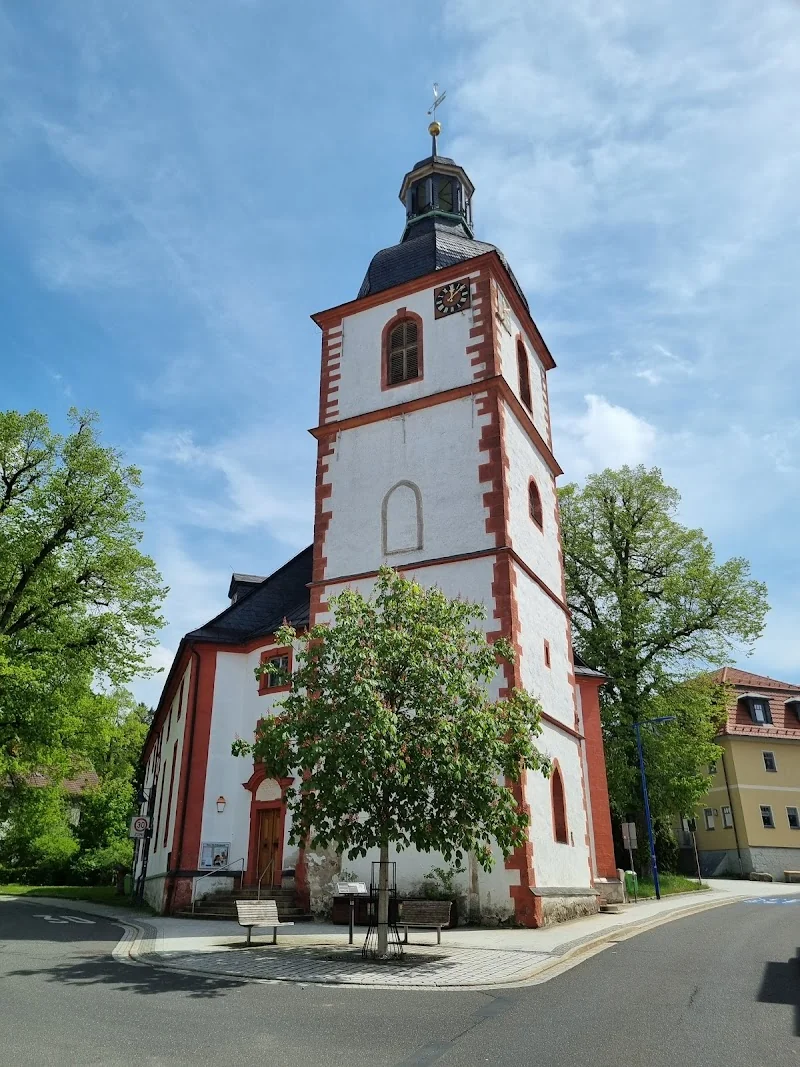
The Magdalenenkirche in Mehlis is much more than a distinctive church building at Hauptstraße 5 in Zella-Mehlis. It is a historical reference point of the district of Mehlis, a place of devotion, a venue for church music, and a quiet landmark that is naturally present in the everyday life of the city. The official presentation of the parish describes the church as a simple yet impressive building with white walls, a long black slate roof, and a wide tower that rises clearly above the rooftops. At the same time, the history of this place goes back a long way, to a time when Mehlis and Zella were still developing separately and the church buildings formed the religious and cultural centers of the two places. Today, services, musical offerings, open church hours, and special events take place here, making the Magdalenenkirche both a historical memorial and a vibrant community space. For visitors looking for events, tickets, history, organ, tours, or directions, the church bundles exactly those topics that are relevant to a special place in Thuringia: lived faith, historical depth, and a manageable, personal visitor experience. ([evangelische-kirche-zella-mehlis.de](https://www.evangelische-kirche-zella-mehlis.de/unsere-kirchen/magdalenenkirche/))
Events, Services, and Current Dates
Those looking for events in the Magdalenenkirche Mehlis will not find an anonymous large operation, but a place where community life is visible and concrete. The current homepage of the parish mentions dates such as the Emmaus hike, which meets at the Magdalenenkirche, and the page also refers to services and other meeting opportunities throughout the year. In the parish announcements, the Magdalenenkirche is explicitly named as the place where the Easter cantata service takes place; furthermore, the church opens on Wednesdays from 10 a.m. to 12 p.m. for visitors who can view a small exhibition by the Zella-Mehlis art circle and listen to the organ. This makes it clear that the Magdalenenkirche plays a role not only on Sundays or during major holidays but also remains present in the weekly rhythm. This mix of services, music, exhibitions, and encounters is particularly important for search queries about events because it describes the character of the place well: Here, church is not understood as a mere monument but as a space where religious practice and cultural mediation meet. Therefore, those looking for a program should keep an eye on the official dates of the parish, as both regular services and musical or thematic special formats are announced there. ([evangelische-kirche-zella-mehlis.de](https://www.evangelische-kirche-zella-mehlis.de/))
For the search intent around events, it is also important that the Magdalenenkirche is not presented as a classic event hall in the official church presentation, but as a church space with a special atmosphere. The EKM profile regularly mentions services, Bible readings, tours on request, a printed church guide, and special events such as concerts and exhibitions. This mix is attractive to interested parties who pay attention not only to a single date but to the entire framework of a visit. The event topics therefore revolve less around a commercial ticket business and more around church and cultural dates that are often associated with music, devotion, and community. The current website confirms this image by assigning the Magdalenenkirche a role as an open house: Visitors can come by, view the exhibition, listen to the organ, and let the space affect them. This is particularly advantageous for people who are in Zella-Mehlis, as the church thus allows for both planned dates and spontaneous visits. For SEO, this is exactly relevant: The search term events refers here to a lively community life, to church music, and to the cultural added value of a place that consciously presents itself openly while still preserving its spiritual identity. ([ekmd.de](https://www.ekmd.de/kirche/kirchenkreise/meiningen/zella-mehlis-oberhof/zella-mehlis/magdalenenkirche-in-mehlis?utm_source=openai))
History of the Magdalenenkirche in Mehlis
The history of the Magdalenenkirche in Mehlis is significantly older than its current external appearance. According to the official parish, the oldest preserved witness of a church at this site can be placed in the altar area on the ground floor of the tower, whose construction dates back to the end of the 12th or the beginning of the 13th century. Although Mehlis is not always directly mentioned in the sources, tradition suggests that there was a church here very early on and that the region was already ecclesiastically shaped in the High Middle Ages. The tourist information adds to this long line by noting that the oldest part of the church is the tower, whose base is considered a possible remnant of a Romanesque original church. In connection with a larger renovation around 1498, late Gothic building elements were created, including inscriptions and a wall tabernacle. The later development then clearly shows how much the building had to adapt repeatedly to the needs of the community. From 1621 to 1623, a larger church nave was built while retaining the medieval tower, which was consecrated in 1623. However, by the early 18th century, the old church had become dilapidated, necessitating new construction plans. ([evangelische-kirche-zella-mehlis.de](https://www.evangelische-kirche-zella-mehlis.de/unsere-kirchen/magdalenenkirche/))
Particularly formative is the construction phase from 1734 to 1741. On June 29, 1734, the foundation stone for the new church nave was laid, the shell and the slate roof were completed the following year, and the consecration took place on Palm Sunday 1741. After that, the old church was demolished. As early as 1730, the tower had been raised to its current bell chamber; it received a Baroque dome and a lantern that still influence the church's appearance today. The tourist information describes the last major renovation between 1734 and 1741 as crucial for the current form of the building, and the official site adds that the church space has been renovated several times since then. Particularly noteworthy is the renovation in 1929/30, during which the altar area on the ground floor of the tower was made visible again. Additionally, there is the church historical context of the parish itself: The Protestant parish of Zella-Mehlis was formed in 1972 from the previously independent parishes, with the Magdalenenkirche in Mehlis and the St. Blasii church in Zella still being the two reference points of the parish today. Thus, the Magdalenenkirche stands not only for a single building but also for the historical continuity of the district of Mehlis and the development of the entire parish in the 20th and 21st centuries. ([evangelische-kirche-zella-mehlis.de](https://www.evangelische-kirche-zella-mehlis.de/unsere-kirchen/magdalenenkirche/))
Architecture, Interior, and Organ
Architecturally, the Magdalenenkirche thrives on its simplicity and clear silhouette. The official description emphasizes that it is an externally simple building without grand adornment, whose white walls and elongated black slate roof create a serious yet dignified impression. This results in its effect as a landmark of the landscape: The building is not characterized by abundance but by a concentration on the essential. The tower rises broad and massive from the ground and sets a clear accent in the townscape. Inside, there is a historically grown sequence of spaces that directs the gaze from the galleries to the organ. According to the parish, the altar area on the ground floor of the tower is the oldest preserved part, and the restorations of recent decades have made this area more visible again. The tourist information additionally highlights that the vaulted tower basement is decorated with Renaissance paintings from the late 16th century and that the Baroque interior furnishings with wooden mirror vault, double galleries, pulpit, and organ have been preserved. Thus, the Magdalenenkirche combines a modest exterior form with a surprisingly rich historical interior life. ([evangelische-kirche-zella-mehlis.de](https://www.evangelische-kirche-zella-mehlis.de/unsere-kirchen/magdalenenkirche/))
A special attraction is the organ. The official church description states that behind the carved, colored prospect lies an organ that was built in 1741 by Johann Caspar Beck from Herrenbreitungen and replaced in 1885 by a new instrument from Guido Knauf from Gotha. This instrument has been modified several times since then, has 30 sounding voices today, and is distributed across two manuals and a pedal. For visitors, this means not only musical quality but also a very immediate spatial experience: The sound unfolds in the church space, interacts with galleries and vaults, and shapes the atmosphere of services as well as concerts or open Wednesday times. The parish also emphasizes that after securing and restoring the tower, the church nave could also be renewed externally and that the roof and outer walls underwent thorough renovation. In the interior, among other things, the northeast wall was redesigned and a heating system was installed. The tourist information adds that during the last major renovation phase, the Baroque interior furnishings were preserved, while individual ceiling paintings, two altars, and other paintings from the 1950s were added. This mix of historical substance, careful modernization, and musical function makes the Magdalenenkirche a place that is not architecturally spectacular in terms of monumental self-representation but convinces through authenticity, sound, and historical layers. ([evangelische-kirche-zella-mehlis.de](https://www.evangelische-kirche-zella-mehlis.de/unsere-kirchen/magdalenenkirche/))
Directions, Parking, and Public Transport
The Magdalenenkirche is easily accessible for visitors at Hauptstraße 5 in Zella-Mehlis and thus on an important inner-city axis. The parish explicitly describes the location as a church on the main road of Mehlis, in an area that lies in the middle of local life and is not secluded on the outskirts. For public transport, the tourist information refers to the bus stop Markt Mehlis as the starting point to the Magdalenenkirche. For parking, it mentions the parking lot P 4 on Louis-Anschütz-Straße in Mehlis. This is particularly useful for visitors as it provides a concrete point of orientation that simplifies access. At the same time, the brochure from the tourist information shows that Zella-Mehlis is overall well-connected and accessible via the A4, A71, and A73 highways as well as the L3247. Therefore, those coming from afar will find a city that is consciously prepared for arrival and orientation. The Magdalenenkirche is thus not only a historical place but also practically well embedded in the urban space. ([evangelische-kirche-zella-mehlis.de](https://www.evangelische-kirche-zella-mehlis.de/unsere-kirchen/magdalenenkirche/))
The accessibility in the surrounding area is also well explained. The city brochure names the Zella-Mehlis train station as a central transport hub where rail, long-distance bus, regional, and city lines converge. This makes traveling without a car fundamentally realistic, especially for visitors who want to combine churches, city exploration, or culture. The same brochure also points out the parking lot P 4 in the district of Mehlis, which is relevant for the Magdalenenkirche. The EKM profile adds this practical aspect by noting that there is a public toilet within 100 meters. For visitors planning a service, a short church visit, or a musical event, this is a significant comfort factor. Since the Magdalenenkirche is located directly on the main road, it is also easy to find in the townscape and can be well combined with other destinations in Zella-Mehlis. Those exploring from a tourist perspective can therefore combine the church with a city walk, a visit to other historical churches, or a trip into the nature of the Thuringian Forest. This combination of a central location, clearly named parking lot, and connected train station is a practical advantage for seekers and strengthens the visibility of the location even in the digital environment. ([tourismus.zella-mehlis.de](https://tourismus.zella-mehlis.de/images/ZM-Broschuere_Waldmomente_20190215_Web.pdf))
Tickets, Tours, and Visitor Information
When searching for tickets, an important distinction must be made regarding the Magdalenenkirche compared to classic event locations. The church is not a hall with a central ticket sale but a community space with regular services, open church hours, and special events. For this reason, it is sensible to read the official information from the parish correctly: The website specifies concrete opening hours on Wednesdays, points out exhibitions and organ sounds, and lists tours on request as well as a printed church guide on the church's profile page. It can be practically deduced that visitors should not primarily look for a ticket shop but for the current dates of the parish and the contact methods of the parish office. The official site provides a phone number and email address for inquiries about visits, musical formats, or special dates, making it easy to ask questions. Therefore, those looking for tickets for the Magdalenenkirche Mehlis should understand the term more in the sense of access and dates rather than in the sense of a classic admission system. ([evangelische-kirche-zella-mehlis.de](https://www.evangelische-kirche-zella-mehlis.de/))
For practical visits, it is also important that the Magdalenenkirche is explicitly described as a place with special openness. Visitors can view the small exhibition on Wednesdays, listen to the organ, and take their time to absorb the space. The EKM page also notes that there are regular services, that special events such as concerts or exhibitions take place, and that the church offers tours on request. Thus, the visit is aimed not only at believing parish members but also at culture-interested guests, architecture enthusiasts, and people who appreciate historical places with authentic atmosphere. Those who pay attention to events should keep an eye on the current parish page, as dates in the church year are published there. Those who focus on history will find in the Magdalenenkirche a building with Romanesque, late Gothic, Baroque, and modern traces. And those who pay attention to music will experience an organ with 30 sounding voices that significantly shapes the space. This variety makes the Magdalenenkirche Mehlis a strong search term for visitors seeking more than just a quick entry. They seek information, orientation, and a genuine impression of a vibrant church cultural site. ([evangelische-kirche-zella-mehlis.de](https://www.evangelische-kirche-zella-mehlis.de/))
Sources:
- Official website of the Evangelical Lutheran Parish Zella-Mehlis – Magdalenenkirche ([evangelische-kirche-zella-mehlis.de](https://www.evangelische-kirche-zella-mehlis.de/unsere-kirchen/magdalenenkirche/))
- Tourist Information Zella-Mehlis – Churches in Zella-Mehlis ([tourismus.zella-mehlis.de](https://tourismus.zella-mehlis.de/entdecken-erkunden-zella-mehlis/sehenswertes-in-zella-mehlis/kirchen))
- Parish Zella-Mehlis – Parish, Services, and Dates ([evangelische-kirche-zella-mehlis.de](https://www.evangelische-kirche-zella-mehlis.de/kirchengemeinde/))
- EKM – Magdalenenkirche in Mehlis (Search excerpt) ([ekmd.de](https://www.ekmd.de/kirche/kirchenkreise/meiningen/zella-mehlis-oberhof/zella-mehlis/magdalenenkirche-in-mehlis?utm_source=openai))
Show moreShow less
Magdalenenkirche Mehlis | Events & Tickets
The Magdalenenkirche in Mehlis is much more than a distinctive church building at Hauptstraße 5 in Zella-Mehlis. It is a historical reference point of the district of Mehlis, a place of devotion, a venue for church music, and a quiet landmark that is naturally present in the everyday life of the city. The official presentation of the parish describes the church as a simple yet impressive building with white walls, a long black slate roof, and a wide tower that rises clearly above the rooftops. At the same time, the history of this place goes back a long way, to a time when Mehlis and Zella were still developing separately and the church buildings formed the religious and cultural centers of the two places. Today, services, musical offerings, open church hours, and special events take place here, making the Magdalenenkirche both a historical memorial and a vibrant community space. For visitors looking for events, tickets, history, organ, tours, or directions, the church bundles exactly those topics that are relevant to a special place in Thuringia: lived faith, historical depth, and a manageable, personal visitor experience. ([evangelische-kirche-zella-mehlis.de](https://www.evangelische-kirche-zella-mehlis.de/unsere-kirchen/magdalenenkirche/))
Events, Services, and Current Dates
Those looking for events in the Magdalenenkirche Mehlis will not find an anonymous large operation, but a place where community life is visible and concrete. The current homepage of the parish mentions dates such as the Emmaus hike, which meets at the Magdalenenkirche, and the page also refers to services and other meeting opportunities throughout the year. In the parish announcements, the Magdalenenkirche is explicitly named as the place where the Easter cantata service takes place; furthermore, the church opens on Wednesdays from 10 a.m. to 12 p.m. for visitors who can view a small exhibition by the Zella-Mehlis art circle and listen to the organ. This makes it clear that the Magdalenenkirche plays a role not only on Sundays or during major holidays but also remains present in the weekly rhythm. This mix of services, music, exhibitions, and encounters is particularly important for search queries about events because it describes the character of the place well: Here, church is not understood as a mere monument but as a space where religious practice and cultural mediation meet. Therefore, those looking for a program should keep an eye on the official dates of the parish, as both regular services and musical or thematic special formats are announced there. ([evangelische-kirche-zella-mehlis.de](https://www.evangelische-kirche-zella-mehlis.de/))
For the search intent around events, it is also important that the Magdalenenkirche is not presented as a classic event hall in the official church presentation, but as a church space with a special atmosphere. The EKM profile regularly mentions services, Bible readings, tours on request, a printed church guide, and special events such as concerts and exhibitions. This mix is attractive to interested parties who pay attention not only to a single date but to the entire framework of a visit. The event topics therefore revolve less around a commercial ticket business and more around church and cultural dates that are often associated with music, devotion, and community. The current website confirms this image by assigning the Magdalenenkirche a role as an open house: Visitors can come by, view the exhibition, listen to the organ, and let the space affect them. This is particularly advantageous for people who are in Zella-Mehlis, as the church thus allows for both planned dates and spontaneous visits. For SEO, this is exactly relevant: The search term events refers here to a lively community life, to church music, and to the cultural added value of a place that consciously presents itself openly while still preserving its spiritual identity. ([ekmd.de](https://www.ekmd.de/kirche/kirchenkreise/meiningen/zella-mehlis-oberhof/zella-mehlis/magdalenenkirche-in-mehlis?utm_source=openai))
History of the Magdalenenkirche in Mehlis
The history of the Magdalenenkirche in Mehlis is significantly older than its current external appearance. According to the official parish, the oldest preserved witness of a church at this site can be placed in the altar area on the ground floor of the tower, whose construction dates back to the end of the 12th or the beginning of the 13th century. Although Mehlis is not always directly mentioned in the sources, tradition suggests that there was a church here very early on and that the region was already ecclesiastically shaped in the High Middle Ages. The tourist information adds to this long line by noting that the oldest part of the church is the tower, whose base is considered a possible remnant of a Romanesque original church. In connection with a larger renovation around 1498, late Gothic building elements were created, including inscriptions and a wall tabernacle. The later development then clearly shows how much the building had to adapt repeatedly to the needs of the community. From 1621 to 1623, a larger church nave was built while retaining the medieval tower, which was consecrated in 1623. However, by the early 18th century, the old church had become dilapidated, necessitating new construction plans. ([evangelische-kirche-zella-mehlis.de](https://www.evangelische-kirche-zella-mehlis.de/unsere-kirchen/magdalenenkirche/))
Particularly formative is the construction phase from 1734 to 1741. On June 29, 1734, the foundation stone for the new church nave was laid, the shell and the slate roof were completed the following year, and the consecration took place on Palm Sunday 1741. After that, the old church was demolished. As early as 1730, the tower had been raised to its current bell chamber; it received a Baroque dome and a lantern that still influence the church's appearance today. The tourist information describes the last major renovation between 1734 and 1741 as crucial for the current form of the building, and the official site adds that the church space has been renovated several times since then. Particularly noteworthy is the renovation in 1929/30, during which the altar area on the ground floor of the tower was made visible again. Additionally, there is the church historical context of the parish itself: The Protestant parish of Zella-Mehlis was formed in 1972 from the previously independent parishes, with the Magdalenenkirche in Mehlis and the St. Blasii church in Zella still being the two reference points of the parish today. Thus, the Magdalenenkirche stands not only for a single building but also for the historical continuity of the district of Mehlis and the development of the entire parish in the 20th and 21st centuries. ([evangelische-kirche-zella-mehlis.de](https://www.evangelische-kirche-zella-mehlis.de/unsere-kirchen/magdalenenkirche/))
Architecture, Interior, and Organ
Architecturally, the Magdalenenkirche thrives on its simplicity and clear silhouette. The official description emphasizes that it is an externally simple building without grand adornment, whose white walls and elongated black slate roof create a serious yet dignified impression. This results in its effect as a landmark of the landscape: The building is not characterized by abundance but by a concentration on the essential. The tower rises broad and massive from the ground and sets a clear accent in the townscape. Inside, there is a historically grown sequence of spaces that directs the gaze from the galleries to the organ. According to the parish, the altar area on the ground floor of the tower is the oldest preserved part, and the restorations of recent decades have made this area more visible again. The tourist information additionally highlights that the vaulted tower basement is decorated with Renaissance paintings from the late 16th century and that the Baroque interior furnishings with wooden mirror vault, double galleries, pulpit, and organ have been preserved. Thus, the Magdalenenkirche combines a modest exterior form with a surprisingly rich historical interior life. ([evangelische-kirche-zella-mehlis.de](https://www.evangelische-kirche-zella-mehlis.de/unsere-kirchen/magdalenenkirche/))
A special attraction is the organ. The official church description states that behind the carved, colored prospect lies an organ that was built in 1741 by Johann Caspar Beck from Herrenbreitungen and replaced in 1885 by a new instrument from Guido Knauf from Gotha. This instrument has been modified several times since then, has 30 sounding voices today, and is distributed across two manuals and a pedal. For visitors, this means not only musical quality but also a very immediate spatial experience: The sound unfolds in the church space, interacts with galleries and vaults, and shapes the atmosphere of services as well as concerts or open Wednesday times. The parish also emphasizes that after securing and restoring the tower, the church nave could also be renewed externally and that the roof and outer walls underwent thorough renovation. In the interior, among other things, the northeast wall was redesigned and a heating system was installed. The tourist information adds that during the last major renovation phase, the Baroque interior furnishings were preserved, while individual ceiling paintings, two altars, and other paintings from the 1950s were added. This mix of historical substance, careful modernization, and musical function makes the Magdalenenkirche a place that is not architecturally spectacular in terms of monumental self-representation but convinces through authenticity, sound, and historical layers. ([evangelische-kirche-zella-mehlis.de](https://www.evangelische-kirche-zella-mehlis.de/unsere-kirchen/magdalenenkirche/))
Directions, Parking, and Public Transport
The Magdalenenkirche is easily accessible for visitors at Hauptstraße 5 in Zella-Mehlis and thus on an important inner-city axis. The parish explicitly describes the location as a church on the main road of Mehlis, in an area that lies in the middle of local life and is not secluded on the outskirts. For public transport, the tourist information refers to the bus stop Markt Mehlis as the starting point to the Magdalenenkirche. For parking, it mentions the parking lot P 4 on Louis-Anschütz-Straße in Mehlis. This is particularly useful for visitors as it provides a concrete point of orientation that simplifies access. At the same time, the brochure from the tourist information shows that Zella-Mehlis is overall well-connected and accessible via the A4, A71, and A73 highways as well as the L3247. Therefore, those coming from afar will find a city that is consciously prepared for arrival and orientation. The Magdalenenkirche is thus not only a historical place but also practically well embedded in the urban space. ([evangelische-kirche-zella-mehlis.de](https://www.evangelische-kirche-zella-mehlis.de/unsere-kirchen/magdalenenkirche/))
The accessibility in the surrounding area is also well explained. The city brochure names the Zella-Mehlis train station as a central transport hub where rail, long-distance bus, regional, and city lines converge. This makes traveling without a car fundamentally realistic, especially for visitors who want to combine churches, city exploration, or culture. The same brochure also points out the parking lot P 4 in the district of Mehlis, which is relevant for the Magdalenenkirche. The EKM profile adds this practical aspect by noting that there is a public toilet within 100 meters. For visitors planning a service, a short church visit, or a musical event, this is a significant comfort factor. Since the Magdalenenkirche is located directly on the main road, it is also easy to find in the townscape and can be well combined with other destinations in Zella-Mehlis. Those exploring from a tourist perspective can therefore combine the church with a city walk, a visit to other historical churches, or a trip into the nature of the Thuringian Forest. This combination of a central location, clearly named parking lot, and connected train station is a practical advantage for seekers and strengthens the visibility of the location even in the digital environment. ([tourismus.zella-mehlis.de](https://tourismus.zella-mehlis.de/images/ZM-Broschuere_Waldmomente_20190215_Web.pdf))
Tickets, Tours, and Visitor Information
When searching for tickets, an important distinction must be made regarding the Magdalenenkirche compared to classic event locations. The church is not a hall with a central ticket sale but a community space with regular services, open church hours, and special events. For this reason, it is sensible to read the official information from the parish correctly: The website specifies concrete opening hours on Wednesdays, points out exhibitions and organ sounds, and lists tours on request as well as a printed church guide on the church's profile page. It can be practically deduced that visitors should not primarily look for a ticket shop but for the current dates of the parish and the contact methods of the parish office. The official site provides a phone number and email address for inquiries about visits, musical formats, or special dates, making it easy to ask questions. Therefore, those looking for tickets for the Magdalenenkirche Mehlis should understand the term more in the sense of access and dates rather than in the sense of a classic admission system. ([evangelische-kirche-zella-mehlis.de](https://www.evangelische-kirche-zella-mehlis.de/))
For practical visits, it is also important that the Magdalenenkirche is explicitly described as a place with special openness. Visitors can view the small exhibition on Wednesdays, listen to the organ, and take their time to absorb the space. The EKM page also notes that there are regular services, that special events such as concerts or exhibitions take place, and that the church offers tours on request. Thus, the visit is aimed not only at believing parish members but also at culture-interested guests, architecture enthusiasts, and people who appreciate historical places with authentic atmosphere. Those who pay attention to events should keep an eye on the current parish page, as dates in the church year are published there. Those who focus on history will find in the Magdalenenkirche a building with Romanesque, late Gothic, Baroque, and modern traces. And those who pay attention to music will experience an organ with 30 sounding voices that significantly shapes the space. This variety makes the Magdalenenkirche Mehlis a strong search term for visitors seeking more than just a quick entry. They seek information, orientation, and a genuine impression of a vibrant church cultural site. ([evangelische-kirche-zella-mehlis.de](https://www.evangelische-kirche-zella-mehlis.de/))
Sources:
- Official website of the Evangelical Lutheran Parish Zella-Mehlis – Magdalenenkirche ([evangelische-kirche-zella-mehlis.de](https://www.evangelische-kirche-zella-mehlis.de/unsere-kirchen/magdalenenkirche/))
- Tourist Information Zella-Mehlis – Churches in Zella-Mehlis ([tourismus.zella-mehlis.de](https://tourismus.zella-mehlis.de/entdecken-erkunden-zella-mehlis/sehenswertes-in-zella-mehlis/kirchen))
- Parish Zella-Mehlis – Parish, Services, and Dates ([evangelische-kirche-zella-mehlis.de](https://www.evangelische-kirche-zella-mehlis.de/kirchengemeinde/))
- EKM – Magdalenenkirche in Mehlis (Search excerpt) ([ekmd.de](https://www.ekmd.de/kirche/kirchenkreise/meiningen/zella-mehlis-oberhof/zella-mehlis/magdalenenkirche-in-mehlis?utm_source=openai))
Magdalenenkirche Mehlis | Events & Tickets
The Magdalenenkirche in Mehlis is much more than a distinctive church building at Hauptstraße 5 in Zella-Mehlis. It is a historical reference point of the district of Mehlis, a place of devotion, a venue for church music, and a quiet landmark that is naturally present in the everyday life of the city. The official presentation of the parish describes the church as a simple yet impressive building with white walls, a long black slate roof, and a wide tower that rises clearly above the rooftops. At the same time, the history of this place goes back a long way, to a time when Mehlis and Zella were still developing separately and the church buildings formed the religious and cultural centers of the two places. Today, services, musical offerings, open church hours, and special events take place here, making the Magdalenenkirche both a historical memorial and a vibrant community space. For visitors looking for events, tickets, history, organ, tours, or directions, the church bundles exactly those topics that are relevant to a special place in Thuringia: lived faith, historical depth, and a manageable, personal visitor experience. ([evangelische-kirche-zella-mehlis.de](https://www.evangelische-kirche-zella-mehlis.de/unsere-kirchen/magdalenenkirche/))
Events, Services, and Current Dates
Those looking for events in the Magdalenenkirche Mehlis will not find an anonymous large operation, but a place where community life is visible and concrete. The current homepage of the parish mentions dates such as the Emmaus hike, which meets at the Magdalenenkirche, and the page also refers to services and other meeting opportunities throughout the year. In the parish announcements, the Magdalenenkirche is explicitly named as the place where the Easter cantata service takes place; furthermore, the church opens on Wednesdays from 10 a.m. to 12 p.m. for visitors who can view a small exhibition by the Zella-Mehlis art circle and listen to the organ. This makes it clear that the Magdalenenkirche plays a role not only on Sundays or during major holidays but also remains present in the weekly rhythm. This mix of services, music, exhibitions, and encounters is particularly important for search queries about events because it describes the character of the place well: Here, church is not understood as a mere monument but as a space where religious practice and cultural mediation meet. Therefore, those looking for a program should keep an eye on the official dates of the parish, as both regular services and musical or thematic special formats are announced there. ([evangelische-kirche-zella-mehlis.de](https://www.evangelische-kirche-zella-mehlis.de/))
For the search intent around events, it is also important that the Magdalenenkirche is not presented as a classic event hall in the official church presentation, but as a church space with a special atmosphere. The EKM profile regularly mentions services, Bible readings, tours on request, a printed church guide, and special events such as concerts and exhibitions. This mix is attractive to interested parties who pay attention not only to a single date but to the entire framework of a visit. The event topics therefore revolve less around a commercial ticket business and more around church and cultural dates that are often associated with music, devotion, and community. The current website confirms this image by assigning the Magdalenenkirche a role as an open house: Visitors can come by, view the exhibition, listen to the organ, and let the space affect them. This is particularly advantageous for people who are in Zella-Mehlis, as the church thus allows for both planned dates and spontaneous visits. For SEO, this is exactly relevant: The search term events refers here to a lively community life, to church music, and to the cultural added value of a place that consciously presents itself openly while still preserving its spiritual identity. ([ekmd.de](https://www.ekmd.de/kirche/kirchenkreise/meiningen/zella-mehlis-oberhof/zella-mehlis/magdalenenkirche-in-mehlis?utm_source=openai))
History of the Magdalenenkirche in Mehlis
The history of the Magdalenenkirche in Mehlis is significantly older than its current external appearance. According to the official parish, the oldest preserved witness of a church at this site can be placed in the altar area on the ground floor of the tower, whose construction dates back to the end of the 12th or the beginning of the 13th century. Although Mehlis is not always directly mentioned in the sources, tradition suggests that there was a church here very early on and that the region was already ecclesiastically shaped in the High Middle Ages. The tourist information adds to this long line by noting that the oldest part of the church is the tower, whose base is considered a possible remnant of a Romanesque original church. In connection with a larger renovation around 1498, late Gothic building elements were created, including inscriptions and a wall tabernacle. The later development then clearly shows how much the building had to adapt repeatedly to the needs of the community. From 1621 to 1623, a larger church nave was built while retaining the medieval tower, which was consecrated in 1623. However, by the early 18th century, the old church had become dilapidated, necessitating new construction plans. ([evangelische-kirche-zella-mehlis.de](https://www.evangelische-kirche-zella-mehlis.de/unsere-kirchen/magdalenenkirche/))
Particularly formative is the construction phase from 1734 to 1741. On June 29, 1734, the foundation stone for the new church nave was laid, the shell and the slate roof were completed the following year, and the consecration took place on Palm Sunday 1741. After that, the old church was demolished. As early as 1730, the tower had been raised to its current bell chamber; it received a Baroque dome and a lantern that still influence the church's appearance today. The tourist information describes the last major renovation between 1734 and 1741 as crucial for the current form of the building, and the official site adds that the church space has been renovated several times since then. Particularly noteworthy is the renovation in 1929/30, during which the altar area on the ground floor of the tower was made visible again. Additionally, there is the church historical context of the parish itself: The Protestant parish of Zella-Mehlis was formed in 1972 from the previously independent parishes, with the Magdalenenkirche in Mehlis and the St. Blasii church in Zella still being the two reference points of the parish today. Thus, the Magdalenenkirche stands not only for a single building but also for the historical continuity of the district of Mehlis and the development of the entire parish in the 20th and 21st centuries. ([evangelische-kirche-zella-mehlis.de](https://www.evangelische-kirche-zella-mehlis.de/unsere-kirchen/magdalenenkirche/))
Architecture, Interior, and Organ
Architecturally, the Magdalenenkirche thrives on its simplicity and clear silhouette. The official description emphasizes that it is an externally simple building without grand adornment, whose white walls and elongated black slate roof create a serious yet dignified impression. This results in its effect as a landmark of the landscape: The building is not characterized by abundance but by a concentration on the essential. The tower rises broad and massive from the ground and sets a clear accent in the townscape. Inside, there is a historically grown sequence of spaces that directs the gaze from the galleries to the organ. According to the parish, the altar area on the ground floor of the tower is the oldest preserved part, and the restorations of recent decades have made this area more visible again. The tourist information additionally highlights that the vaulted tower basement is decorated with Renaissance paintings from the late 16th century and that the Baroque interior furnishings with wooden mirror vault, double galleries, pulpit, and organ have been preserved. Thus, the Magdalenenkirche combines a modest exterior form with a surprisingly rich historical interior life. ([evangelische-kirche-zella-mehlis.de](https://www.evangelische-kirche-zella-mehlis.de/unsere-kirchen/magdalenenkirche/))
A special attraction is the organ. The official church description states that behind the carved, colored prospect lies an organ that was built in 1741 by Johann Caspar Beck from Herrenbreitungen and replaced in 1885 by a new instrument from Guido Knauf from Gotha. This instrument has been modified several times since then, has 30 sounding voices today, and is distributed across two manuals and a pedal. For visitors, this means not only musical quality but also a very immediate spatial experience: The sound unfolds in the church space, interacts with galleries and vaults, and shapes the atmosphere of services as well as concerts or open Wednesday times. The parish also emphasizes that after securing and restoring the tower, the church nave could also be renewed externally and that the roof and outer walls underwent thorough renovation. In the interior, among other things, the northeast wall was redesigned and a heating system was installed. The tourist information adds that during the last major renovation phase, the Baroque interior furnishings were preserved, while individual ceiling paintings, two altars, and other paintings from the 1950s were added. This mix of historical substance, careful modernization, and musical function makes the Magdalenenkirche a place that is not architecturally spectacular in terms of monumental self-representation but convinces through authenticity, sound, and historical layers. ([evangelische-kirche-zella-mehlis.de](https://www.evangelische-kirche-zella-mehlis.de/unsere-kirchen/magdalenenkirche/))
Directions, Parking, and Public Transport
The Magdalenenkirche is easily accessible for visitors at Hauptstraße 5 in Zella-Mehlis and thus on an important inner-city axis. The parish explicitly describes the location as a church on the main road of Mehlis, in an area that lies in the middle of local life and is not secluded on the outskirts. For public transport, the tourist information refers to the bus stop Markt Mehlis as the starting point to the Magdalenenkirche. For parking, it mentions the parking lot P 4 on Louis-Anschütz-Straße in Mehlis. This is particularly useful for visitors as it provides a concrete point of orientation that simplifies access. At the same time, the brochure from the tourist information shows that Zella-Mehlis is overall well-connected and accessible via the A4, A71, and A73 highways as well as the L3247. Therefore, those coming from afar will find a city that is consciously prepared for arrival and orientation. The Magdalenenkirche is thus not only a historical place but also practically well embedded in the urban space. ([evangelische-kirche-zella-mehlis.de](https://www.evangelische-kirche-zella-mehlis.de/unsere-kirchen/magdalenenkirche/))
The accessibility in the surrounding area is also well explained. The city brochure names the Zella-Mehlis train station as a central transport hub where rail, long-distance bus, regional, and city lines converge. This makes traveling without a car fundamentally realistic, especially for visitors who want to combine churches, city exploration, or culture. The same brochure also points out the parking lot P 4 in the district of Mehlis, which is relevant for the Magdalenenkirche. The EKM profile adds this practical aspect by noting that there is a public toilet within 100 meters. For visitors planning a service, a short church visit, or a musical event, this is a significant comfort factor. Since the Magdalenenkirche is located directly on the main road, it is also easy to find in the townscape and can be well combined with other destinations in Zella-Mehlis. Those exploring from a tourist perspective can therefore combine the church with a city walk, a visit to other historical churches, or a trip into the nature of the Thuringian Forest. This combination of a central location, clearly named parking lot, and connected train station is a practical advantage for seekers and strengthens the visibility of the location even in the digital environment. ([tourismus.zella-mehlis.de](https://tourismus.zella-mehlis.de/images/ZM-Broschuere_Waldmomente_20190215_Web.pdf))
Tickets, Tours, and Visitor Information
When searching for tickets, an important distinction must be made regarding the Magdalenenkirche compared to classic event locations. The church is not a hall with a central ticket sale but a community space with regular services, open church hours, and special events. For this reason, it is sensible to read the official information from the parish correctly: The website specifies concrete opening hours on Wednesdays, points out exhibitions and organ sounds, and lists tours on request as well as a printed church guide on the church's profile page. It can be practically deduced that visitors should not primarily look for a ticket shop but for the current dates of the parish and the contact methods of the parish office. The official site provides a phone number and email address for inquiries about visits, musical formats, or special dates, making it easy to ask questions. Therefore, those looking for tickets for the Magdalenenkirche Mehlis should understand the term more in the sense of access and dates rather than in the sense of a classic admission system. ([evangelische-kirche-zella-mehlis.de](https://www.evangelische-kirche-zella-mehlis.de/))
For practical visits, it is also important that the Magdalenenkirche is explicitly described as a place with special openness. Visitors can view the small exhibition on Wednesdays, listen to the organ, and take their time to absorb the space. The EKM page also notes that there are regular services, that special events such as concerts or exhibitions take place, and that the church offers tours on request. Thus, the visit is aimed not only at believing parish members but also at culture-interested guests, architecture enthusiasts, and people who appreciate historical places with authentic atmosphere. Those who pay attention to events should keep an eye on the current parish page, as dates in the church year are published there. Those who focus on history will find in the Magdalenenkirche a building with Romanesque, late Gothic, Baroque, and modern traces. And those who pay attention to music will experience an organ with 30 sounding voices that significantly shapes the space. This variety makes the Magdalenenkirche Mehlis a strong search term for visitors seeking more than just a quick entry. They seek information, orientation, and a genuine impression of a vibrant church cultural site. ([evangelische-kirche-zella-mehlis.de](https://www.evangelische-kirche-zella-mehlis.de/))
Sources:
- Official website of the Evangelical Lutheran Parish Zella-Mehlis – Magdalenenkirche ([evangelische-kirche-zella-mehlis.de](https://www.evangelische-kirche-zella-mehlis.de/unsere-kirchen/magdalenenkirche/))
- Tourist Information Zella-Mehlis – Churches in Zella-Mehlis ([tourismus.zella-mehlis.de](https://tourismus.zella-mehlis.de/entdecken-erkunden-zella-mehlis/sehenswertes-in-zella-mehlis/kirchen))
- Parish Zella-Mehlis – Parish, Services, and Dates ([evangelische-kirche-zella-mehlis.de](https://www.evangelische-kirche-zella-mehlis.de/kirchengemeinde/))
- EKM – Magdalenenkirche in Mehlis (Search excerpt) ([ekmd.de](https://www.ekmd.de/kirche/kirchenkreise/meiningen/zella-mehlis-oberhof/zella-mehlis/magdalenenkirche-in-mehlis?utm_source=openai))
Frequently Asked Questions
Reviews
Michal
13. January 2025
Church
Rene Weck
22. July 2019
The ancient chapel is particularly beautiful.
Anke Hirschberger
28. December 2019
Very beautiful church
Christian “Rhinewalker”
30. August 2023
Steffen
7. December 2025