
Traunstein
Rupprechtstraße 6, 83278 Traunstein, Deutschland
House St. Rupert Traunstein | Photos & Reviews
The House St. Rupert Traunstein is an educational and retreat house located at Rupprechtstraße 6, 83278 Traunstein. The facility combines the unique character of a historic Art Nouveau villa with modern guest rooms, professionally usable seminar rooms, its own chapel, and a spacious park. Therefore, the place is primarily aimed at individuals and groups who wish to connect education, reflection, exchange, and collaborative work rather than classical concert or trade fair events. The house is situated in the heart of Traunstein and at the same time in a landscape characterized by its proximity to Lake Chiemsee, the Chiemgau Alps, and Salzburg.
Those searching for photos of House St. Rupert will primarily discover the architectural atmosphere of the villa, the garden area, the rooms, and the tranquil surroundings. Those looking for reviews are usually interested in personal care, suitability for seminars, accommodation options, the kitchen, and the character of the house. The available location data indicates a rating of five stars based on 30 reviews. For reliable planning, the official information on rooms, arrival, programs, and equipment is also crucial. The following overview organizes this information according to the most important search topics and shows what distinguishes House St. Rupert in Traunstein as a venue for meetings, education, and encounters.
House St. Rupert Traunstein Photos: Art Nouveau Villa, Park, and Unique Atmosphere
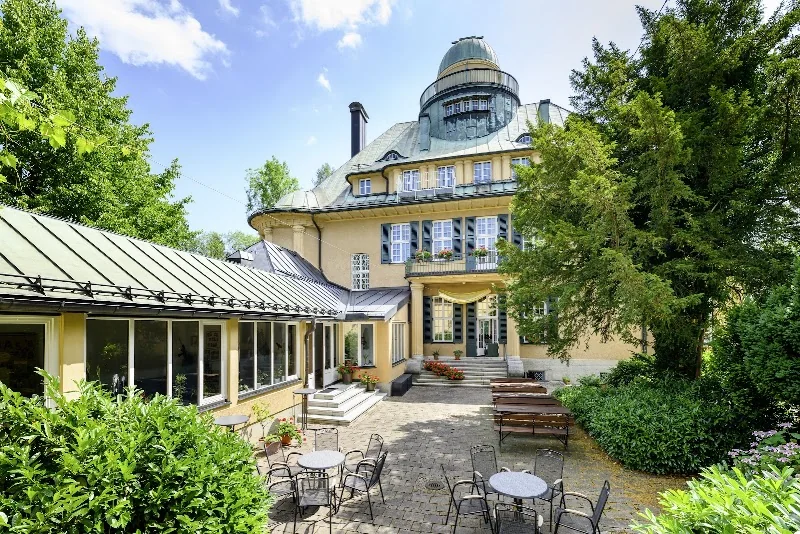
Photos of House St. Rupert Traunstein are particularly interesting because the location does not appear as a neutral seminar building. At the center of the complex is an Art Nouveau villa, built between 1912 and 1914 as a private residence for the steel industrialist Dr. Emil Ehrensberger. The original complex also included an observatory. The historic villa still shapes the character of the house today and provides events with a framework that clearly differs from ordinary conference hotels. Therefore, images are not only relevant for rooms and seating but also for facade details, garden views, historical elements, and the connection between architecture and nature.
The official description highlights a large park in the middle of Traunstein. For participants, this outdoor area can be an important complement to the seminar program. Breaks can be spent in a green environment, conversations can continue away from the meeting room, and multi-day events receive a spatial change between focused work and relaxation. Especially for retreats, reflection days, or spiritual exercises, such an environment supports the desired distance from everyday life. Photos can convey this impression but cannot replace a personal visit to the rooms.
The atmosphere also includes the in-house chapel, the proximity to Chiemgau, and the view of the Chiemgau Alps. The chapel is available for services, prayer, and meditation. It was artistically designed, among others, by the sculptor Friedrich Koller; the stained glass windows depicting the story of the prophet Jonah come from Inge Regnat-Ulner. These details make the place particularly suitable for church groups, spiritual courses, and religious educational offerings.
Those needing their own photos for an event page, invitation, or social media communication should clarify in advance which areas may be photographed. Particularly expressive are motifs of the villa, the park, the chapel, the seminar rooms, and the surroundings. For a serious presentation, it is advisable not only to use decorative images but also to include practical perspectives: entrance, room sizes, possible seating arrangements, technical equipment, and pathways within the house. This creates a realistic impression of the location and not just a purely promotional snapshot.
History of the House: Art Nouveau, Observatory, and Development into an Educational Venue
The history of House St. Rupert Traunstein begins with the Art Nouveau villa, which was built as a private residence between 1912 and 1914. The builder is the steel industrialist Dr. Emil Ehrensberger. The villa featured an observatory and was thus more than an ordinary residential building from the beginning. Its architecture and original use explain why the place today has a special identity. Visitors do not experience an interchangeable conference center but a developed complex with a historical core and later added functional areas.
The conference area was built in 1983, followed by the guest room wing in 1995. These expansions created a connection between the historic villa, modern seminar areas, and accommodation options. The development shows how the house has transformed from a private estate into an educational and meeting place. The historical substance remained an important part of the atmosphere, while the additions enable use for groups, courses, and multi-day events.
Today, House St. Rupert is located in the center of a former diocesan area belonging to Salzburg in the Archdiocese of Munich and Freising in the Chiemsee region. The ecclesiastical influence is essential for the profile of the house. The educational program has always been biblically oriented and is aimed at people who wish to engage with questions of faith, life issues, biblical texts, and social topics. At the same time, the house can be used by various groups, including parishes, parish councils, women's associations, and other interested organizations.
The connection between history and current use is a key reason why House St. Rupert appears in search queries for special features, photos, and reviews. The historic villa creates a memorable atmosphere, while the modern additions ensure practical usability. For organizers, this combination is important: a space should be functional but also create an atmosphere that supports the purpose of the event. At St. Rupert, this impression arises from several components: Art Nouveau architecture, park, chapel, educational profile, personal care, and the location in Chiemgau.
A visit can therefore be sensible before a group makes a binding booking. Especially for multi-day formats, it is possible to assess on-site how historical areas, seminar rooms, guest rooms, chapel, and outdoor spaces interact. The history is not just a background theme for an informational text but shapes the concrete experience during the stay.
Rooms, Seating, and Capacity at House St. Rupert Traunstein
When searching for House St. Rupert Traunstein rooms, seating plan, or capacity, the question usually centers on whether the location fits a specific group size. The official information states a hall for 80 people with an area of 100 square meters. Additionally, there are two rooms for 20 to 35 people each. These rooms are 61 and 52 square meters in size, respectively. For smaller working groups, there are four more rooms for 10 to 15 people each; one of them is 27 square meters, and three others are each 23 square meters.
The room structure allows for several event formats. A large hall can be used for a joint opening, lectures, plenary phases, or a closing round. The medium-sized rooms are suitable for workshops, discussion rounds, and parallel working groups. The smaller rooms are ideal for confidential conversations, small group work, individual meetings, or focused seminars. A classic seating plan with numbered theater seats is not described because the house is geared towards flexible conference and educational formats. Therefore, the specific seating should be coordinated with the purpose of the event when making inquiries.
As equipment, tables, chairs, and media technology are mentioned. Modern equipment and teaching materials can be provided upon request. For planning, this means that not every event has to take place with the same technical configuration. Different requirements apply for a presentation than for moderated group work, a Bible day, a retreat, or a quieter exercise format. Organizers should therefore indicate as early as possible whether projection options, sound, flipcharts, work surfaces, or a specific table arrangement are needed.
The stated capacity of 80 people refers to the large hall and does not automatically apply to every event format. With parliamentary seating, working groups, meals, or additional technical areas, the usable number of people may be lower. Accessibility, pathways, break areas, and special requirements for older participants should also be clarified directly with the house. The municipal overview of event rooms confirms for House St. Rupert a hall for 80 people, two rooms for 20 to 35 people, and four rooms for 10 to 15 people, as well as tables, chairs, and media technology.
For an accurate inquiry, four details are particularly helpful: expected number of participants, desired event format, required technology, and number of parallel groups. This allows the team to check which room combination is suitable. A significant advantage of the location lies in the possibility of not only renting a single hall but also utilizing a tiered room offer for different phases of a program.
Events and Program: Seminars, Courses, Retreats, and Education
House St. Rupert Traunstein is especially suitable for events where education, reflection, religious topics, and communal exchange are at the forefront. The official profile lists retreats, reflection days, and spiritual exercises as possible formats. These can be organized as individual events, over a weekend, or for an entire week. The house is also suitable for seminars and conferences for groups seeking a calm, personal, and content-oriented venue.
The educational program is biblically-theologically oriented. Day, evening, and weekend courses on various biblical topics are offered. Additionally, individual online events and educational trips to biblical countries are included. The published program information includes formats on the Bible, archaeology and spirituality, Christian-Jewish dialogue, biblical female figures, and questions about the future of Christianity. These topics show that the program does not consist solely of quiet reflection days but also includes lectures, discussions, study offerings, and excursions.
For external organizers, it is important to distinguish between the in-house educational program and a self-organized conference. The house can be used for seminars, while the education team additionally brings in its own professional offerings. Upon request, collaboration with the pastoral advisor for biblical-theological education or the responsible clergy can be arranged. This makes events possible where organizational room use and content support are combined.
The surroundings support different program flows. An intensive morning can be complemented by a break in the park. A discussion round can be combined with a quiet moment in the chapel. Multi-day courses benefit from the accommodation options and the in-house kitchen. The proximity to Lake Chiemsee, the mountains, and Salzburg also opens up options for excursions and leisure activities outside the actual seminar rooms.
Those looking for the current program should check the official educational pages, as dates, available spots, and types of events may change. The location is not positioned as a permanent concert program or a classic event hall. Its strength lies rather in the combination of educational offerings, accommodation, conference infrastructure, and spiritual atmosphere. For groups seeking exactly this mix, St. Rupert can be a convincing alternative to an ordinary conference hotel.
Accommodation, Chapel, Catering, and Stay On-Site
House St. Rupert features modern guest rooms with single rooms that, according to official information, are equipped with a toilet and shower. This makes the location suitable not only for individual evening events but also for multi-day courses, weekend seminars, retreats, and retreats. Overnight stays facilitate participation for those traveling from outside and allow for a clear distance from the normal daily routine. Especially for educational formats with multiple units, it is helpful if seminar room, accommodation, meals, and retreat areas are connected in one place.
The in-house chapel is available for services, prayer, and meditation. It is therefore not just an architectural detail but a usable part of the house. For religious groups, the chapel can serve as a fixed part of the daily routine. For other events, it can be a special space for quiet moments or an optional spiritual unit. The artistic design with the stained glass windows depicting the story of the prophet Jonah gives the chapel its own thematic and visual character.
Other facilities include a gym and a beer parlor. The official description also highlights the regional cuisine and homemade cakes. For conference planning, such points are relevant because catering and informal encounters significantly influence the process. A shared meal or a conversation in the beer parlor can complement the formal seminar phases. However, the exact catering, meal times, and possible special requests should be coordinated directly before booking.
The large park is an additional area for staying. It offers opportunities for breaks, walks, and informal conversations. In conjunction with the central location in Traunstein, a balanced relationship between accessibility and retreat emerges. The house is not isolated in a mountain region but is significantly quieter than a purely urban conference building due to the park, villa, and surroundings.
The location in Chiemgau extends the stay beyond the house. According to the official description, Lake Chiemsee is about ten kilometers away; Salzburg is approximately 30 kilometers to the east. The Chiemgau Alps shape the landscape. For groups, this can create optional leisure or educational components. It is crucial that these excursions should not be understood as fixed services of the location. They are opportunities in the surroundings and must be planned separately organizationally.
Directions to House St. Rupert Traunstein and Parking Information
The address of the house is Rupprechtstraße 6, 83278 Traunstein. The location is accessible by both train and car. According to the house's official information, it is about a ten-minute walk from the main exit of Traunstein train station. The described route leads left to Wasserburger Straße, through the railway underpass or along it, and then into Rupprechtstraße. Another official description also mentions the route via Güterhallenstraße, Wasserburger Straße, and the turn into Rupprechtstraße.
For arrival by car, the A8 highway between Munich and Salzburg is mentioned as an important connection. The exit Siegsdorf or Traunstein serves as orientation. After that, travelers follow the signs towards Seebruck and Traunstein. In the city center, continue towards Wasserburg and Altötting on the B 304. About 200 meters after the railway underpass, Rupprechtstraße branches off to the right. This description serves as a basis for arrival but should be supplemented with a current navigation system in case of construction sites or changed traffic regulations.
Regarding parking, the published information is reserved. The official contact and directions pages explain the route but do not provide binding details on the number, location, or fees for parking spaces on the verified pages. Therefore, visitors should not automatically assume a specific parking situation. Those arriving with a larger group, a minibus, or with limited mobility should inquire directly with the house in advance.
For group leaders, it is advisable to include the travel information in the invitation. This includes the complete address, the note on the short walk from the train station, the car arrival via the A8, and the recommendation to clarify the parking situation in advance. For events with many participants, a staggered arrival can help. Train travelers reach the house without additional transfer from the station; drivers should allow sufficient time to find a suitable parking space.
The central location in Traunstein is overall a practical advantage. The house combines an inner-city address with a park and retreat character. Accessibility is thus an important argument for seminars and educational offerings where participants come together from various locations.
Reviews, Ratings, and Planning an Event
When searching for reviews for House St. Rupert Traunstein, users are usually interested in several areas simultaneously: atmosphere, rooms, food, care, spaces, cleanliness, location, and suitability for groups. The available location data indicates a rating of five stars based on 30 reviews. A review portal also mentions a very good rating but lists a different number of reviews. Such differences are normal because platforms use different times, data sets, and counting methods. Therefore, review numbers should always be viewed as a snapshot.
The official information provides the factual framework, while reviews reflect personal experiences. For decision-making, it is sensible to combine both. The description of the house mentions a historic Art Nouveau villa, modern guest rooms, a large park, seminar rooms, chapel, gym, beer parlor, and regional cuisine. Reviews can complement how these offerings are perceived in everyday life. At the same time, each review should be read in the context of the respective visit occasion. Expectations for a retreat house differ from those for a large event hall or a business hotel.
For an inquiry to the house, organizers should provide as concrete information as possible. This includes the desired time frame, the number of people, the required duration of stay, the preferred room size, the desired seating arrangement, technical requirements, catering, and special access needs. If a chapel, gym, beer parlor, or park is to be used, this should also be mentioned. This way, the team can better assess whether the planned format fits the infrastructure.
The question of photos can also be clarified in direct contact. Online images are helpful, but in a house with several room types, it is important to know which hall, which room, and which outdoor area actually belong to the own booking. A visit can be particularly useful for larger groups. This allows for a realistic assessment of room layout, pathways, acoustics, lighting, technical equipment, and break areas.
House St. Rupert Traunstein is thus primarily a location for people seeking a personal, historical, and content-oriented venue. The combination of an 80-person hall, additional group rooms, accommodation, chapel, park, and educational program creates a versatile range of uses. Those planning a quiet conference, a course, a reflection day, or a multi-day group event will find a clearly defined place here. The final decision should be based on direct coordination with the house, especially regarding questions about dates, parking, prices, accessibility, catering, and current equipment.
Sources:
- House St. Rupert Traunstein – House, Location, and Equipment
- House St. Rupert Traunstein – Contact and Directions
- House St. Rupert Traunstein – Conference and Accommodation Operations
- Large District Town Traunstein – Event Rooms
- Catholic Adult Education Traunstein – Educational Program St. Rupert
- ProvenExpert – Reviews of House St. Rupert Traunstein
Mehr anzeigenWeniger anzeigen
House St. Rupert Traunstein | Photos & Reviews
The House St. Rupert Traunstein is an educational and retreat house located at Rupprechtstraße 6, 83278 Traunstein. The facility combines the unique character of a historic Art Nouveau villa with modern guest rooms, professionally usable seminar rooms, its own chapel, and a spacious park. Therefore, the place is primarily aimed at individuals and groups who wish to connect education, reflection, exchange, and collaborative work rather than classical concert or trade fair events. The house is situated in the heart of Traunstein and at the same time in a landscape characterized by its proximity to Lake Chiemsee, the Chiemgau Alps, and Salzburg.
Those searching for photos of House St. Rupert will primarily discover the architectural atmosphere of the villa, the garden area, the rooms, and the tranquil surroundings. Those looking for reviews are usually interested in personal care, suitability for seminars, accommodation options, the kitchen, and the character of the house. The available location data indicates a rating of five stars based on 30 reviews. For reliable planning, the official information on rooms, arrival, programs, and equipment is also crucial. The following overview organizes this information according to the most important search topics and shows what distinguishes House St. Rupert in Traunstein as a venue for meetings, education, and encounters.
House St. Rupert Traunstein Photos: Art Nouveau Villa, Park, and Unique Atmosphere
Photos of House St. Rupert Traunstein are particularly interesting because the location does not appear as a neutral seminar building. At the center of the complex is an Art Nouveau villa, built between 1912 and 1914 as a private residence for the steel industrialist Dr. Emil Ehrensberger. The original complex also included an observatory. The historic villa still shapes the character of the house today and provides events with a framework that clearly differs from ordinary conference hotels. Therefore, images are not only relevant for rooms and seating but also for facade details, garden views, historical elements, and the connection between architecture and nature.
The official description highlights a large park in the middle of Traunstein. For participants, this outdoor area can be an important complement to the seminar program. Breaks can be spent in a green environment, conversations can continue away from the meeting room, and multi-day events receive a spatial change between focused work and relaxation. Especially for retreats, reflection days, or spiritual exercises, such an environment supports the desired distance from everyday life. Photos can convey this impression but cannot replace a personal visit to the rooms.
The atmosphere also includes the in-house chapel, the proximity to Chiemgau, and the view of the Chiemgau Alps. The chapel is available for services, prayer, and meditation. It was artistically designed, among others, by the sculptor Friedrich Koller; the stained glass windows depicting the story of the prophet Jonah come from Inge Regnat-Ulner. These details make the place particularly suitable for church groups, spiritual courses, and religious educational offerings.
Those needing their own photos for an event page, invitation, or social media communication should clarify in advance which areas may be photographed. Particularly expressive are motifs of the villa, the park, the chapel, the seminar rooms, and the surroundings. For a serious presentation, it is advisable not only to use decorative images but also to include practical perspectives: entrance, room sizes, possible seating arrangements, technical equipment, and pathways within the house. This creates a realistic impression of the location and not just a purely promotional snapshot.
History of the House: Art Nouveau, Observatory, and Development into an Educational Venue
The history of House St. Rupert Traunstein begins with the Art Nouveau villa, which was built as a private residence between 1912 and 1914. The builder is the steel industrialist Dr. Emil Ehrensberger. The villa featured an observatory and was thus more than an ordinary residential building from the beginning. Its architecture and original use explain why the place today has a special identity. Visitors do not experience an interchangeable conference center but a developed complex with a historical core and later added functional areas.
The conference area was built in 1983, followed by the guest room wing in 1995. These expansions created a connection between the historic villa, modern seminar areas, and accommodation options. The development shows how the house has transformed from a private estate into an educational and meeting place. The historical substance remained an important part of the atmosphere, while the additions enable use for groups, courses, and multi-day events.
Today, House St. Rupert is located in the center of a former diocesan area belonging to Salzburg in the Archdiocese of Munich and Freising in the Chiemsee region. The ecclesiastical influence is essential for the profile of the house. The educational program has always been biblically oriented and is aimed at people who wish to engage with questions of faith, life issues, biblical texts, and social topics. At the same time, the house can be used by various groups, including parishes, parish councils, women's associations, and other interested organizations.
The connection between history and current use is a key reason why House St. Rupert appears in search queries for special features, photos, and reviews. The historic villa creates a memorable atmosphere, while the modern additions ensure practical usability. For organizers, this combination is important: a space should be functional but also create an atmosphere that supports the purpose of the event. At St. Rupert, this impression arises from several components: Art Nouveau architecture, park, chapel, educational profile, personal care, and the location in Chiemgau.
A visit can therefore be sensible before a group makes a binding booking. Especially for multi-day formats, it is possible to assess on-site how historical areas, seminar rooms, guest rooms, chapel, and outdoor spaces interact. The history is not just a background theme for an informational text but shapes the concrete experience during the stay.
Rooms, Seating, and Capacity at House St. Rupert Traunstein
When searching for House St. Rupert Traunstein rooms, seating plan, or capacity, the question usually centers on whether the location fits a specific group size. The official information states a hall for 80 people with an area of 100 square meters. Additionally, there are two rooms for 20 to 35 people each. These rooms are 61 and 52 square meters in size, respectively. For smaller working groups, there are four more rooms for 10 to 15 people each; one of them is 27 square meters, and three others are each 23 square meters.
The room structure allows for several event formats. A large hall can be used for a joint opening, lectures, plenary phases, or a closing round. The medium-sized rooms are suitable for workshops, discussion rounds, and parallel working groups. The smaller rooms are ideal for confidential conversations, small group work, individual meetings, or focused seminars. A classic seating plan with numbered theater seats is not described because the house is geared towards flexible conference and educational formats. Therefore, the specific seating should be coordinated with the purpose of the event when making inquiries.
As equipment, tables, chairs, and media technology are mentioned. Modern equipment and teaching materials can be provided upon request. For planning, this means that not every event has to take place with the same technical configuration. Different requirements apply for a presentation than for moderated group work, a Bible day, a retreat, or a quieter exercise format. Organizers should therefore indicate as early as possible whether projection options, sound, flipcharts, work surfaces, or a specific table arrangement are needed.
The stated capacity of 80 people refers to the large hall and does not automatically apply to every event format. With parliamentary seating, working groups, meals, or additional technical areas, the usable number of people may be lower. Accessibility, pathways, break areas, and special requirements for older participants should also be clarified directly with the house. The municipal overview of event rooms confirms for House St. Rupert a hall for 80 people, two rooms for 20 to 35 people, and four rooms for 10 to 15 people, as well as tables, chairs, and media technology.
For an accurate inquiry, four details are particularly helpful: expected number of participants, desired event format, required technology, and number of parallel groups. This allows the team to check which room combination is suitable. A significant advantage of the location lies in the possibility of not only renting a single hall but also utilizing a tiered room offer for different phases of a program.
Events and Program: Seminars, Courses, Retreats, and Education
House St. Rupert Traunstein is especially suitable for events where education, reflection, religious topics, and communal exchange are at the forefront. The official profile lists retreats, reflection days, and spiritual exercises as possible formats. These can be organized as individual events, over a weekend, or for an entire week. The house is also suitable for seminars and conferences for groups seeking a calm, personal, and content-oriented venue.
The educational program is biblically-theologically oriented. Day, evening, and weekend courses on various biblical topics are offered. Additionally, individual online events and educational trips to biblical countries are included. The published program information includes formats on the Bible, archaeology and spirituality, Christian-Jewish dialogue, biblical female figures, and questions about the future of Christianity. These topics show that the program does not consist solely of quiet reflection days but also includes lectures, discussions, study offerings, and excursions.
For external organizers, it is important to distinguish between the in-house educational program and a self-organized conference. The house can be used for seminars, while the education team additionally brings in its own professional offerings. Upon request, collaboration with the pastoral advisor for biblical-theological education or the responsible clergy can be arranged. This makes events possible where organizational room use and content support are combined.
The surroundings support different program flows. An intensive morning can be complemented by a break in the park. A discussion round can be combined with a quiet moment in the chapel. Multi-day courses benefit from the accommodation options and the in-house kitchen. The proximity to Lake Chiemsee, the mountains, and Salzburg also opens up options for excursions and leisure activities outside the actual seminar rooms.
Those looking for the current program should check the official educational pages, as dates, available spots, and types of events may change. The location is not positioned as a permanent concert program or a classic event hall. Its strength lies rather in the combination of educational offerings, accommodation, conference infrastructure, and spiritual atmosphere. For groups seeking exactly this mix, St. Rupert can be a convincing alternative to an ordinary conference hotel.
Accommodation, Chapel, Catering, and Stay On-Site
House St. Rupert features modern guest rooms with single rooms that, according to official information, are equipped with a toilet and shower. This makes the location suitable not only for individual evening events but also for multi-day courses, weekend seminars, retreats, and retreats. Overnight stays facilitate participation for those traveling from outside and allow for a clear distance from the normal daily routine. Especially for educational formats with multiple units, it is helpful if seminar room, accommodation, meals, and retreat areas are connected in one place.
The in-house chapel is available for services, prayer, and meditation. It is therefore not just an architectural detail but a usable part of the house. For religious groups, the chapel can serve as a fixed part of the daily routine. For other events, it can be a special space for quiet moments or an optional spiritual unit. The artistic design with the stained glass windows depicting the story of the prophet Jonah gives the chapel its own thematic and visual character.
Other facilities include a gym and a beer parlor. The official description also highlights the regional cuisine and homemade cakes. For conference planning, such points are relevant because catering and informal encounters significantly influence the process. A shared meal or a conversation in the beer parlor can complement the formal seminar phases. However, the exact catering, meal times, and possible special requests should be coordinated directly before booking.
The large park is an additional area for staying. It offers opportunities for breaks, walks, and informal conversations. In conjunction with the central location in Traunstein, a balanced relationship between accessibility and retreat emerges. The house is not isolated in a mountain region but is significantly quieter than a purely urban conference building due to the park, villa, and surroundings.
The location in Chiemgau extends the stay beyond the house. According to the official description, Lake Chiemsee is about ten kilometers away; Salzburg is approximately 30 kilometers to the east. The Chiemgau Alps shape the landscape. For groups, this can create optional leisure or educational components. It is crucial that these excursions should not be understood as fixed services of the location. They are opportunities in the surroundings and must be planned separately organizationally.
Directions to House St. Rupert Traunstein and Parking Information
The address of the house is Rupprechtstraße 6, 83278 Traunstein. The location is accessible by both train and car. According to the house's official information, it is about a ten-minute walk from the main exit of Traunstein train station. The described route leads left to Wasserburger Straße, through the railway underpass or along it, and then into Rupprechtstraße. Another official description also mentions the route via Güterhallenstraße, Wasserburger Straße, and the turn into Rupprechtstraße.
For arrival by car, the A8 highway between Munich and Salzburg is mentioned as an important connection. The exit Siegsdorf or Traunstein serves as orientation. After that, travelers follow the signs towards Seebruck and Traunstein. In the city center, continue towards Wasserburg and Altötting on the B 304. About 200 meters after the railway underpass, Rupprechtstraße branches off to the right. This description serves as a basis for arrival but should be supplemented with a current navigation system in case of construction sites or changed traffic regulations.
Regarding parking, the published information is reserved. The official contact and directions pages explain the route but do not provide binding details on the number, location, or fees for parking spaces on the verified pages. Therefore, visitors should not automatically assume a specific parking situation. Those arriving with a larger group, a minibus, or with limited mobility should inquire directly with the house in advance.
For group leaders, it is advisable to include the travel information in the invitation. This includes the complete address, the note on the short walk from the train station, the car arrival via the A8, and the recommendation to clarify the parking situation in advance. For events with many participants, a staggered arrival can help. Train travelers reach the house without additional transfer from the station; drivers should allow sufficient time to find a suitable parking space.
The central location in Traunstein is overall a practical advantage. The house combines an inner-city address with a park and retreat character. Accessibility is thus an important argument for seminars and educational offerings where participants come together from various locations.
Reviews, Ratings, and Planning an Event
When searching for reviews for House St. Rupert Traunstein, users are usually interested in several areas simultaneously: atmosphere, rooms, food, care, spaces, cleanliness, location, and suitability for groups. The available location data indicates a rating of five stars based on 30 reviews. A review portal also mentions a very good rating but lists a different number of reviews. Such differences are normal because platforms use different times, data sets, and counting methods. Therefore, review numbers should always be viewed as a snapshot.
The official information provides the factual framework, while reviews reflect personal experiences. For decision-making, it is sensible to combine both. The description of the house mentions a historic Art Nouveau villa, modern guest rooms, a large park, seminar rooms, chapel, gym, beer parlor, and regional cuisine. Reviews can complement how these offerings are perceived in everyday life. At the same time, each review should be read in the context of the respective visit occasion. Expectations for a retreat house differ from those for a large event hall or a business hotel.
For an inquiry to the house, organizers should provide as concrete information as possible. This includes the desired time frame, the number of people, the required duration of stay, the preferred room size, the desired seating arrangement, technical requirements, catering, and special access needs. If a chapel, gym, beer parlor, or park is to be used, this should also be mentioned. This way, the team can better assess whether the planned format fits the infrastructure.
The question of photos can also be clarified in direct contact. Online images are helpful, but in a house with several room types, it is important to know which hall, which room, and which outdoor area actually belong to the own booking. A visit can be particularly useful for larger groups. This allows for a realistic assessment of room layout, pathways, acoustics, lighting, technical equipment, and break areas.
House St. Rupert Traunstein is thus primarily a location for people seeking a personal, historical, and content-oriented venue. The combination of an 80-person hall, additional group rooms, accommodation, chapel, park, and educational program creates a versatile range of uses. Those planning a quiet conference, a course, a reflection day, or a multi-day group event will find a clearly defined place here. The final decision should be based on direct coordination with the house, especially regarding questions about dates, parking, prices, accessibility, catering, and current equipment.
Sources:
- House St. Rupert Traunstein – House, Location, and Equipment
- House St. Rupert Traunstein – Contact and Directions
- House St. Rupert Traunstein – Conference and Accommodation Operations
- Large District Town Traunstein – Event Rooms
- Catholic Adult Education Traunstein – Educational Program St. Rupert
- ProvenExpert – Reviews of House St. Rupert Traunstein
Upcoming Events
No events found
Frequently Asked Questions
Reviews
No reviews found