
Robert Schumann
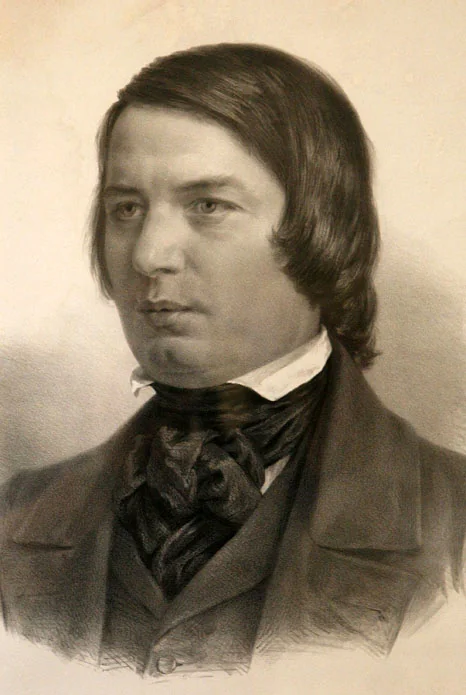
Image from Wikipedia
Image from Wikipedia
Robert Schumann: The Poetic Sound Architect of Romanticism
A Composer Between Literature, Passion, and Musical Revolution
Robert Schumann is one of the most influential figures of European Romanticism. Born on June 8, 1810, in Zwickau and died on July 29, 1856, in Endenich near Bonn, he uniquely combined exceptional literary sensitivity with a deep compositional vision as a composer, music critic, and conductor. His work spans from intimate piano music to grand symphonies, as well as songs, chamber music, choral music, and opera, showcasing an artist who understood music as a poetic language. ([britannica.com](https://www.britannica.com/biography/Robert-Schumann?utm_source=openai))
Biography: From Zwickau to the Intellectual World of Romanticism
Schumann's artistic heritage was shaped in two significant ways: he possessed a literary and musical talent where poems, prose, drafts of plays, and musical ideas coexisted in his youth. It was only after 1830 that music ultimately became the focus of his life, and he described himself as a tone poet. This self-identification is crucial as it explains why his music often feels like a continuation of Romantic literature: not merely as form but as a space for thought and feeling. ([britannica.com](https://www.britannica.com/biography/Robert-Schumann?utm_source=openai))
In his early years, Schumann seriously studied piano with Friedrich Wieck, Clara Wieck's father, who later became his wife. His encounter with Clara, a brilliant pianist with her own career, profoundly influenced his life and work. The personal connection to her and the artistic closeness to the piano world are reflected in many of his compositions, which brought the possibilities of the instrument to a new, psychologically rich level. ([britannica.com](https://www.britannica.com/biography/Robert-Schumann?utm_source=openai))
The Breakthrough: Piano Miniatures as Literary Sound Forms
Schumann's early creative phase is characterized by piano music. Here he developed the characteristic art of the miniature, where short musical forms become dramatically charged character pieces. Instead of merely showcasing virtuosity, he combined technical finesse with inner tension, poetic condensation, and often sharply contoured emotionality. This is at the core of his musical career: he made the piano a mirror of emotional states. ([britannica.com](https://www.britannica.com/biography/Robert-Schumann?utm_source=openai))
That Schumann's piano works became not only popular but also impactful is evidenced by their lasting place in the repertoire of pianists worldwide. Works such as his character pieces and cycles are now considered milestones of Romantic form because they unite musical affections, literary allusion, and a personal touch in a compact manner. It is this combination of intimacy and formal mastery that continues to fascinate performers and audiences alike today. ([britannica.com](https://www.britannica.com/biography/Robert-Schumann?utm_source=openai))
1840: The Year of Song and the Connection to Clara
The year 1840 marks a turning point in Schumann's career. In the year of his marriage to Clara Wieck, he composed nearly 150 songs, an extraordinary burst of creativity that elevated his song composition to a new level. The song composer Schumann thinks not only in melodies but in fine connections between text, harmony, and pianistic commentary, making the piano an equal narrative partner in the song. ([britannica.com](https://www.britannica.com/biography/Robert-Schumann?utm_source=openai))
This phase particularly illustrates how closely personal experience and musical design are linked for Schumann. The song becomes a space of condensed feeling, where linguistic imagery and musical gestures penetrate one another. His approach remains never merely illustrative but develops a poetic logic that makes Romanticism audible in its most mature form. ([britannica.com](https://www.britannica.com/biography/Robert-Schumann?utm_source=openai))
Symphonies, Chamber Music, and the Expansion of the Oeuvre
After 1840, Schumann's work became noticeably more diverse. He turned to orchestral music and created four symphonies, as well as concertante works, chamber music, choral music, and an opera. This expansion shows a composer who continuously broadened his expressive means without abandoning his poetic foundational attitude. Even in larger forms, Schumann remains a master of internal movement, motivic sensitivity, and dramatic density. ([britannica.com](https://www.britannica.com/biography/Robert-Schumann?utm_source=openai))
His symphonic works are now considered central to the development of Romantic orchestral culture. Where older listening habits sometimes perceived formal difficulty, contemporary reception recognizes a distinctive, highly subjective sound language. Schumann works with transitions, motivic intertwining, and atmospheric tension, which gives his symphonies an unmistakable tone. ([britannica.com](https://www.britannica.com/biography/Robert-Schumann?utm_source=openai))
Style and Musical Language: Poetic Harmony over External Effects
Schumann's style is marked by a profound literariness of sound. He sought a forward-looking, poetic music and distanced himself from Franz Liszt's program music. This attitude makes him a composer who does not tell superficially but translates internal states, mental images, and emotional constellations into musical structure. ([britannica.com](https://www.britannica.com/biography/Robert-Schumann?utm_source=openai))
In composition, Schumann often thinks in fragmented but closely connected building blocks that come together to form larger arcs. His harmony can sometimes seem bold, his rhythm nervous and lively, his counterpoint characterized by dense internal motion. The fact that contemporaries sometimes found his works difficult is explained by this musical modernity: Schumann demands active listening and rewards it with an extraordinarily nuanced sound world. ([britannica.com](https://www.britannica.com/biography/Robert-Schumann?utm_source=openai))
Critical Reception, Illness, and Reevaluation of Late Works
For a long time, the saying persisted that Schumann began as a genius and ended up as mere talent, and his late works were often interpreted through the lens of the mental illness that ultimately led him to a psychiatric clinic. However, musicological discussions have corrected this view. Today, his overall work is evaluated in a much more nuanced manner, and late works are no longer seen as mere decline but as a significant part of his artistic thought. ([britannica.com](https://www.britannica.com/biography/Robert-Schumann?utm_source=openai))
This reevaluation is of great importance for Schumann's reception. It shows how musical judgments change when historical distance, analytical precision, and interpretative practice come together. Consequently, Schumann does not appear as a problematic case in Romanticism, but rather as one of its most radical and multifaceted innovators. ([britannica.com](https://www.britannica.com/biography/Robert-Schumann?utm_source=openai))
Cultural Influence and Present Presence
Schumann's influence extends far beyond the concert stages. In Zwickau, Düsseldorf, and other places, his legacy lives on in festivals, societies, and concert halls; his music remains a touchstone of the Romantic repertoire and a reference point for both young and established performers. Events such as Schumann programs in Zwickau or Schumann festivals in Düsseldorf demonstrate how vibrant the engagement with his work still is today. ([zwickau.de](https://www.zwickau.de/de/aktuelles/pressemitteilungen/2023/11/441.php?utm_source=openai))
Current concert series and performances related to Schumann further confirm that his music does not come across as museum-like but creates presence. His works serve as a touchstone for interpretative depth and as a source of inspiration for musicians who combine Romantic expressiveness with intellectual precision. It is this blend of emotional intensity and structural sophistication that keeps his name alive at the center of classical music. ([schumann-gesellschaft.de](https://www.schumann-gesellschaft.de/aktuelles.html?utm_source=openai))
Discography, Works, and Lasting Significance
Schumann does not have a classical discography in the pop or jazz sense; his oeuvre consists of works that are documented in countless recordings. Among the most important genres are the early piano music, the songs of 1840, four symphonies, concertante compositions, chamber music, choral pieces, and opera as part of a widely ranging development of works. This variety makes him a composer of immense interpretative depth for musicians. ([britannica.com](https://www.britannica.com/biography/Robert-Schumann?utm_source=openai))
His legacy lies not only in individual famous pieces but also in an attitude toward music: Schumann understood composition as a poetic form of thought. Those who listen to his works encounter not only Romantic beauty but a radically subjective sound consciousness that still feels modern today. For this reason, Schumann remains a central name in music history and a composer whose work can always be rediscovered. ([britannica.com](https://www.britannica.com/biography/Robert-Schumann?utm_source=openai))
Conclusion: Why Robert Schumann Still Electrifies Today
Robert Schumann fascinates because he fused music, literature, and emotional experience into a distinctive art form. His biography tells of creative intensity, his works of poetic boldness, and his reception of a late but deserved reevaluation. Engaging with Schumann leads to experiencing a composer who not only represents Romanticism but has shaped it. ([britannica.com](https://www.britannica.com/biography/Robert-Schumann?utm_source=openai))
Especially live, Schumann's music unfolds all its power: in the interplay of inner tension, lyrical intimacy, and dramatic intensification. Whether in the concert hall, in song recitals, or chamber music, his works remain an intense experience and invite listeners to understand Romanticism not as history but as a present aspect of listening. ([zwickau.de](https://www.zwickau.de/de/aktuelles/pressemitteilungen/2023/11/441.php?utm_source=openai))
Official Channels of Robert Schumann:
- Instagram: No official profile found
- Facebook: No official profile found
- YouTube: No official profile found
- Spotify: No official profile found
- TikTok: No official profile found
Sources:
- Britannica – Robert Schumann
- Robert-Schumann-Gesellschaft Düsseldorf – Current News
- City of Zwickau – New Concert Season Starting January 7, 2024, at the Robert Schumann House
- City of Zwickau – June 5-15, 2025: Schumann Festival in Zwickau
- Kunstpalast Düsseldorf – Robert Schumann Hall | Music & Stage
- Wikipedia – Robert Schumann
Upcoming Events
Family Sunday - Rally at the Schumann House
Schumann: The Paradise and the Peri in Munich
Schumann Festival 2026: Robert Schumann - Nocturnes
Since I Saw Him – Sound and Poetry in the Capella Hospitalis
3rd Concert of the Schumann Series commemorating the 170th anniversary of his death
Clara & Robert Schumann
Song Cycle
Song Cycle
Song Cycle in the PSD Foyer: Schumann VR in Koblenz