
Modest Petrowitsch Mussorgski
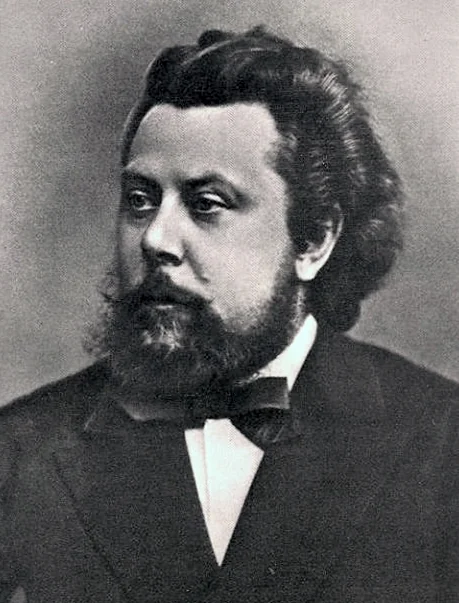
Image from Wikipedia
Image from Wikipedia
Modest Petrovich Mussorgsky: The Radical Sound Poet of Russian Music
A Composer Between Folk Proximity, Psychological Weight, and Musical Steadfastness
Modest Petrovich Mussorgsky is one of the defining voices of 19th-century Russian music. Born on March 21, 1839, in Karevo, the composer died on March 28, 1881, in Saint Petersburg at the age of 42, yet his work resonates surprisingly directly to this day. Especially through the opera Boris Godunov and the piano cycle Pictures at an Exhibition, he became a key figure in music history. ([britannica.com](https://www.britannica.com/biography/Modest-Mussorgsky))
His art thrives on a rare blend of dramatic directness, speech-like declamation, and stark sound language. Mussorgsky sought not academic smoothness but expression, character, and authenticity. This is exactly where the fascination of his musical career lies: he did not compose for decorative elegance, but for psychological depth, national identity, and an almost theatrical immediacy. ([britannica.com](https://www.britannica.com/biography/Modest-Mussorgsky))
Biographical Roots: From Manor House to Russian Sound Language
Mussorgsky came from a noble landowning family, but his musical upbringing began early in rural Russia. Britannica describes how he took his first piano lessons from his mother and was already able to play simple pieces by Franz Liszt as a child. Equally crucial was his early familiarity with Russian fairy tales and the life of peasants, which profoundly inspired his musical imagination. ([britannica.com](https://www.britannica.com/biography/Modest-Mussorgsky))
This background was not a mere biographical detail, but became the driving force of his artistic development. Young Mussorgsky encountered musical Russia not as a mere stylistic question but as a cultural and spiritual reality. Later, he combined this experience with literary thinking, folk proximity, and an intense engagement with the Russian language. ([encyclopedia.com](https://www.encyclopedia.com/history/encyclopedias-almanacs-transcripts-and-maps/mussorgsky-modest))
The Formative Years: Military Service, Friendships, and the Path to Composition
A decisive turning point was his contact with Mily Balakirev, who became his teacher and introduced him to the circles of Russian national composers. Mussorgsky left the military and worked as a civil servant in the Ministry of Communications since 1863 while his financial situation increasingly remained precarious. These years were marked by material concerns but also by artistic self-discovery. ([britannica.com](https://www.britannica.com/biography/Modest-Mussorgsky))
With Aleksandr Borodin, Nikolay Rimsky-Korsakov, César Cui, and Balakirev, he was part of The Five, a group that aimed to establish an independent Russian national school. Mussorgsky represented the most uncompromising style within this group: less academic regularity, more rhythmic speech, more dramatic intensification, more proximity to life. ([britannica.com](https://www.britannica.com/biography/Modest-Mussorgsky))
The Breakthrough: Operas as Musical Dramas of History
His greatest triumph is Boris Godunov, which Mussorgsky began in 1869 to his own libretto based on Pushkin. The first version was rejected by the Imperial Theater Commission, after which he revised the work in 1872, adding the roles of Marina and Rangoni. The final version was premiered in 1874 and marked a high point in Russian opera history. ([britannica.com](https://www.britannica.com/biography/Modest-Mussorgsky))
The score draws from folk songs and church hymns, creating a distinctly Russian sound. Musically, Mussorgsky combines arioso and recitative with unorthodox harmony to transform political power, moral anguish, and the collective voice of the people into a dense musical drama. This blend of archaic force and psychological precision makes Boris Godunov to this day a core work of the repertoire. ([classical.music.apple.com](https://classical.music.apple.com/us/work/modest-mussorgsky-1839-pp11))
The Great Sound Images: From Piano Cycle to Orchestral Icon
Pictures at an Exhibition was created in 1874 as a piano cycle in memory of the deceased painter Victor Hartmann. Britannica and Universal Edition describe the close relationship between image and music: Mussorgsky transformed the exhibition into a sequence of musical miniatures that are not merely illustrative but dramatic and characterful. Later, Maurice Ravel made the work internationally famous with his orchestral version. ([britannica.com](https://www.britannica.com/biography/Modest-Mussorgsky))
Night on Bald Mountain, the symphonic poem from 1867, also showcases his penchant for the untamed and pictorial. Britannica ranks the piece as a peak of his compositional maturity, alongside songs like The Nursery and his early experiments with Gogol's The Marriage. These works demonstrate how far Mussorgsky transcended traditional forms and already sought new expressive logic in detail. ([britannica.com](https://www.britannica.com/biography/Modest-Mussorgsky))
Style and Language: Realism, Declamation, and Unorthodox Harmony
Mussorgsky's style is radically independent. Britannica emphasizes that his 65 songs depict scenes from Russian life with great vividness and realistically replicate the melodic speech of spoken Russian. This is a core of his artistic modernity: he listened to the tone of language and made it a compositional principle. ([britannica.com](https://www.britannica.com/biography/Modest-Mussorgsky))
Encyclopedia.com highlights that his vocal lines are "boldly realistic" and characterized by natural melody. Additionally, his unorthodox approach to tonality and harmony creates enormous dramatic tension, particularly through the fusion of arioso and recitative. In this regard, Mussorgsky acts as a precursor to later musical authenticity, placing the structure of emotion above convention. ([encyclopedia.com](https://www.encyclopedia.com/history/encyclopedias-almanacs-transcripts-and-maps/modest-petrovich-mussorgsky))
Unfinished, Controversial, Rediscovered: The Afterlife of His Work
Many of his compositions remained unfinished, including Khovanshchina and Sorochintsy Fair. Shortly after his death, Rimsky-Korsakov prepared Mussorgsky's works for publication, smoothing out what he viewed as harmonic idiosyncrasies and orchestral "weaknesses." Although these versions were played most frequently for a long time, interest in the original versions grew starting in the early 20th century. ([britannica.com](https://www.britannica.com/biography/Modest-Mussorgsky))
Britannica reports that the original versions became accessible starting in 1928 in a complete edition edited by Paul Lamm. This rediscovery fundamentally changed the perception of Mussorgsky: instead of a problematic outsider, an innovative composer emerged whose rough edges were not a flaw but an aesthetic program. ([britannica.com](https://www.britannica.com/biography/Modest-Mussorgsky))
Cultural Influence: A Russian National Composer with Global Impact
Mussorgsky's significance in music history, according to Britannica, is disproportionate to his comparatively small oeuvre. His operas, songs, and piano works have influenced generations of composers because they are emotionally direct, psychologically precise, and formally bold. In particular, Boris Godunov and Pictures at an Exhibition have become international reference points that have been reinterpreted time and again. ([britannica.com](https://www.britannica.com/biography/Modest-Mussorgsky))
Even in the 20th and 21st centuries, Mussorgsky remains present on concert programs. Today's concert and opera landscape continues to showcase his works in performances and reinterpretations; even in 2025 and 2026, current classical programs and platforms like Apple Music document ongoing releases, remasters, and performances surrounding his creations. This confirms how enduring his music is embedded in cultural memory. ([music.apple.com](https://music.apple.com/us/artist/modest-mussorgsky/239667))
Conclusion: Why Mussorgsky Still Electrifies Today
Modest Mussorgsky fascinates because he understood music not as adornment but as a spiritual and societal truth. His operas, songs, and piano pieces connect national identity with bold form, raw directness with poetic depth. Those who experience this art live feel how relevant Mussorgsky's artistic development remains: uncomfortable, intense, human. ([britannica.com](https://www.britannica.com/biography/Modest-Mussorgsky))
His work demands, moves, and rewards with a power of expression that has become rare. Anyone wanting to experience Russian music history, grand opera, and visionary piano art in their purest form should encounter Mussorgsky on stage and in the concert hall. There, the stage presence unfolds that makes his scores something truly extraordinary to this day. ([britannica.com](https://www.britannica.com/biography/Modest-Mussorgsky))
Official Channels of Modest Petrovich Mussorgsky:
- Instagram: no official profile found
- Facebook: no official profile found
- YouTube: no official profile found
- Spotify: no official profile found
- TikTok: no official profile found
Sources:
- Britannica – Modest Mussorgsky
- Britannica – Modest Mussorgsky Summary
- Encyclopedia.com – Modest Petrovich Mussorgsky
- Encyclopedia.com – Mussorgsky, Modest
- Deutsche Grammophon – Modest Petrovich Mussorgsky Biography
- Bavarian State Opera – Modest Petrovich Mussorgsky
- Apple Music Classical – Boris Godunov
- Universal Edition – Pictures at an Exhibition
- IMSLP – List of works by Modest Mussorgsky
- Wikipedia – Modest Petrovich Mussorgsky