
Albert Einstein
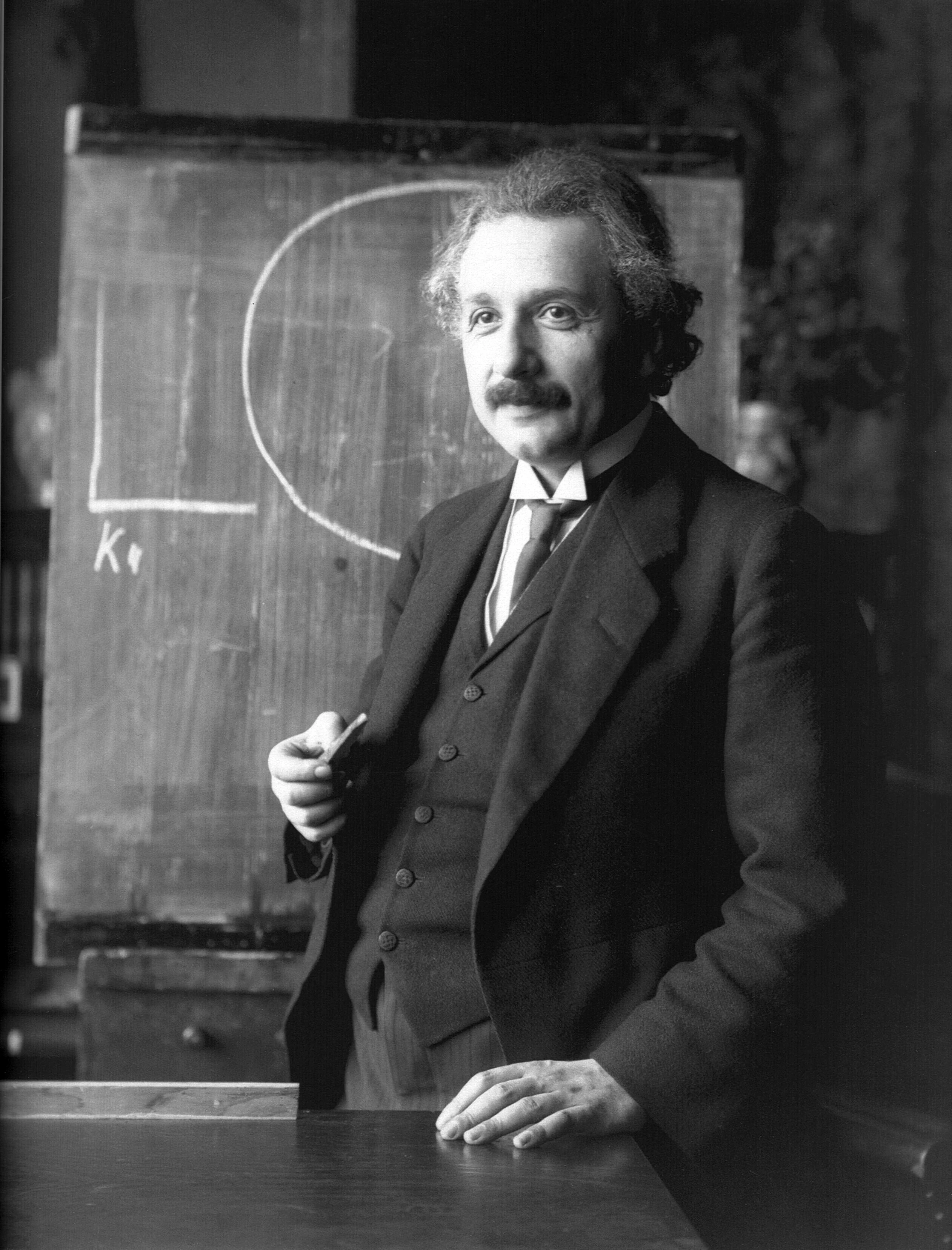
Image from Wikipedia
Image from Wikipedia
Albert Einstein: The Century Genius Between Science, Culture, and World History
A Portrait of a Thinker Who Recomposed the Modern Worldview
Albert Einstein, born on March 14, 1879, in Ulm and died on April 18, 1955, in Princeton, is one of the most influential figures in the history of science. His work on relativity, the structure of space and time, and the photoelectric effect fundamentally changed the understanding of physics, making him a world-renowned icon far beyond the academic community. Even the Wikipedia entry describes him as a theoretical physicist of extraordinary importance; Britannica and NobelPrize.org confirm his historical significance in light of his publications, Nobel Prize, and international impact. ([britannica.com](https://www.britannica.com/biography/Albert-Einstein?utm_source=openai))
When one considers Einstein, they see not only a researcher, but a cultural figure with enormous charisma. He embodied intellectual independence, analytical boldness, and the courage to overcome established patterns of thought. This very mixture of intellectual authority and public presence made him a name that remains prominent in schools, museums, media, and pop culture to this day. ([britannica.com](https://www.britannica.com/biography/Albert-Einstein?utm_source=openai))
Biographical Beginnings: Ulm, Munich, Zurich – The Early Shaping of an Exceptional Mind
Einstein's journey began in the Kingdom of Württemberg and took him through Munich to Zurich, where he studied at the Polytechnic. NobelPrize.org notes that after finishing his studies, he initially worked at the Bern patent office, where he developed the concentrated mindset that enabled his revolutionary work. Britannica also describes how early impressions, such as a compass and a geometry book, profoundly influenced him, igniting his lifelong fascination with invisible forces and mathematical order. ([nobelprize.org](https://www.nobelprize.org/laureate/26?utm_source=openai))
These years portray a young man who did not follow the rhythm of conventional academic careers. Einstein found school hierarchies and authoritarian structures confining, yet it was this very resistance that shaped his independent thinking style. In retrospect, this biography resembles the classic origin story of a radically original mind: unadjusted but highly precise, uncomfortable yet epochally effective. ([britannica.com](https://www.britannica.com/biography/Albert-Einstein?utm_source=openai))
The Breakthrough of 1905: A Year That Catapulted Physics into a New Era
The year 1905 marks Einstein's true breakthrough in his scientific career: In this "annus mirabilis," he published several papers, including those on Brownian motion, the light quantum hypothesis, and special relativity. Britannica emphasizes that these works were initially ignored before Max Planck's endorsement and subsequent experimental confirmations accelerated Einstein's fame. Particularly, his paper "On the Electrodynamics of Moving Bodies" established a new perspective on time, space, and motion. ([britannica.com](https://www.britannica.com/biography/Albert-Einstein?utm_source=openai))
The special theory of relativity made Einstein known worldwide because it shattered the classical Newtonian worldview. The equation E = mc² became a symbol for the radical condensation of physical understanding into a concise formula. NobelPrize.org and Britannica highlight that this very intellectual movement has profoundly shaped modern physics and remains one of the most quoted findings in science today. ([nobelprize.org](https://www.nobelprize.org/laureate/26?utm_source=openai))
General Relativity and Scientific Authority: From Upstart to Worldwide Research Star
In 1915, Einstein published the General Theory of Relativity, his magnum opus. Britannica describes how, in the years prior, he worked intensively on formulating a theory of gravitation that is understood not merely as a force but as a curvature of space-time. This idea gained further public renown through observations like the deflection of light during the solar eclipse in 1919, transforming him into a scientific international figure. ([britannica.com](https://www.britannica.com/biography/Albert-Einstein/General-relativity-and-teaching-career?utm_source=openai))
With this work, Einstein ascended to the rank of an intellectual benchmark. He received professorships in Zurich, Prague, at the Swiss Federal Polytechnic, and finally in Berlin, where he became the director of the Kaiser Wilhelm Institute for Physics. Both Britannica and NobelPrize.org agree that his academic career was accompanied by increasing international recognition, making him one of the most influential scholars of his time. ([britannica.com](https://www.britannica.com/biography/Albert-Einstein/General-relativity-and-teaching-career?utm_source=openai))
Nobel Prize, Quantum Physics, and Cultural Impact
The Nobel Prize in Physics 1921, awarded in 1922, explicitly recognized his contributions to theoretical physics, particularly the discovery of the photoelectric effect. NobelPrize.org identifies this award as a central honor of his life's work; Britannica adds that with it, Einstein received a scientific acknowledgment that further enhanced his global fame. At the same time, his work in quantum physics was groundbreaking, even though he himself struggled with some interpretations of quantum mechanics. ([nobelprize.org](https://www.nobelprize.org/laureate/26?utm_source=openai))
Einstein acted not only as a researcher but also as a public moral authority. The Wikipedia entry and Britannica portray him as a pacifist who advocated for international understanding, peace, and socialism. This political and cultural dimension makes his persona fascinating to this day: he stood not merely for knowledge but for stance, conscience, and civic responsibility. ([britannica.com](https://www.britannica.com/biography/Albert-Einstein?utm_source=openai))
Exile, Princeton, and Later Years: A Life Marked by Responsibility
After the Nazi seizure of power, Einstein emigrated to the United States and worked at the Institute for Advanced Study in Princeton. NobelPrize.org and Britannica situate his later life there as a phase of research, teaching, and public thinking. Despite his worldwide fame, he remained a person who refused to be reduced to mere glory but instead combined scientific curiosity with societal reflection. ([nobelprize.org](https://www.nobelprize.org/laureate/26?utm_source=openai))
His theoretical work played only an indirect role in the building of the atomic bomb and the development of nuclear energy, as explicitly stated in the Wikipedia entry. This distinction is important for a trustworthy classification: Einstein was not the engineer of the bomb but a theorist whose foundational research was later politically and technically utilized in other contexts. This makes his historical role complex and still open to discussion. ([nobelprize.org](https://www.nobelprize.org/laureate/26?utm_source=openai))
Musical Metaphor, Style, and Cultural Influence
Although Einstein was not a musician, his intellectual impact could almost be described like that of a great composer: he changed theme presentation, structure, and harmony theory in thinking. In physics, he replaced classical certainty with a new architecture of space, time, and gravity. This upheaval makes him a figure whose "composition" of formula, theory, and imagination resonates even today. ([britannica.com](https://www.britannica.com/biography/Albert-Einstein?utm_source=openai))
Culturally, Einstein also remained a symbol of creative radicalism. He became the epitome of genius, the image of the researcher with a keen mind and unique style. The academic world valued his theory just as the broad public appreciated his distinctive profile; in a 1999 survey by the journal Physics World, leading physicists voted him the greatest physicist of all time, ahead of Newton, Maxwell, Bohr, and Heisenberg, as noted in the Wikipedia entry. ([einsteinfoundation.de](https://www.einsteinfoundation.de/aktuelles/list/lesen--4?utm_source=openai))
Discography, Current Projects, and Social Channels: No Musical Works, No Official Accounts
There is no discography in the musical sense for Albert Einstein, no official albums, no chart hits, and no current music projects. Web searches yield scientific biographies, archives, and institutional pages instead; current releases in the sense of an artistic career are nonexistent. There was also no verifiable profile found for official social media channels of the historical Albert Einstein. ([britannica.com](https://www.britannica.com/biography/Albert-Einstein?utm_source=openai))
Therefore, there is also no section for "Fan Voices." Without verified official accounts, there is no reliable basis for quotes from Instagram, YouTube, or Facebook. This restraint is part of a trustworthy representation and protects against invented attributions. ([einstein-website.de](https://einstein-website.de/?utm_source=openai))
Conclusion: Why Albert Einstein Continues to Fascinate
Albert Einstein remains captivating because he combined scientific precision with intellectual boldness and created a new worldview from abstract formulas. His life tells of independence, international impact, political conscience, and intellectual exceptionalism. Anyone seeking to understand Einstein encounters not just a physicist but a cultural figurehead of the 20th century. ([britannica.com](https://www.britannica.com/biography/Albert-Einstein?utm_source=openai))
His legacy lives on in modern physics, in public debates about the responsibilities of science, and in the imagination of what a single mind can change. Engaging with Einstein means not just experiencing history but also participating in a way of thinking that remains alive to this day. That is why it is worthwhile to read him again and again, to recontextualize him, and to understand his theoretical revolution as a lasting challenge. ([britannica.com](https://www.britannica.com/summary/Albert-Einstein?utm_source=openai))
Official Channels of Albert Einstein:
- Instagram: No official profile found
- Facebook: No official profile found
- YouTube: No official profile found
- Spotify: No official profile found
- TikTok: No official profile found